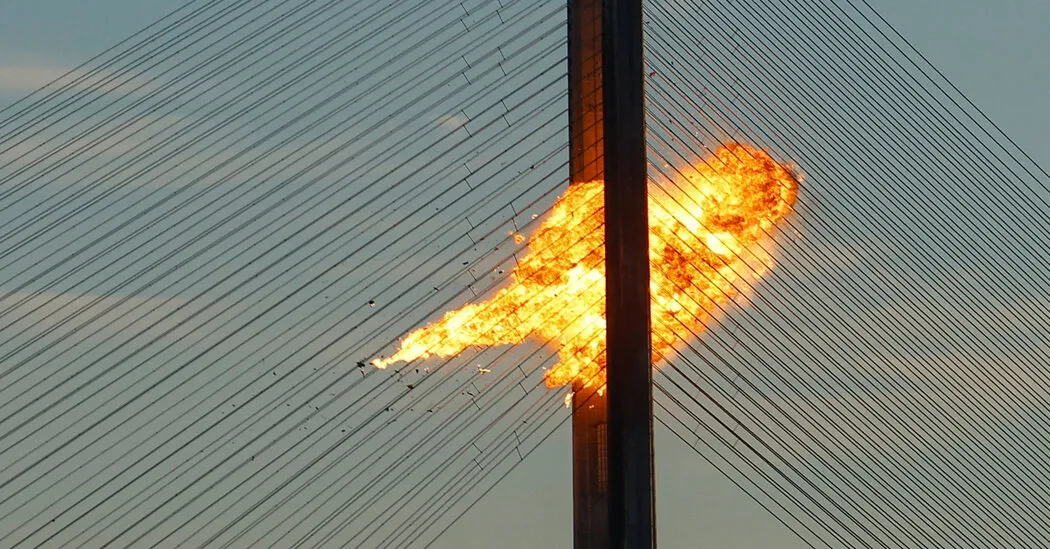
Russia has a new target on its growing list of Ukrainian infrastructure to bomb: bridges. In the past three days, Russia has attacked bridges in the capital kyiv six times. Three drones hit one in the south of the city on Thursday and the same bridge was hit twice on Friday. On Saturday morning, another attack hit a bridge in the north. The structures remain standing, but the damage and the threat of further attacks have led local authorities to restrict or stop traffic on five of the capital’s six road bridges. This has severely disrupted daily life in Ukraine’s largest city, which, like much of the country, is bisected by the wide Dnipro River. Many in kyiv commute daily between the largely residential eastern bank, where about a million people live, and the western bank, where most government offices and businesses are located. The bridges are the latest target in a broad Russian attack campaign against Ukrainian infrastructure far from the front lines. That campaign has expanded in recent weeks to include warehouses, trains, data centers, medical depots and steel factories, and comes on top of an intense attack on Ukraine’s power grid that Russia plans to intensify this winter. The goal, Ukrainian officials and military experts say, is to devastate Ukraine’s economy (and the country’s ability to sustain the war effort) while breaking the population’s will to fight by making daily life increasingly difficult. Ukraine has withstood other similar campaigns since Russia’s full-scale invasion in 2022. But a critical shortage of air defenses, coupled with Moscow’s growing weapons arsenal, now leaves the country more vulnerable than ever to such attacks. “The enemy is destroying kyiv,” the city’s mayor, Vitali Klitschko, said in a social media post on Friday. “It is no longer possible to pretend that we can live as we did in times of peace!” Klitschko’s message echoed a sentiment that has grown across the capital in recent weeks: the relative safety that kyiv enjoyed for most of the war (demonstrated by packed cafes and nail salons) is over. Now drones buzz over the city all day, generating near-constant airstrike alerts. People trapped outside during an attack can be seen checking phone apps that track the flight paths of drones. On Monday, a drone attacked a downtown university and set the building on fire, shocking residents of a neighborhood that had been spared Russian attacks for most of the war. The assault on kyiv’s bridges could further disrupt life. Authorities temporarily closed the north bridge after Saturday’s attack, closed the south bridge to cars and the subway, and limited traffic on three other bridges. The first attack on the south bridge, on Thursday, occurred as a subway train was crossing the bridge. No one was injured, but service across the bridge was suspended. On Friday night, residents crossing the bridge on foot saw another drone attack it, according to a video posted on social media. Destroying the bridges would be difficult. They are large concrete structures that would have to be hit several times to knock them down. Ukraine’s own attacks on Russian bridges have yielded mixed results. The Kerch Bridge, which connects the illegally annexed Crimean Peninsula to Russia, was temporarily closed several times after the attacks but was never torn down. Still, the attacks could weaken the bridges’ support structures and force authorities to close them indefinitely rather than risk a collapse. The result would be a logistical nightmare for kyiv and the entire country. The capital’s bridges transport all kinds of food and equipment across the Dnieper River, which runs north to south through Ukraine and divides the country in two. There would be few alternatives if they closed. A road bridge crosses the river north of kyiv. To the south, the closest is about 90 kilometers or 55 miles away, a trip of about 2.5 hours. More bridges lie downstream, but using them would mean a long detour, and their proximity to the southern front leaves them even more exposed to Russian attacks. In the early days of the war, Ukrainian officials considered blowing up kyiv’s bridges to prevent Russian troops from approaching the eastern bank. They were held at bay while counterattacks finally managed to defeat the Russian forces advancing from the east. Dzvinka Pinchuk contributed reporting.