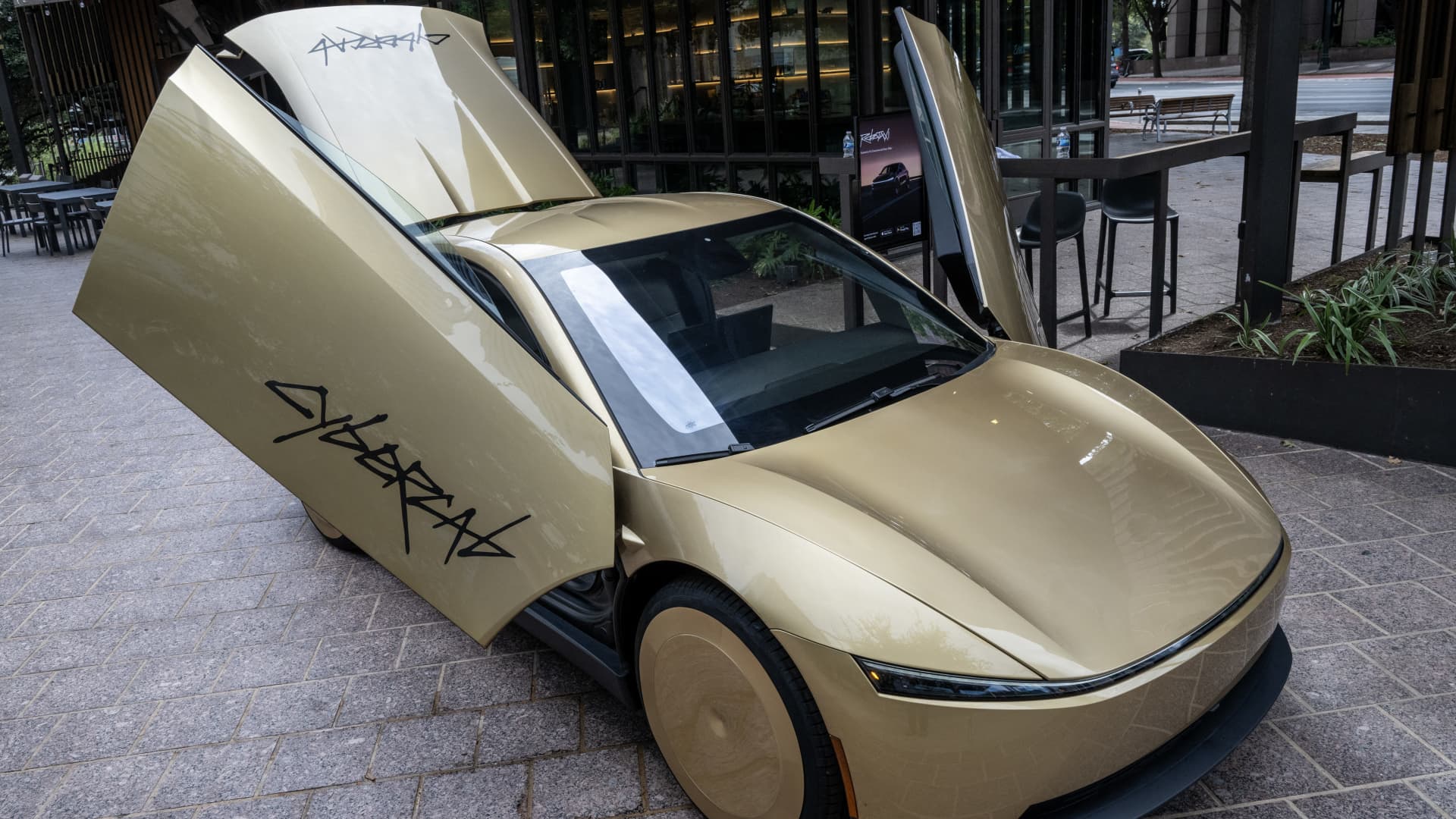
A Tesla “Cybercab” is displayed in downtown Austin, Texas, on September 3, 2026. Ronaldo Schemidt | AFP | Getty Images In the month since the launch of Tesla’s Cybercab in Austin, the company has nearly quadrupled the number of its driverless bronze two-seaters authorized for commercial service in Texas. For Elon Musk to achieve his ambitions, growth has to accelerate. The unusual driverless vehicles, without a steering wheel, pedals, rear- or side-view mirrors or exterior door handles, have received mixed reviews from paying passengers, who shared videos and posts online after the Sept. 3 launch. Criticism has included long waiting times, pick-ups and deliveries at the wrong location, and technical difficulties with the vehicles’ butterfly doors or incorrectly closing the trunk. Improving its driverless technology and rapidly growing the Robotaxi service are key to Tesla’s effort to reignite investor enthusiasm. Auto sales have been slow for an extended period, and the stock has been a loser on Wall Street this year, falling 18%, the only mega-cap tech stock that has failed to generate positive returns for investors. On Friday, Tesla reported better-than-expected vehicle deliveries for the third quarter, lifting the stock nearly 5%, but the company still showed a 2% year-over-year drop in deliveries. Tesla’s core automotive business has seen consecutive annual revenue declines as it faces pressure from Chinese electric vehicle makers such as BYD and Xiaomi, which are selling more affordable and innovative models while increasing exports to Tesla’s key markets, especially Europe and Asia. Meanwhile, Alphabet’s Waymo continues to open in new cities. It is now in 15 U.S. markets with 15 more on the horizon, according to the company’s website. It has also announced planned international launches in London, Tokyo and Munich. In Texas, Waymo had 1,154 autonomous vehicles authorized for commercial use as of Friday, including 359 of its new Ojai models, which feature a low step and sliding doors. Waymo provides more than 500,000 paid trips each week and has completed 270 million fully autonomous miles of commercial driving nationwide. It currently has more than 4,000 driverless vehicles in commercial operations in the United States. Tesla had 45 Cybercabs authorized for commercial use in Texas at the time of its Austin introduction, a number that increased to 169 as of Friday, according to public records from the Texas Department of Motor Vehicles. Tesla’s hometown of Austin is the only city where it currently has the Cybercab operating as part of its driverless transportation service. The company’s Robotaxi fleet in Texas also includes 420 Model Y vehicles equipped with Tesla automated driving systems, which are not yet available to individual car buyers. Austin has emerged as an early popular market for robotaxis due to a combination of relatively lax state regulations and the capital city’s vibrant tech community. Amazon’s Zoox is also being tested in Austin. Obstacles to expansion Growing beyond Austin is the next challenge for Tesla’s Cybercab. In addition to the technical problems, the company faces some potential regulatory obstacles to its expansion. The National Highway Traffic Safety Administration (NHTSA) launched a so-called audit inquiry after Cybercab’s launch to ensure the vehicles met federal safety standards. NHTSA originally ordered Tesla to respond by Sept. 30 to a long list of safety questions, but the company got an extension, an agency spokesperson told CNBC via email. Ethan McKanna, an Austin resident and former Tesla intern, told CNBC that he has taken rides in all types of autonomous vehicles available to public riders in the city. McKanna, 20, now a sophomore computer science student at Texas A&M University, also created a site called RobotaxiTracker.com, which uses machine learning to analyze data from traffic cameras and other public records, to show how autonomous services work in cities across the U.S. He likes having his “own space with access to a huge screen, media controls and apps,” and found the drive quality to be “very smooth.” The “pick-up and drop-off experience,” he said, has not yet been perfected and butterfly doors that extend outward are “less convenient” than more traditional doors or doors that slide open. Patience is also needed, he said. “There was so much demand that wait times were often more than 45 minutes,” he said, referring to the period when Cybercab was first launched. That’s due to more “matched demand” in recent weeks, he said. “Waymo has been doing business longer, so they’re more mature with 24/7 service, better support, things like that,” McKanna said, adding that in Waymo’s early days in Austin, there were some “hard braking” issues. There have been no major safety incidents or collisions reported in Austin involving a Cybercab since its commercial debut. But first responders have expressed concerns about dealing with the Cybercab’s lack of manual driving controls and its unique doors. Austin Fire Capt. Matt McElearney told CNBC in an interview that while Tesla provided detailed emergency guidelines and gave first responders complete instructions on how to deal with the Cybercab and Model Y Robotaxi vehicles in a variety of events, that’s not enough. McElearney said he would like to see national or state-level regulation of autonomous vehicles requiring robotaxis without steering wheels or pedals to provide some other way for “public safety representatives to take control (move, steer or shut down an AV) in both emergent and non-emergent events.” And since their performance can change with bugs or software updates, AVs should have to “pass tests throughout the life of the product,” through a kind of “dynamic certification” process, McElearney added. Tesla did not immediately respond to a request for comment. The public also has a wide range of safety concerns. According to surveys conducted by Slingshot Strategies in a September 2026 Electric Vehicle Intelligence Report, 50% of US respondents said they would not be comfortable with the idea of riding in a robotaxi without a steering wheel or pedals. Upon learning of the NHTSA investigation into Tesla’s Cybercab, 70% wanted the company to pause rides, surveys showed. Musk needs that sentiment to change if he wants to successfully take Tesla into the driverless era. Its next step in trying to become a major player in the market will be expansion in Texas in San Antonio, Dallas and other cities, as well as in Nevada and Florida, where AV companies can take advantage of the warm climate and favorable state regulations. In January, Musk said at the World Economic Forum in Davos that the company’s robotaxis would be “very, very widespread” in the US by the end of 2026. That hasn’t happened yet. And in California, where Waymos are common in several cities, Tesla has not yet obtained permits to circulate its vehicles on public roads without humans at the wheel. After Tesla’s deliveries report on Friday, Cantor analysts emphasized the magnitude of the opportunity. “Management has previously said that once it ramps up production, it expects the Cybercab to ultimately be the highest-volume vehicle in its lineup,” they wrote. WATCH: Tesla stock surged ahead of Cybercab event