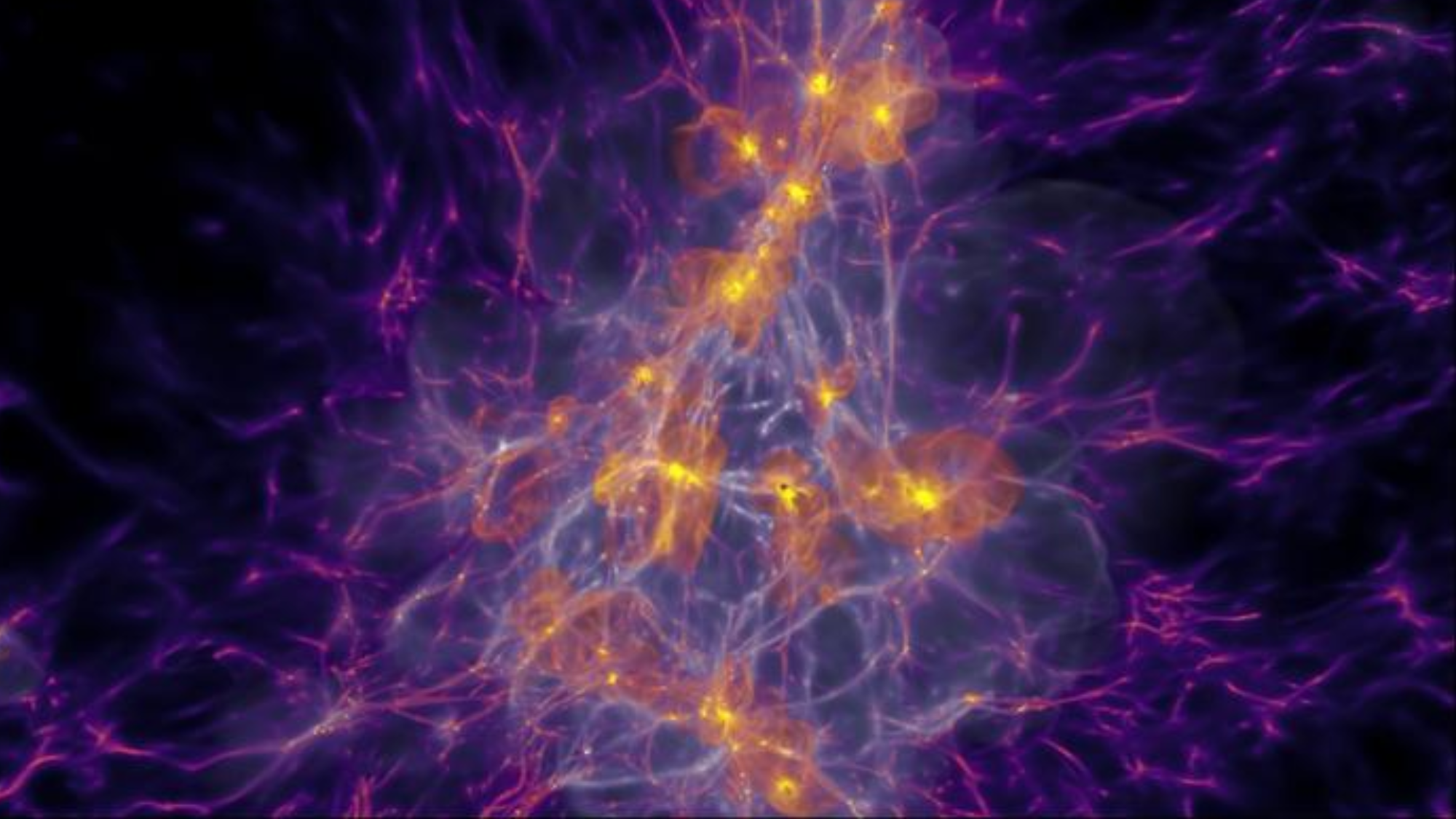
MEGATRON is a good guy?! Well, at least for cosmologists who are using this simulation to transform (sorry, couldn’t resist) our understanding of the universe’s first stars. Of course, in this case Megatron is not the diabolical leader of the Decepticons who killed Optimus Prime in the Transformers franchise, but rather the most detailed simulation of the early universe to date. Starting in 2023 and running through 2030, MEGATRON uses data from the James Webb Space Telescope (JWST) to combine cutting-edge cosmological simulations with sophisticated models of radiation, chemistry, and galaxy formation. This allows researchers to investigate how the first galaxies and stars, known as Population III (POP III) stars, illuminated the shadows of the cosmic Dark Ages. This is an important quest; POP III stars were composed primarily of hydrogen and helium, the lightest elements and all that was available in the universe’s infancy. However, during their lifetime, POP III stars forged heavier elements, which astronomers call metals. Following their death as a supernova, POP III stars distributed elements such as nitrogen, carbon and oxygen to become the building blocks of the next generation of stars, their planets and, eventually, life itself, whether here on Earth or elsewhere in the cosmos. “The elements that make our world and life possible (carbon, oxygen, iron and many others) were forged by stars. To understand where those elements came from, we must understand how the first stars formed and enriched their environment,” Martin King of the Department of Physics at the University of Bath said in a statement. “MEGATRON allows us to test these ideas directly by comparing detailed simulations with JWST observations and the chemical fingerprints preserved in ancient stars.” This new research represents MEGATRON’s first major finding. So what did he find? You might like MEGATRON saves the day!?! The first results from MEGATRON demonstrate the importance of the interaction between starlight, gas and newly forged elements in connecting the astronomical data of galaxies in the early universe provided by JWST and the chemical signatures found within the ancient stars of our Milky Way galaxy. galactic neighborhood,” Rey explained. “MEGATRON provides a physical bridge between the two.” This unification could reconstruct the properties of POP III stars, in turn revealing how they enriched their surroundings with metals. MEGATRON did this by simulating the evolution of a young galaxy that had the potential to grow into a system similar in mass to the Milky Way, starting with pristine, pristine hydrogen and helium. The simulation tracked the movement of gas, the passage of light from stars and the change in chemical concentrations, thus revealing how stars shape the gas in and around galaxies over billions of years. An artist’s illustration of what the universe’s first stars might have looked like (Image credit: NR Fuller, National Science Foundation) The findings imply that some cosmological models may underestimate the importance of radiation emitted by stars and chemical changes in the gas around galaxies to cosmic evolution. of these factors, MEGATRON recreated structures in the gas that do not manifest themselves in simpler models. This could improve predictions for current and future astronomical observations. The team will now continue to use MEGATRON to forge even stronger links between astronomical observations and theory. our cosmic playground. “MEGATRON provides a common physical framework for interpreting two of the most exciting new data sets in astronomy: JWST’s view of the oldest galaxies and the stellar fossil record,” Rey concluded. “Together, these complementary observations allow us to test competing models of early stars in ways not previously possible.”