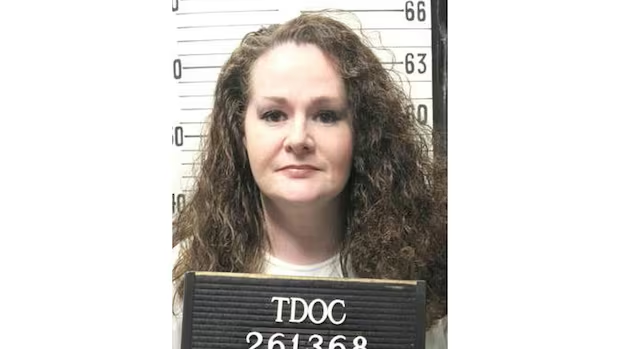
Listen to this articleDear 2 minutesThe audio version of this article is generated using AI-based technology. Pronunciation errors may occur. We are working with our partners to continually review and improve results. Christa Pike is unconscious, intubated and receiving respiratory support from a ventilator after Tennessee’s failed attempt to execute her, her attorneys said Friday, providing the first detailed account of the extent of the injuries she suffered during the lethal injection. Hospital staff are working to save Pike’s life and remove the lethal drug pentobarbital from his system, his attorneys said in an emergency court filing seeking an order requiring the Tennessee Department of Corrections to preserve evidence from Wednesday night’s botched execution. Pike remains in critical condition, her attorneys said, two days after the state administered two doses of pentobarbital but failed to kill her. He has suffered significant injuries to both arms, they added. “At no time did any member of the execution team realize that the intravenous lines were not placed correctly or that the veins had burst and that pentobarbital was, in whole or in part, entering Ms. Pike’s body,” Pike’s attorneys said in a filing in the Court of Chancery for the State of Tennessee’s Twentieth Judicial District. execution that, according to Tennessee Governor Bill Lee, followed the protocol established by the state. It was the state’s second botched execution this year. Lee halted further state killings for the rest of 2026 and ordered an independent review into what happened.WATCH | Expert explains what may have happened during botched execution: What we know about Christa Pike’s botched execution Christa Pike, the 50-year-old woman who was convicted of killing a classmate when she was 18, survived two doses of lethal injection drugs after what experts described as a “very rare” and “unprecedented” botched execution in Tennessee on Wednesday. An expert explains what could have happened. Pike’s attorneys have said the execution team’s difficulties in administering the drug were related to intravenous access, a problem they had warned the state and the courts about before the execution. Pike, 50, was convicted of killing her classmate Colleen Slemmer, 19, in 1995, when Pike was 18. She was scheduled to become the first woman executed in Tennessee in more than two centuries.