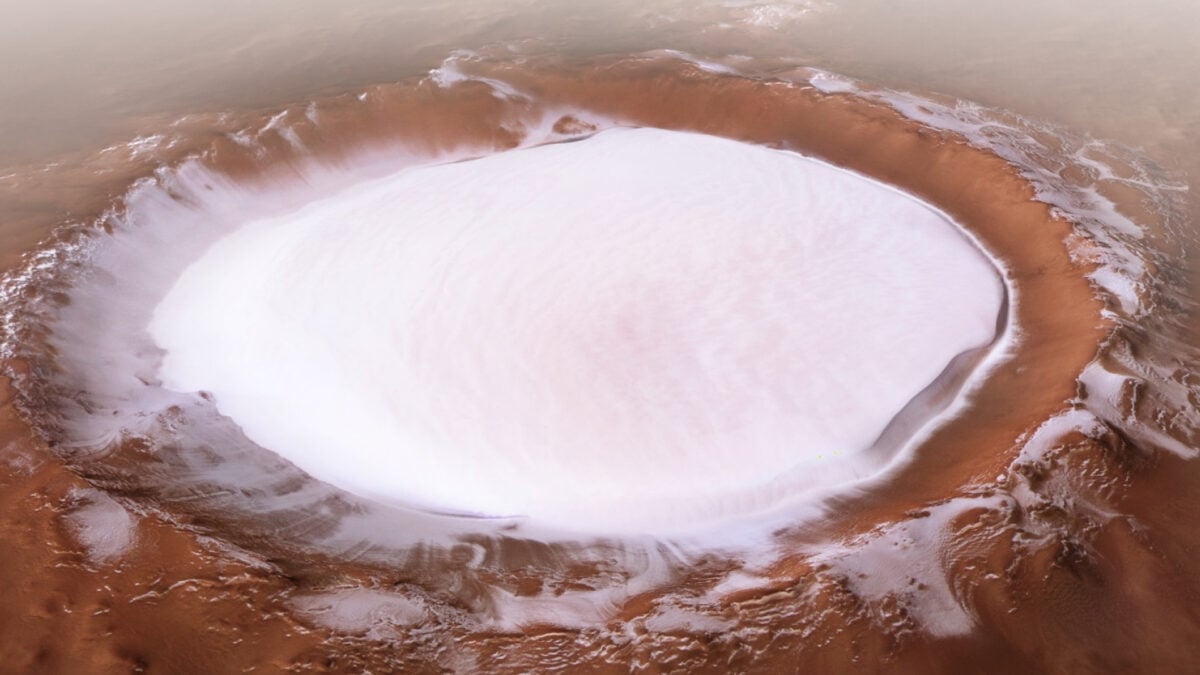
When NASA’s Mars Phoenix mission successfully sampled ice from the Martian arctic regions, it made astrobiological history. This sample, along with others that followed, led scientists to realize that the Martian ice was buried under a layer of dust, although they may have overestimated its degree of dust, new findings suggest. Using a combination of different data sets, scientists reviewed suspected dust from the north polar region of Mars and found that the top layer of Martian polar ice was about 3% dust. This is significantly lower than the previous estimate, 25%, an error that the researchers attribute to a calculation technique that was originally developed to study lunar regolith. Specifically, the Martian north pole resembles an “ice cream sandwich” with layers of dustier, older, cleaner ice circulating throughout the seasons, the team explained in a statement. As a result, there is some variation in the amount of dust, but not as much as we thought. The findings were published in npj Space Exploration. “We know there is water ice in the area around the north pole of Mars, but there has been widespread disagreement about how dusty that ice is,” study co-author Aditya Khuller, a planetary scientist at the University of Washington, said in the statement. A gift from nature Ice may be one of the strangest natural miracles in the universe. It is a molecular laboratory for researchers who investigate physics in extreme regimes. It’s no secret that ice is one of the key signatures astronomers look for in the search for extraterrestrial life. Long cylinders of ice (ice cores) preserve information about the atmosphere from millions of years ago. Plus, it keeps your drink cold in summer. Consequently, the study of Martian ice has led to enormous advances in what we know about its “formation, evolution and persistence, and offers insights into the broader history of the Martian climate,” the team wrote in the paper. It is also an integral part of the investigation of how, despite having very different atmospheres, Earth and Mars share some climatic and geological patterns. Small but significant The latest study builds on previous work from the same team, which tested whether three common models used to analyze Martian ice were valid for studying Antarctic ice on Earth. These techniques, called radiative transfer models, infer ice grain radius based on albedo, or the reflectance of sunlight by a surface. A map of the six North Pole locations where water ice is exposed at the surface that were analyzed in the study. © Khuller et al., 2026 But these methods were initially devised to study soil on the Moon, Khuller said in the statement. So when researchers discovered that the models didn’t work as well for Earth, another, possibly more important question arose: Does it really work for Mars? To find out, the team referenced an alternative method for studying snow and ice and made appropriate adaptations to account for known conditions on Mars. He then applied the new framework to six locations at the Martian north pole. The researchers found that conventional models overestimated the impurity of Martian ice. Specifically, dustier, darker ice forms in winter. And of course, Mars is hit by huge dust storms. But dusty ice also vaporizes faster, especially during the summer, so what ends up exposed is cleaner, older ice, Khuller explained. Moving the needle Although it is “difficult to determine how exactly dust is incorporated into the North Pole ice,” our best estimates suggest that the proportion of dust is lower than we expected, according to the paper. The cleaner, older subsurface ice may also indicate changes in atmospheric pressure on Mars in the past that slowed the impact of dust storms, the team added in the study. Meanwhile, the findings (or really, any investigation of Martian ice) have us wondering what all this could mean for life on Mars. Khuller is definitely thinking about these questions; In another paper, he and his colleagues explored whether dark layers of ice could trap sunlight and form pockets of meltwater, conditions that create rich pockets of life on Earth. “The fact that Mars and Earth have similar layers of water ice and dust is interesting,” Khuller said. “Why does one planet have life and the other doesn’t?”