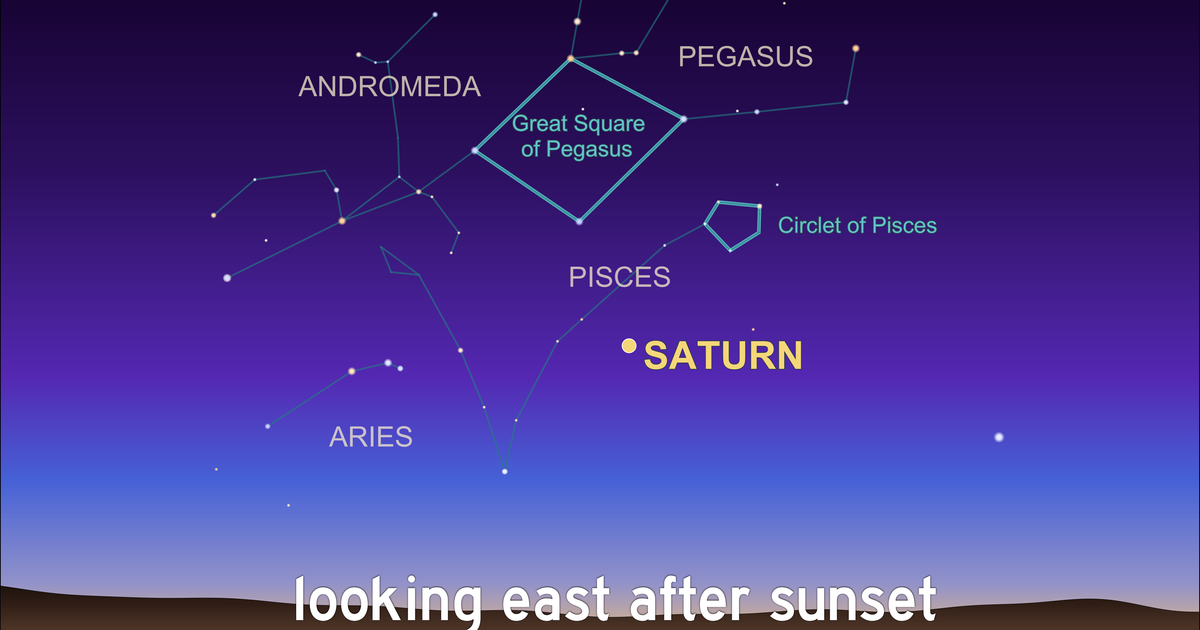
Saturn is at its biggest and brightest when the ringed planet reaches opposition this weekend. The opposition occurs when Earth passes between Saturn and the Sun, bringing the planet to its closest point to Earth during the year, about 784 million miles (1.26 billion kilometers) away. This minimum distance makes Saturn appear brighter than at any other time of the year. Opposition is a good time to observe Saturn because it rises in the east around sunset, reaches its highest point around midnight, and remains visible until dawn. It will appear as a yellowish point of light in the eastern and southeastern sky. You don’t need a telescope to see Saturn, but even a small telescope can reveal the planet’s rings and the brightest pair of its 293 moons. While observing Saturn, look a little higher to see a large group of four stars that astronomers call the Great Pegasus Square. Above and to the right is the Circlet (ring) of Pisces. These are asterisms or recognizable patterns within the more official constellations of Pegasus (the winged horse) and Pisces (the fish). The vision for 2026 is very different from last year, when Earth crossed the plane of Saturn’s rings. Although the ring system extends for approximately 175,000 miles, it is, on average, about 30 feet thick, so it effectively disappears when viewed edge-on. As of opposition in 2025, the rings are tilted 7.5 degrees from our perspective, making them visible again. Saturn will be at opposition Sunday morning at 8:21 am, but with clouds expected this weekend, the best views will be tonight, Friday, October 2. The planet will continue to be an excellent nighttime target for much of the month. Saturn’s last opposition occurred on September 21, 2025. Saturn reaches opposition every 378 days, or about two weeks later each year, when Earth catches up to Saturn in its orbit. We will have similarly good opportunities to see Jupiter when it reaches its own opposition on February 11, 2027, followed by Mars on February 19, 2027.