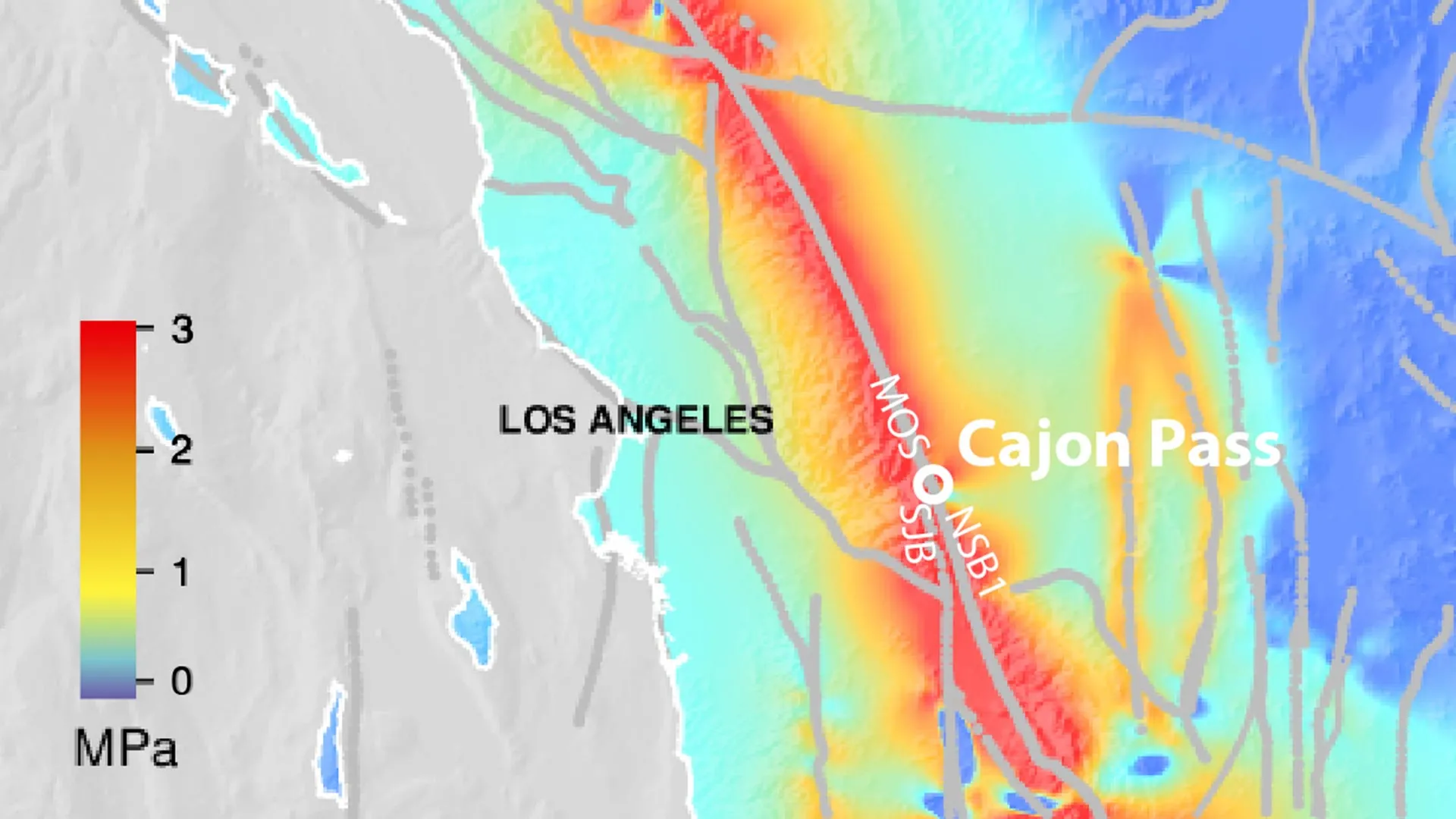
Southern California is located on one of the most active and closely watched fault networks in the United States. Earthquakes typically occur when sections of the Earth’s crust move against each other, get stuck, and slowly build up stress. When that stored energy is finally released, the result can be an earthquake. Two of the most important fault systems in Southern California are the San Andreas and San Jacinto faults. Together, they accommodate much of the region’s tectonic movement. Northeast of Los Angeles, the two systems approach each other at Cajon Pass, a complicated geologic junction where a rupture traveling along one fault can, under the right conditions, continue toward the other. That possibility is important because the broader Los Angeles region has not experienced a comparable major earthquake since the magnitude 7.9 Fort Tejón earthquake in 1857. During that long period of quiet, tectonic stress has continued to build up along parts of the fault system, raising long-standing questions about how a major rupture might develop in the future. California Fault Stress Reaches Extreme Levels A new study led by Dr. Liliane Burkhard from the Space Research and Planetary Sciences (WP) Division of the Institute of Physics at the University of Bern has now taken a much broader view of that risk. An international team modeled approximately 1,000 years of seismic activity along the southern San Andreas and San Jacinto fault systems to estimate the amount of stress currently concentrated around Cajon Pass. Also involved in the research were scientists from the University of Hawaii at Mānoa, the U.S. Geological Survey Earthquake Science Center in Pasadena, and the Scripps Institution of Oceanography at the University of California, San Diego. Their results suggest that tectonic stresses in parts of the system have reached, and in some places exceeded, the highest values found in the 1,000-year history of the model. Researchers also describe Cajon Pass as an “earthquake gate”: a junction of faults that can help determine whether a large earthquake remains limited to one fault or continues across both fault systems. The study has just been published in the Journal of Geophysical Research: Solid Earth. Modeling 1,000-year earthquakes To reconstruct how stress changed over centuries, the researchers developed a four-dimensional, physics-based earthquake cycle model. In practical terms, the model simulates what happens in three dimensions of space and at the same time tracks how the fault system changes over time. The team then incorporated a 1,000-year record of past earthquakes compiled from various types of evidence. These included radiocarbon dating, unusual patterns recorded in tree rings, and historical records describing ruptures that broke the ground surface. “The model tracks how each earthquake changes stress on neighboring fault segments, how stress builds up during calm intervals between events, and how deeper layers of the crust slowly relax after large ruptures,” Burkhard explains. “This simulation allows us to understand how stresses build up in the fault system over centuries,” Burkhard continues. “By running the history of Southern California earthquakes as a simulation, we can estimate the extent to which the fault system is already under stress today.” According to the model, tensions across the region are now at their highest level in the last 1,000 years. Why Cajon Pass Acts as a “Seismic Gate” One of the central findings of the study concerns what happens when a rupture reaches Cajon Pass. The crossing does not behave as a simple barrier. Depending on the state of stress on surrounding faults, it can stop a rupture or allow it to continue from one fault system to another. Past earthquakes illustrate both possibilities. During the Fort Tejon earthquake of 1857, rupturing stopped at Cajon Pass and did not continue to the San Jacinto fault. In contrast, the Wrightwood earthquake of 1812 passed through the junction and ruptured both systems into a single continuous event. “The seismic gate concept captures something important about how fault junctions work,” Burkhard explains. “Cajon Pass doesn’t simply block or channel earthquakes: it responds to stress conditions, and those conditions change over centuries.” Two failures are stressed together The amount of stress on an individual failure is only part of the story. The researchers found that the relationship between stress levels on the two fault systems may be especially important. If both faults become highly stressed at the same time, conditions may become more favorable for a rupture to cross Cajon Pass and continue through both systems. Instead, if stress levels increase at different times, a seismic rupture is more likely to stop at the joint. Currently, the model places the stress in the San Jacinto-Bernardino section at 3.6 MPa, which is higher than any value achieved elsewhere during the 1,000-year simulation. MPa stands for megapascals, a unit scientists use to measure pressure or mechanical stress. On the nearby South Mojave section of the San Andreas Fault, the modeled stress reached 2.8 MPa. That means that both fault segments sustain unusually high and relatively similar stress levels. According to the researchers, this configuration resembles the conditions observed in the model before past ruptures that crossed both fault systems. “So it’s not only concerning that stresses are reaching historic highs,” Burkhard says, “but also that the relative stress conditions between the two fault systems are approaching the range that we associate with major ruptures crossing both faults simultaneously, and that’s a scenario with much larger consequences for the region.” Why a joint rupture could have broader consequences A rupture that crossed Cajon Pass and involved both the San Andreas Fault and the San Jacinto Fault could affect a much larger area than an earthquake limited to a single fault. The surrounding region includes some of the most densely populated and infrastructure-dependent parts of the country. Areas that could be affected include the Los Angeles metropolitan area, San Bernardino, Riverside and the Coachella Valley. Cajon Pass itself is also an important transportation and infrastructure corridor. Highways, railway lines and energy infrastructure pass through the area, making the crossing important not only from a geological perspective but also for emergency planning. “The question of when and how the next large earthquake will occur in this region is one of the most pressing problems in applied geoscience. Our results provide a clearer, physics-based picture of the current stress state of the fault system, and the framework we developed is not only applicable to California, but also to other complex fault junctions around the world,” says Burkhard. High stress does not mean that an earthquake is imminent. The researchers emphasize that their findings should not be interpreted as a forecast of the date of an earthquake. Even when faults are highly stressed, scientists can’t use that information to determine exactly when a rupture will occur. Instead, the model helps reveal which earthquake scenarios may be physically plausible given the current state of the fault system. Burkhard emphasizes: “The study is not a prediction of when an earthquake will occur. What we can say is that the system is under critical stress and that physics-based models like ours give a clearer picture of the variety of scenarios we need to be prepared for. This information is important for hazard assessment, infrastructure planning and emergency preparedness.”