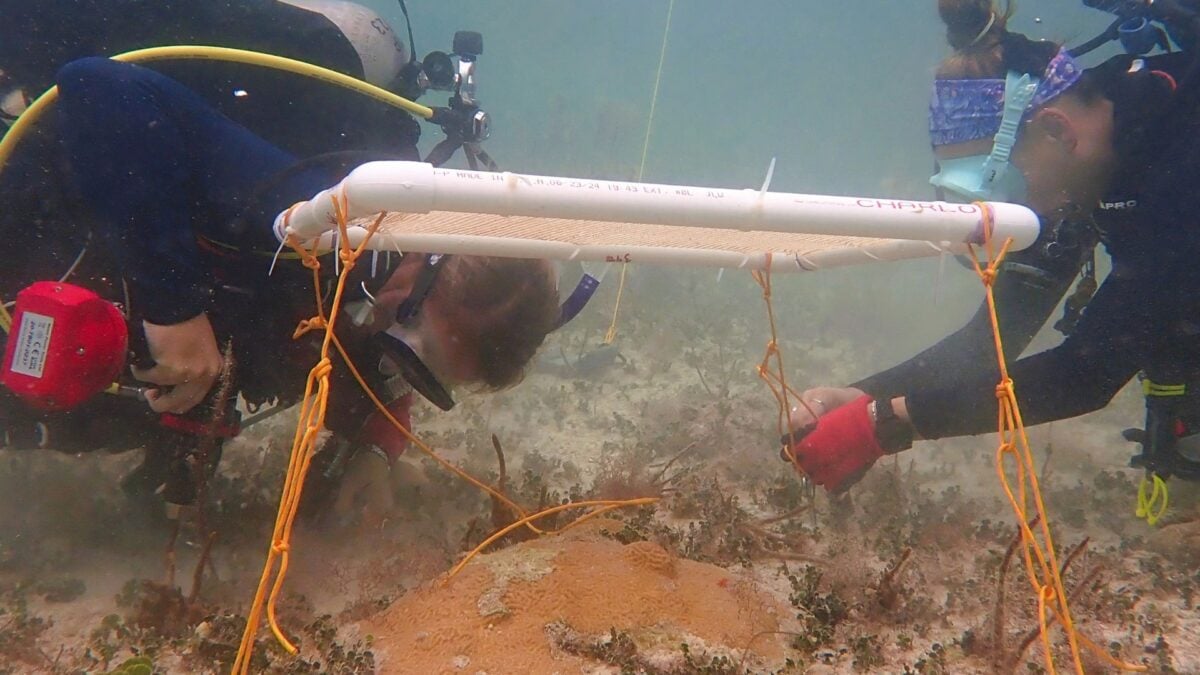
Earth is in the midst of its fourth global coral bleaching event. Scientists expect that by 2050 the world’s oceans will have warmed so much that most reefs will suffer mass bleaching each year. A surprisingly simple invention could help protect some of them. In a study published today in the journal Frontiers in Marine Science, researchers present “underwater umbrellas” that shade corals to reduce their exposure to the sun, which exacerbates bleaching caused by warming waters. They tested these ingenious canopies in the Caribbean, where corals are especially vulnerable to solar radiation and heat stress, and found that shaded corals suffered less bleaching. Some even regained some of their color. “The particular structures we implemented are good for smaller areas, such as high-priority individual corals, coral nurseries, or small transplant areas,” lead author Karen Neely, a research scientist at Nova Southeastern University, told Gizmodo in an email. “But new engineering ideas could make it suitable for larger reef areas.” Corals in crisis When corals are stressed by changes in environmental conditions such as temperature, light or nutrient availability, they expel the symbiotic algae that live in their tissues. These algae, called zooxanthellae, give corals their characteristic bright colors and also serve as their main food source. Without zooxanthellae, corals turn white (hence the term “bleaching”) and begin to starve. Cooling the waters where corals live will require global action. Humanity will need to reduce its greenhouse gas emissions to zero and remove carbon from the atmosphere to reverse the current warming trend. Until we can achieve those feats (and we are nowhere near achieving them), coral reefs will continue to suffer from mass bleaching events. The decimation of these vital ecosystems threatens many other marine species, the natural protections of coastal communities, and the multibillion-dollar fishing industry that feeds and employs millions of people. As Earth’s oceans continue to warm, scientists are developing strategies to mitigate damage to coral reefs. Shading has emerged as a promising solution and researchers have conducted experiments in the Pacific Ocean using a variety of designs, according to Neely. His team’s design was inspired by a colleague in Dominica who created some of the umbrella-shaped structures during the marine heatwave of 2023. Shades can save lives. The curtains, made of tubes with nylon fabrics attached, are attached to the sea floor so that they float about a foot (30 centimeters) above a coral. In the summer of 2024, Neely and his colleagues installed 20 shades in 10 different colonies of two species of brain coral, Pseudodiploria clivosa and Colpophyllia natans, in Newfound Harbor in the Florida Keys. They also chose 20 matching corals that would remain unshaded to serve as controls. The researchers found that the shades reduced the corals’ light exposure by 60%. Using diving equipment, they visited the corals every two weeks to look for color changes and perform biopsies of their tissues. They then analyzed those tissue samples in the laboratory to monitor the algae living inside them. That summer, heat stress measured in Newfound Harbor was the second highest on record, but shaded corals suffered less bleaching than expected. The researchers noticed the greatest differences during the most intense periods of heat stress. The shadows also seemed to reverse the bleaching that had already occurred, as some of the corals began to regain their color. Interestingly, the unshaded corals also suffered less bleaching than expected and none of the corals in either group died. Neely and his colleagues suspect this may be because the marine heat wave caused most of the corals to be occupied by an algae called Durusdinium. This species is particularly heat tolerant, but is associated with reduced coral growth and perhaps increased susceptibility to disease. What’s more, the researchers observed no difference in algal occupancy density or algal species between shaded and unshaded corals. This may be because their permits stipulated sampling at the edges of the corals, which are less exposed to sunlight and experience less bleaching. They also believe the curtains could have been more effective if they had been installed before the water temperature rose enough to cause discoloration. Despite these warnings, the shadows still had a measurable positive impact, and Neely said his team did not see any evidence to suggest they caused harm to other parts of the ecosystem. The experiment serves as proof of concept for the positive effects of shade on Caribbean corals, and future designs could work for larger reef areas. “Efforts have already been made this summer to test these broader efforts,” Neely said. Next, he hopes to investigate the long-term effects these hues have on corals. “In theory, they should reduce subsequent disease and increase subsequent reproduction, but this needs to be tested,” he said.