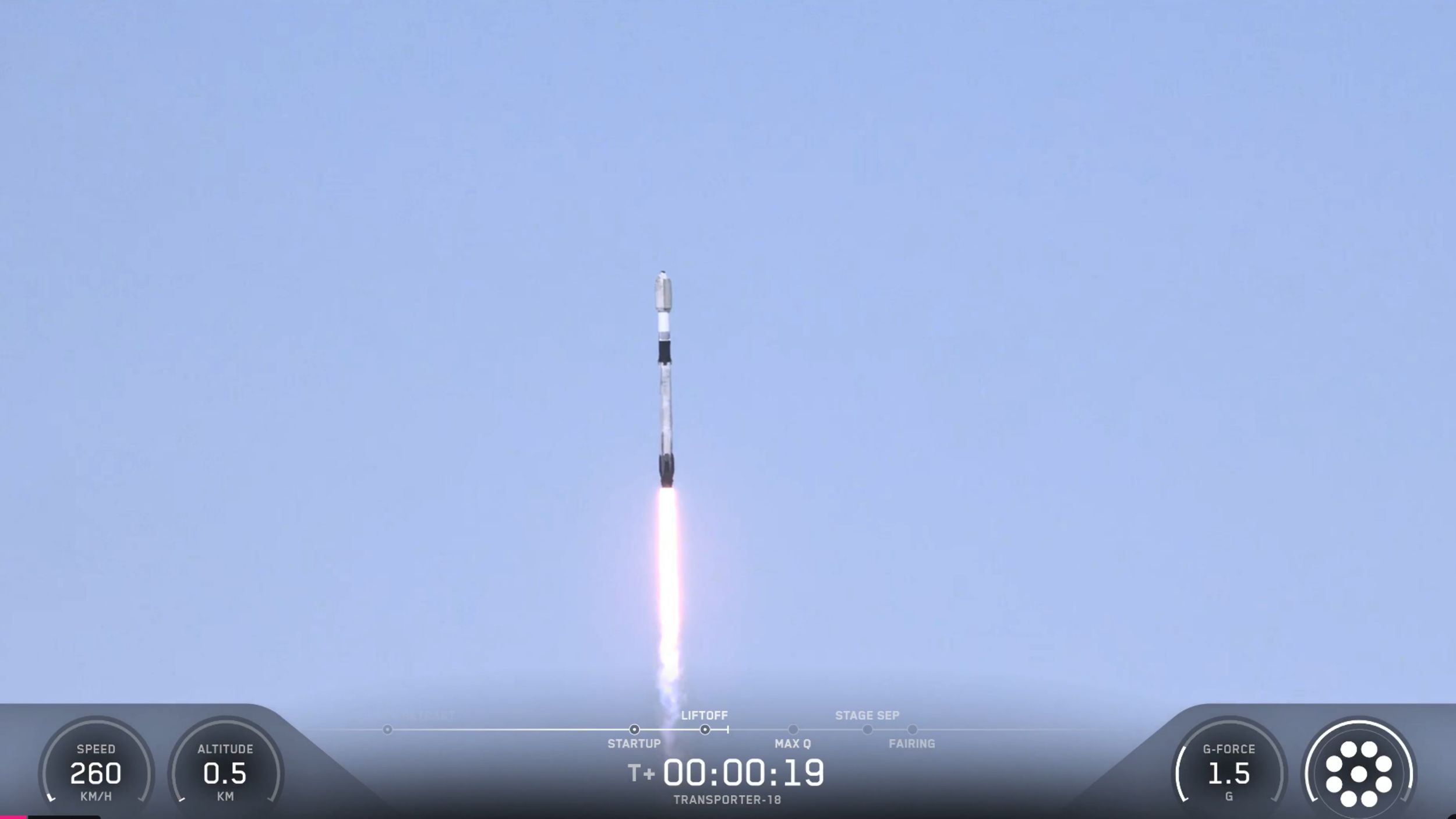
SpaceX launched 130 payloads into orbit today (Oct. 1), including a prototype Google AI satellite, in the second stage of a planned triple spaceflight. The rideshare mission, called Transporter-18, lifted off atop a Falcon 9 rocket from California’s Vandenberg Space Force Base today at 2:32 p.m. EDT (1832 GMT; 11:32 a.m. local time California), rising through the fog that normally covers this picturesque coastal site. to plan the flight. The first stage of the Falcon 9 returned to Vandenberg to land about 7.5 minutes after takeoff, completing its 25th flight to date. And the rocket’s upper stage made its way to low Earth orbit (LEO), where it deployed all 130 payloads over a period of about 11 minutes starting 54.5 minutes after launch. The highest-profile payload it carried is a Pathfinder spacecraft for Project Suncatcher, the artificial intelligence constellation that Google plans to build and operate in LEO. This satellite will help the project team determine how Tensor Processing Units (TPUs), the Google chips that are the core hardware of Suncatcher, operate in space. atmosphere. Of particular importance is how TPUs resist space radiation and how efficiently the heat they generate is dissipated. You might like Another company with AI data center ambitions also flew on Transporter-18: Cowboy Space put its Reason-1 satellite on the Falcon 9. “Its job is to test power transmission: using a high-power laser to transfer power from low-Earth orbit to a ground-based receiver,” Cowboy Space said of Reason-1 in a Sept. 28 X post. “If you want to build data centers in space, you have to master the optical systems between orbit and Earth. This is where the journey begins.” Transporter-18 also launched Starfish Space’s first Otter service satellite. “This is a big moment for Starfish Space,” the Washington-based company said via X on September 24. “We have spent years developing, iterating and testing the key technologies necessary for affordable and available satellite service. Now we are launching Otters, putting our satellite service vehicles to work for customers in orbit.” The rest of the 130 payloads were a diverse batch, consisting of “cubesats, microsats, hosted payloads, and two spacecraft with reentry vehicles and four orbital transfer vehicles carrying 41 of those payloads to be deployed later,” SpaceX wrote in its Transporter-18 mission description. The first stage of the Falcon 9 that launched the Transporter-18 mission pierces the clouds above California’s Vandenberg Space Force Base during its return to Earth on October 1, 2026. (Image credit: SpaceX) Transporter-18 didn’t set a record for most payloads launched at once, but it came close. The current mark is 143, sent on SpaceX’s Transporter-1 mission in January 2021. Transporter-18 was part of a very busy day for SpaceX. The company also launched the Crew-13 astronaut mission for NASA this morning, and aims to lift flight NROL-97 for the U.S. National Reconnaissance Office late tonight, both from Florida’s Space Coast. Crew-13 flew on a Falcon 9, and NROL-97 will travel on a Falcon Heavy to orbit. Editor’s note: This story was updated at 2:50 pm EDT on October 1 with news about the successful launch and landing of the rocket, and then again at 4:35 pm EDT with news about the payload deployment.