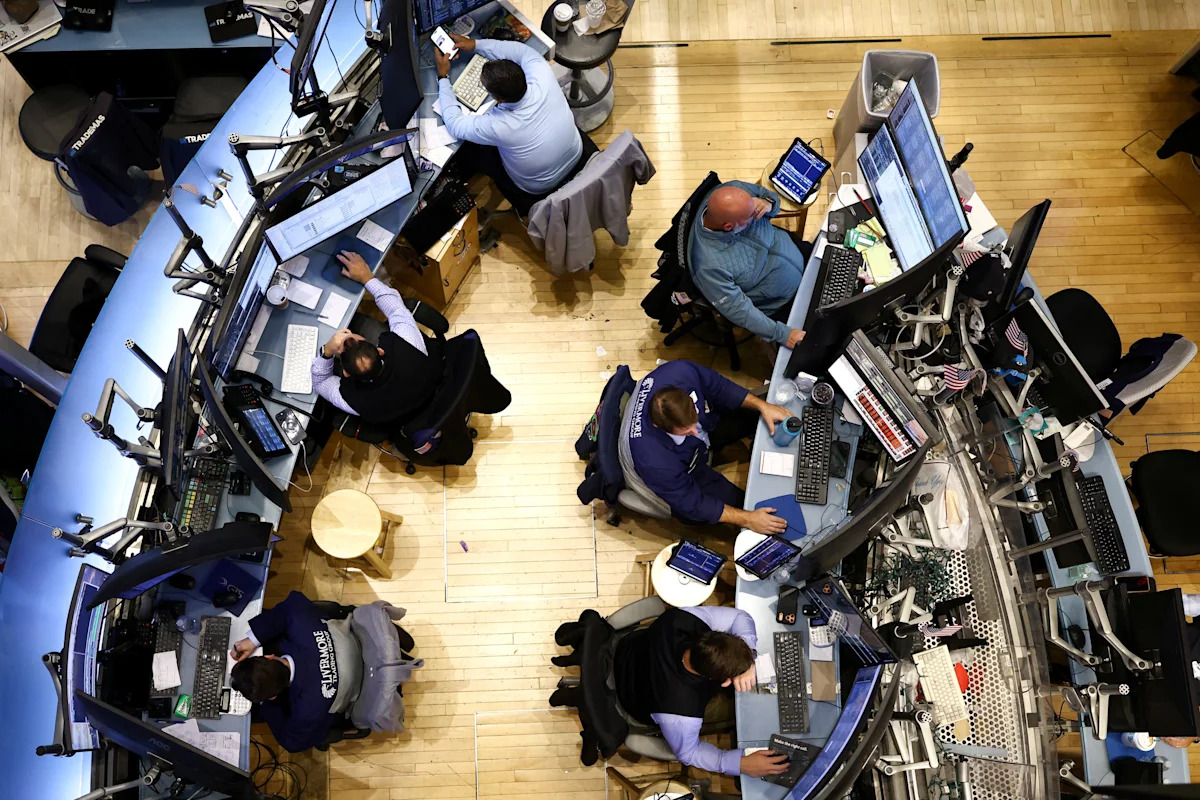
U.S. stocks began the new month moving lower as investors kept their eyes on the bond market tumult even as upbeat earnings from Micron (MU) fueled tech momentum. The Dow Jones Industrial Average (^DJI) fell 0.4%, and the tech-heavy S&P 500 (^GSPC) and Nasdaq Composite (^IXIC) fell 0.3% and 0.2%, paring gains from the previous Thursday. The 10-year Treasury yield (^TNX) rose another 3 basis points on Thursday to 5.3%, a new multi-decade high after the bond market suffered its worst quarter in decades. 50,654.26 -251.79 (-0.49%) At 10:29:35 amEDT. Open market. ^DJI ^GSPC ^IXIC Shares of Micron (MU) were little changed after the memory giant reported fourth-quarter earnings that beat Wall Street expectations and raised its outlook for the first quarter. Stocks closed out the third quarter and the historically weak month of September on Wednesday. The Dow Jones posted losses in both periods as US bond yields saw their biggest move since September 2022, while the Nasdaq rose. Market momentum has waned as much of the market remains weighed down by uncertainty amid persistently high Treasury yields and oil prices (CL=F, BZ=F), even as top tech and semiconductor stocks fuel AI enthusiasm. Nvidia (NVDA) shares rose 0.7% after rising 5% in September; AMD (AMD) fell 1% on the day after gaining 30% in September. Initial jobless claims fell for the fourth consecutive week in the latest sign that the labor market remains broadly stable. A report on layoff plans for Challenger, Gray & Christmas, released Thursday morning, also showed that layoff plans slowed in September, although companies are also not rushing to hire. These labor market data reports set the tone for Friday’s monthly employment report. Nike (NKE) reports earnings after the bell, offering a glimpse into how its turnaround efforts are going, but it will take a lot to change Wall Street’s sentiment on the stock, which is trading at its lowest levels since 2014. LIVE 7 updates U.S. stocks open higher after bond yields hit new multi-decade highs U.S. stocks rose at the open on the first day of October. The Dow Jones Industrial Average (^DJI) hovered near the flat line, and the S&P 500 (^GSPC) rose 0.2%, while the tech-heavy Nasdaq Composite (^IXIC) rose 0.3%. Beneath the surface of the major indices, stock performance ended September with increasing divergence. AI-powered tech stocks have rallied, while the rest of the market remains pressured by rising government bond yields and elevated oil prices (CL=F, BZ=F). 50,654.26 -251.79 (-0.49%) At 10:29:35 amEDT. Open market. ^DJI ^GSPC ^IXIC The pressure does not stop in the bond market. Earlier on Thursday, the yield on the benchmark 10-year Treasury bond fell slightly after briefly rising to 5.34%, its highest level since 2002. Initial jobless claims declined last week. The number of people filing for unemployment fell for the fourth consecutive week, highlighting that the pace of layoffs remains low. U.S. jobless claims fell by 1,000 to 197,000 in the week ending Sept. 26, the Labor Department said Thursday. That was below economists’ expectations of 200,000 claims. Initial Claims Over the Past Year (FRED) Continuing claims, an indicator of how many people are receiving benefits, decreased by 11,000 to 1.7 million in the week ending September 19. On Friday, the Labor Department will release its monthly employment report, considered the gold standard for employment data. Follow our live blog for more updates. Bitcoin just got a surprising new bull. A surprising new bull has entered the bitcoin space: Citigroup. Citi analyst Alex Saunders on Thursday raised his base price forecast for bitcoin (BTC-USD) to $113,000 from $82,000. “The increase is based on all three components of our process: activity, macro, and ETF flows. Downgrade fears coupled with SEC agency rulemaking, paradoxically spurred by the failed Clarity Act, helped cryptocurrencies regain technical levels. ETF inflows resumed as prices surpassed the 200-day moving averages. We now assume base-case inflows of $5 billion over 12 months, versus a stable level, given sentiment. positive,” Saunders said. Bitcoin just posted its strongest quarter since 2024, leaving gold and other assets in the dust despite rising Treasury yields and commodity prices. The digital asset gained around 43% in the third quarter. However, it is still down about 4% so far this year. Read more. Micron’s “impressive” earnings show data center demand remains strong. Micron (MU) reported fiscal fourth-quarter earnings after the bell on Wednesday, and the results were strong. The memory giant beat Wall Street analysts’ expectations top-line and bottom-line, and raised its outlook for the first quarter. During the quarter, Micron reported earnings per share of $33.42 and revenue of $54.23 billion, compared to estimates of $31.83 EPS and revenue of $51.49 billion. “Expectations were already very high, so the fact that they can still exceed them even at this level is incredibly impressive,” DA Davidson head of technology research Gil Luria told Yahoo Finance. “This indicates that there is a lot of demand for memory and that supply will not increase any time before the end of next year or before the latter part of next year, and that sets Micron up very well,” Luria added, “and it’s a good indication to the entire data center construction ecosystem that demand is clearly still very strong.” Layoffs have slowed, but employers are not rushing to hire for the holidays. Layoff plans fell in September to the lowest levels for the month since 2022. But companies do not seem to be in a hurry to add staff. American employers announced 43,281 job cuts in September, a 20% drop from September 2025, according to outplacement firm Challenger, Gray & Christmas. Through September of this year, layoff announcements have dropped sharply compared to last year, falling 39% overall and 15% excluding government workers. Tech companies continued to be responsible for the bulk of the latest layoffs, announcing 10,799 cuts in September. Nearly a third of all announced job cuts came from technology companies, leading all other sectors. Read more. Good day. This is what is happening today. Economic data: Challenger job cuts, year-on-year, September (-38.5% previously); Initial unemployment claims, week ending September 26 (previously 197,000); Continuing claims, week ending September 19 (previously 1.719 million); S&P Global US Manufacturing PMI, final September reading (previously 57); ISM manufacturing, September (expected 55, previously 54.6); ISM prices paid, September (expected 72, previously 71.1); new ISM orders, September (previously 53.7); ISM employment, September (51.2 previously); Construction spending, month-over-month, August (+0.1% expected, -0.5% previously); Omdia Total Vehicle Sales, September (16.59M expected, 16.76M previously) Earnings Calendar: Accenture (ACN), NIKE (NKE), McCormick & Company (MKC), Acuity (AYI) Catch up on some of the top news overnight: AI safety measures widely backed by most Americans HPE demand outstrips supply as stock hits a plateau record Billionaire Bill Ackman calls Anthropic ‘perhaps the best business story I’ve ever seen’ ‘It’s been seen’ Stocks do better than expected in September Greer urges G20 to back Trump’s tariff agenda, takes aim at China Fed’s Kashkari says central bank must reduce inflationary pressures Paramount gets court green light for Warner Bros deal, names Mattel co-CEO Kreiz “AI or bust:” The Tech trading boosted stocks during a volatile September Yahoo Finance’s David Hollerith summarizes how markets performed in September: Wall Street performed better than expected in September, given the month’s historical reputation as the worst month for stocks. It all comes down, as you may have guessed, to trading in artificial intelligence. The S&P 500 (^GSPC) fell 0.4% for the month as Treasury yields rose. It is down 1.9% from its all-time high set in August. September has historically been the weakest month for the S&P 500, with an average decline of 0.6% since 1950. Markets diverged in September. The Nasdaq Composite (^IXIC) gained 1.8% after reaching a new peak on September 22. Tech giants Meta (META) and AMD (AMD), along with a handful of other semiconductor stocks, fueled that performance. Meanwhile, the Dow Jones Industrial Average (^DJI) fell about 4.3%, while the small-cap-focused Russell 2000 (^RUT) fell 5.4%. “It’s AI or bust,” said Interactive Brokers chief strategist Steve Sosnick, pointing to the divergence in stock performance from the major market indices. Read more.