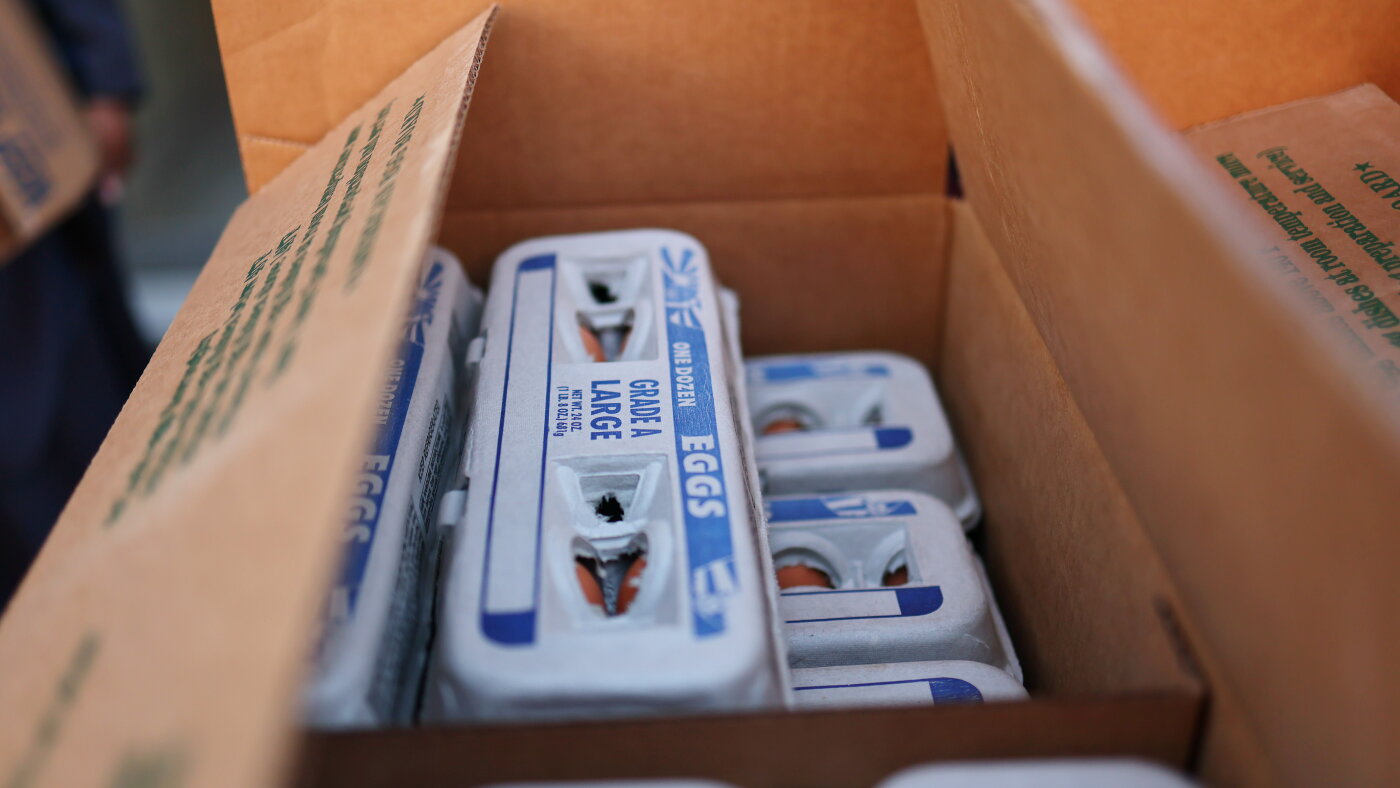
Eggs are given out for free in front of Brown Butter Craft Bar & Kitchen in New York City on March 21, 2025. The cost of a dozen eggs hit a record high of $6.23 that month. Michael M. Santiago/Getty Images hide caption toggle caption Michael M. Santiago/Getty Images President Trump has repeatedly boasted about lowering egg prices during his second term. He has often blamed former President Joe Biden for the recent high costs American consumers were paying for this staple food, claiming that it was his return to office that finally put an end to runaway egg prices. It’s true that the price of eggs has more than halved during Trump’s second term. According to federal data, the average cost of a dozen eggs when he took office in January 2025 was $4.95, while the typical price in August was just $2.27. But the reasons egg prices have plummeted so far in that time are complicated, and agricultural industry experts say the administration has taken other actions that have made it harder for farms to turn a profit. Perhaps the most significant factor affecting egg prices over the past five years has little to do with politics. Bird flu wiped out flocks across the United States and devoured domestic egg supplies, causing retail prices to soar. Prices fell again as herds recovered. “That’s been the biggest factor and it’s outweighing everything else,” said Michael Walden, professor emeritus of economics at North Carolina State University. The Trump administration has helped farmers beef up biosecurity measures to protect their flocks, and Walden also noted that the U.S. Department of Agriculture has tried to reduce bureaucracy for egg producers. But he said Trump’s tariffs on foreign trading partners and the war with Iran have made life difficult for farmers by increasing their operating costs for necessities such as diesel. “While the federal government has tried to relax some regulations on farmers to reduce costs, the benefits have been far outweighed by the negatives,” he said. Now, as the midterm elections approach, Trump and his fellow Republicans continue to grapple with voters’ concerns about affordability, particularly the cost of food. Bird flu hits egg industry In early 2022, the United States began experiencing its largest outbreak of highly pathogenic avian influenza (HPAI), or bird flu, in years. That year caused the death of millions of laying hens and prices rose in the following months. A similar pattern repeated itself in late 2024 and early 2025, when another wave of bird flu devastated American farms. According to the USDA Economic Research Service, nearly 51 million laying hens died or were culled between October 2024 and March 2025 alone. A smaller flock was left to lay eggs, causing prices to rise. The cost of a dozen eggs hit a record high of $6.23 in March 2025, just two months into Trump’s second term. Consumers felt the price increase acutely. Agricultural industry experts say this is because eggs are what economists call an inelastic product, meaning the demand for eggs doesn’t change much when the cost increases. Emily Metz, president and CEO of the American Egg Board, an industry marketing group, says that’s because eggs hold an indispensable place in the American diet. “Not only are they a central element of the dish, not only do people eat them on their own, but they also use them in baked goods, in drinks to foam and whip things up,” he said. “They use them in all kinds of recipes and in different ways.” Last winter turned out to be a less severe period for bird flu on American farms and farmers were able to rebuild their herds, helping to calm last year’s record prices. How the Trump administration responded In February of last year, after the worst of the bird flu outbreak, Agriculture Secretary Brooke Rollins announced up to $1 billion to combat the disease that had devastated the country’s herds. It included up to $500 million to help farms improve biosecurity protections, including things like hygiene protocols and wildlife safeguards, complementing what many producers had already been doing. (The USDA had conducted biosecurity assessments on more than 900 farms as of June 2025.) Up to $400 million was set aside to pay farmers who had to cull their flocks or destroy eggs in response to possible infection, and the amount of compensation they could receive per bird increased. Metz, of the American Egg Board, said farmers always work closely with the USDA during bird flu outbreaks and that Rollins’ plan helped, too. But it’s also true that last year’s bird flu season was simply much milder. “I think those initiatives have made progress, but we have also benefited in the industry because avian flu is very cyclical,” Metz said. “The wild bird population continues, so this year we haven’t had bird flu in the environment in the same way as last year.” The USDA also said last year it would explore ways to increase egg imports, and imports increased. U.S. egg imports in 2025 reached 121 million dozen equivalents, well above the 29.8 million dozen equivalents imported the previous year. Mark Jordan, chief executive of LEAP Market Analytics, a consulting firm specializing in animal protein markets, said that while the increase in imports was a positive step in replenishing domestic supplies devastated by bird flu, it had a relatively modest impact on the U.S. poultry industry, which produces about 90 billion eggs per year. “That’s nothing, but it’s a small impact,” he said. Jordan said that ultimately the change in egg prices was due to how well farms were protected from infection and how severe that wave of disease was. “I would say 90% to 95% of the impact we’ve seen in terms of price declines has simply been a measure of success in biosecurity and some measure of, you know, luck,” he said. Also last year, the Justice Department, along with 17 states, settled an alleged price-fixing case against three major egg producers: Cal-Maine Foods, Hickman’s Egg Ranch and Versova. Prosecutors alleged that coordination between the companies drove up egg prices even further in recent years. Farmers hit by tariffs and war with Iran Even as the Trump administration responded to bird flu, it also imposed tariffs on foreign trading partners and went to war with Iran, raising operating costs for American farmers, industry experts said. Poultry farmers have faced “pretty tough inflationary pressures coming from corn and soybean meal” to feed their flocks, Jordan said, while the American Egg Board’s Metz noted that others who grow crops to feed their birds have faced higher fertilizer costs. Transportation prices have skyrocketed due to rising energy prices. And egg producers have also seen higher packaging costs, including cardboard and other corrugated materials that have been affected by U.S. trade negotiations with Canada, Metz said. “There are a lot of inputs that go into a farm that people don’t realize beyond the animal itself, and all of those inputs have increased in cost quite significantly in recent years,” he said. This has put pressure not only on egg producers, but also on the food industry, raising overall food prices for American consumers. Federal data showed that grocery prices in August rose 2.2% over a year, even as egg prices fell 23% over the same period.