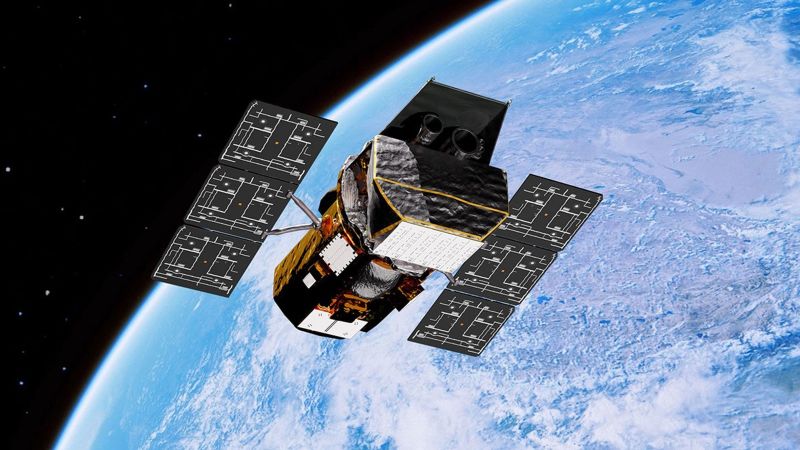
A celebrated space telescope is rapidly drifting away from its once-stable orbit and falling to Earth shortly before the 22nd anniversary of its launch. The Neil Gehrels Swift Observatory will soon have to cease its scientific observations after an attempt at a daring rescue mission to boost its orbit failed over the summer. The telescope, named after fast-flying birds, could spin rapidly to observe blink-and-miss cosmic events, like burning black holes. The telescope was originally designed to study the most powerful explosions in the universe, called gamma-ray bursts, but scientists have also used it to observe other types of cosmic flashes, as well as asteroids and comets. The 3,200-pound (1,452-kilogram) observatory is currently about 200 miles (325 kilometers) above Earth. But engineers estimate that once Swift moves below 300 kilometers (185 miles) in early to mid-October, operating the telescope will become a challenge, according to NASA. Swift will then fall from its orbit and is expected to burn up in Earth’s atmosphere during the fall. “While it is possible that some of the Swift spacecraft’s hardware could survive re-entry due to its size, the likelihood of the debris causing significant property damage or physical harm to anyone is very small,” according to a statement from space tracking company LeoLabs shared with CNN via email. “Most likely, as with most debris that survives re-entry, it will fall into the ocean or onto uninhabited land.” NASA did not respond to a request for comment on potential risks related to the observatory’s reentry. Scientists hoped that a rapid-production satellite called LINK, which was developed, built and launched by Arizona-based Katalyst Space Technologies in just nine months, could grab the telescope and lift it into a stable orbit. The rescue mission to boost Swift failed just weeks after LINK’s launch in early July when the satellite spun out of control in space. “From the beginning, this was a high-risk, high-reward mission,” Shawn Domagal-Goldman, director of NASA’s Astrophysics Division, said in a statement. “Without intervention, Swift would re-enter the atmosphere by the end of the year.” But NASA and Katalyst say LINK’s modified mission was not a wasted effort, and both groups learned lessons that could help in future space operations. “And while we will be sad to see Swift’s mission come to an end, we knew this momentum effort would be valuable to the agency on multiple levels: advancing American spacecraft maintenance technology, challenging us to meet unprecedented mission schedules, and testing how we operate satellites to extend their time in low Earth orbit,” Domagal-Goldman further stated. “We are very proud of how quickly this team came this far and are capturing the lessons learned to ensure we are ready to go even further.” Katalyst decided to move forward with its plan to have LINK rendezvous with Swift in mid-August, but as a demonstration rather than a rescue due to LINK’s continued orientation problems in space. While Katalyst engineers were able to use the satellite’s thrusters to slow its unexpected spin and load new flight software, the maneuver that reoriented LINK in space also depleted its thruster. “As a result, Katalyst and NASA together determined that LINK no longer had enough fuel to safely execute the planned orbit capture and elevation phase of the mission,” according to Katalyst. The satellite came within 12 to 15 kilometers (7.5 to 9 miles) of Swift the first week of September, practicing how a future servicing mission might approach a satellite or telescope, especially one like Swift, which was not designed to be serviced in space. LINK also deployed its three robotic arms, which were originally intended to grab Swift, and ignited its three electric-powered thrusters. The satellite operated in space for 85 days before re-entering Earth’s atmosphere on September 25, according to Katalyst. “LINK was created to address a problem that had no easy solution,” said Ghonhee Lee, CEO of Katalyst Space. “While we did not achieve all of the goals we set, in less than a year we went from mission concept to launching and operating the first commercial space robot. This is a foundation we can build on.” Katalyst will apply data and lessons from LINK’s mission to its next generation of spacecraft that could be used to service existing missions in space. “The future of space will require spacecraft that can do more once they get there. We are building toward that future,” Lee said. The Swift Observatory, which has no established observing replacement waiting in the wings, has served as an astrophysics multi-tool in low-Earth orbit since its launch in November 2004. Swift mission scientists have been slowly restarting the telescope’s instruments to collect data and make observations until the end, which is actually accelerating the observatory’s decline. The instruments were turned off for months to reduce energy use and prevent the Swift from sinking. Swift was steadily losing altitude due to atmospheric drag, which was only magnified by an increase in solar activity in recent years as the sun reached the peak of its 11-year cycle in 2024. Intense flares and coronal mass ejections caused Earth’s atmosphere to expand, intensifying drag on Swift, leading scientists to predict that it would descend toward our planet in the fall, according to NASA. “When Swift’s namesake Neil Gehrels designed the observatory, nothing like it had ever been launched,” said S. Bradley Cenko, Swift principal investigator at NASA’s Goddard Space Flight Center in Greenbelt, Maryland. “I would have welcomed this momentum effort as part of Swift’s legacy, allowing NASA to try something new and daring even if the outcome was not guaranteed.” Subscribe to CNN’s Wonder Theory science newsletter. Explore the universe with news about fascinating discoveries, scientific breakthroughs and more.