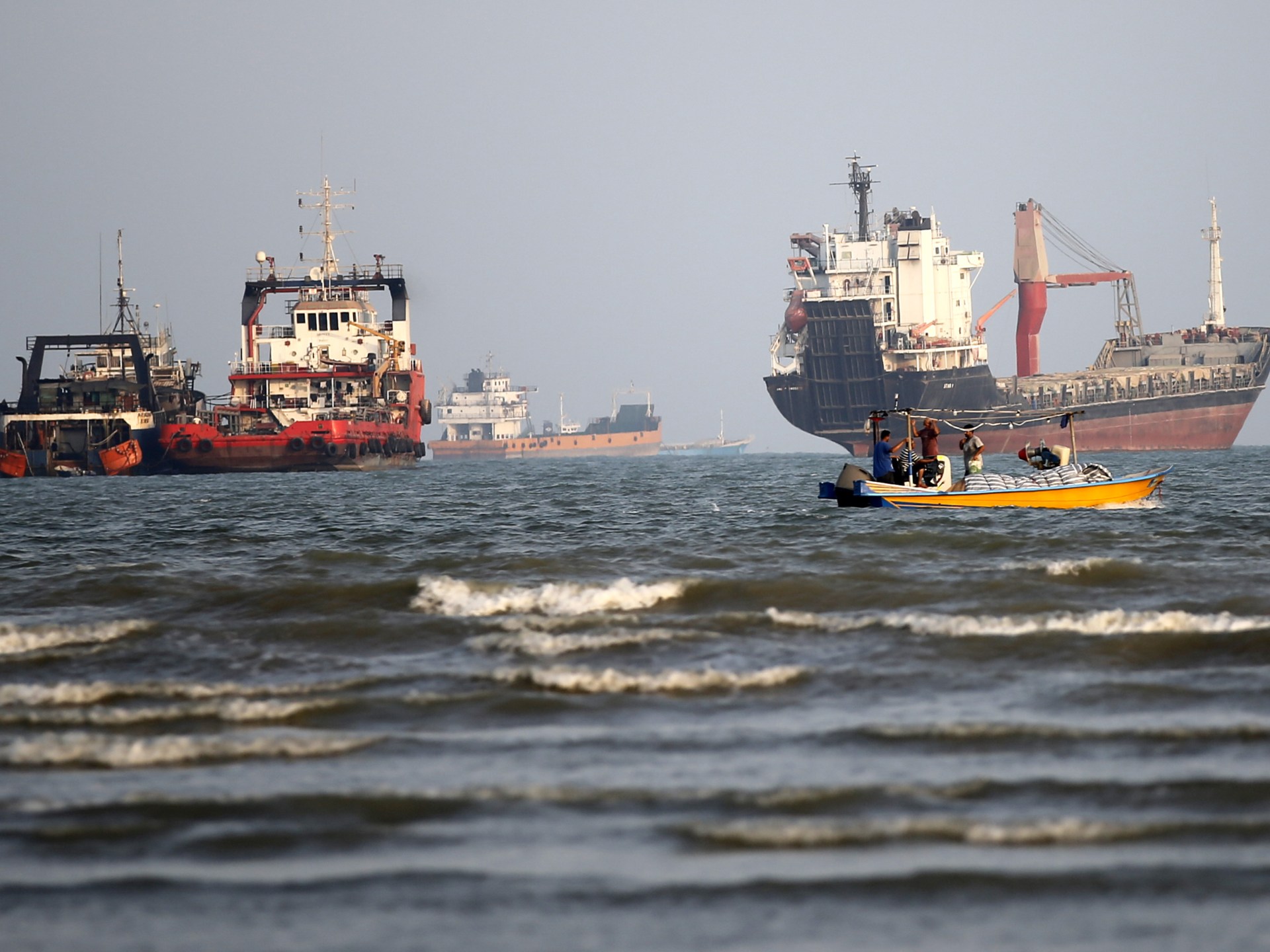
As Iran and the United States work with mediators to end seven months of hostilities, the reality in the Strait of Hormuz is changing in ways that could be a game-changer in ongoing negotiations. According to the latest data from tanker tracking websites, traffic through the key waterway has been steadily increasing, with some estimates putting the flow of oil through the Strait of Hormuz at nearly 80 percent of what it was before the US-Israel war against Iran began in February. 28.Recommended Stories list of 3 itemsend of listThis could affect Iran’s leverage in reaching a deal favorable to itself in its attempts to end the fighting, which has seriously hampered its already heavily sanctioned economy, amid the US blockade of Iranian ships and ports. Despite that, experts believe it would be a mistake to think that normality in the Strait of Hormuz is imminent, or that Iran will easily bow down despite growing economic difficulties. “The fact that oil is passing through the Strait of Hormuz is encouraging, but flows are not yet considered completely safe or guaranteed, particularly while the broader conflict remains unresolved,” Susannah Streeter, chief investment strategist at Wealth Club, told Al Jazeera. Iran’s leverage may be weakening rather than disappearing. Oil flows through Hormuz recover The latest data from commodity analysis firm Kpler points to a significant recovery in Middle East oil exports. Crude exports reached an estimated 16.328 million barrels per day (bpd) in September, their highest level since the war began in late February, the firm reported this week. Saudi Arabia has driven much of the increase, with its exports rebounding from 2.446 million bpd in August to around 5.4 million bpd in September. Kpler said Middle East crude exports have recovered to just under 80 percent of their pre-war level. of bpd down from the 19.513 million bpd exported in February The data also does not include ships crossing Hormuz with their tracking systems turned off, meaning that actual traffic could be higher. At the height of the fighting, traffic at. through the waterway was reduced to just two tankers a day after Iran effectively closed the strait in retaliation for attacks by the United States and Israel. Is Iran losing influence? The rebound in oil flow presents a challenge for Tehran. Iran has sought to use its ability to disrupt the Strait of Hormuz – one of the world’s most important energy chokepoints – as leverage against military and economic pressure from Washington. As Iran itself remains under a U.S. naval blockade, Tehran’s bargaining power could decline. However, Iran rejects any assessment that its control over the strait is diminishing. Hossein Mohebbi, Islamic Revolutionary Guard Corps of the United Kingdom (UKMTO) said unknown projectiles hit three ships in the waterway on Tuesday, including a crude oil tanker. Oil prices are another indication that Iran has not lost all its influence. Villagers stand near plastic containers at a fuel station to fill their water pumps, as India faces rising oil prices, in Halvad, Gujarat, India. [File: Amit Dave/Reuters]Brent crude fell 2.6 percent to $102.59 a barrel on Tuesday as traders focused on recovering Middle East exports. But it was still on track for a gain of about 13 percent in September. Chris Beauchamp, an analyst at IG, said markets were starting to factor in evidence of a recovery in flows, but he remained cautious about how long-lasting that recovery would be. “It takes time for evidence to reach the markets,” Beauchamp said. “Oil prices fell yesterday as the narrative began to take hold and should continue to fall.” But he said concerns remained about whether the U.S. protection system could withstand a new barrage from Iranian missiles and drones. Streeter of Wealth Club said the market still had a geopolitical risk premium built into crude oil prices, despite improving flows. waterway,” he said. Additionally, Streeter cautioned that the raw numbers only tell part of the story. Flows of refined fuels, particularly diesel and gasoline, remain limited, while damage to infrastructure has put additional pressure on energy supply chains, he added. There is another vulnerability, the investment strategist noted. Countries such as the United States have relied heavily on strategic oil reserves to cushion the impact of the disruption and help contain prices. “With those reserves now significantly exhausted, there is a thinner buffer if there is another shock, which is helping to keep a floor under crude oil prices,” Streeter added. ‘Economic war’ against Iran There is no doubt that economic pressure on Iran is intensifying, potentially increasing Tehran’s incentive to reach a deal. (GDP) contracted 10.1 percent year-on-year between March 21 and June 20, while the crucial oil and gas sector contracted by 26.4 percent Iran has also been struggling with high inflation and a falling currency as the US blockade limits oil exports and foreign exchange earnings Tajrish Bazaar in northern Tehran, Iran. [File: Abedin Taherkenareh/EPA]In August, the United States announced a new economic pressure campaign against Iran, vowing to target Tehran’s financial interests around the world. Mohammad Eslami, a researcher at the University of Tehran, told Al Jazeera that Iran was facing an “economic war” alongside the military conflict. “There is a US blockade of the Strait of Hormuz, which affects Iran’s revenue from oil exports and other products such as petrochemicals, which are important to Iran’s economy,” Eslami said. “As a result, Iran’s dollar revenues have been affected by the blockade.” But he warned against judging Iran’s economy solely by the value of its currency. “The exchange rate is a very important indicator, but it is not the only measure to explain what is happening or the difficulties and challenges facing Iran’s economy,” Eslami said, adding that Iran has faced economic pressure from the United States for “five decades.” Negar Mortazavi, political analyst and host of The Iran Podcast, echoed Eslami’s sentiment. opinion that the economic blockade is imposing “enormous pressure on Iran,” but that does not mean it is relenting, he told Al Jazeera. “Tehran has demonstrated that it is prepared to tolerate considerable economic pain rather than negotiate entirely on Washington’s terms.” The war is also damaging the American economy. Iran is not the only one facing economic pressure. Diesel prices in the United States hit a record high of $6.53 per gallon ($1.73 per liter) this month, more than 70 percent higher than the price before the United States waged its war against Iran. The Trump administration is discussing restrictions on diesel exports to ease prices ahead of the November midterm elections. Higher energy costs have also fueled inflation, experts say, contributing to the Federal Reserve’s decision to raise interest rates by 25 basis points this month, its first increase in three years. In addition, the cost of living crisis in the country is also weighing on Trump politically. A recent Reuters/Ipsos poll put his approval at a career-low 32 percent, and just 17 percent approve of his handling of living costs. From time to time, Iran has taken advantage of this pressure, often mocking Trump for prematurely declaring victory in the war despite the apparent economic crisis in the United States. Parliament Speaker Mohammad Bagher Ghalibaf this month used a mathematical equation to suggest that Tehran’s ability to disrupt energy supplies is influencing US monetary policy. Analysts say that while the claim is exaggerated, it highlights Iran’s own economic influence over Washington. Can an agreement be reached? Despite military and economic pressure, negotiations have not failed. At the United Nations General Assembly last week, Tehran and Washington engaged in three hours of indirect talks, while US special envoys Steve Witkoff and Jared Kushner met with Iranian Foreign Minister Abbas Araghchi. President Trump later described the meeting as “very good” and “very productive.” Iran also proposed a seven-day road map under which the Strait of Hormuz could be reopened and normal shipping traffic restored if Washington meets Tehran’s conditions, a plan Trump categorically rejected. Those conditions included ending the naval blockade against Iran, easing sanctions and releasing frozen Iranian funds. However, on Wednesday, the Reuters news agency reported that Araghchi had received comments from the United States on the proposal through Qatari mediators. An official briefed on the talks said the main disagreement now centered on the sequence of measures rather than the components of the plan. Mortazavi said Iran’s latest proposal shows that Tehran is willing to be flexible because it wants to end the war. The proposal builds on the June memorandum of understanding between Iran and the United States but offers a much faster timeline, including an immediate end to the war, reopening the Strait of Hormuz within a week and a quick return to nuclear negotiations. “Iran is offering a compromise to stop the war, not capitulation under pressure.” Mortazavi said. But that flexibility is tied to reciprocal concessions from Washington, he added. “There has to be something in return from the United States.” Mortazavi said there was a “danger” if Trump misinterpreted Iran’s willingness to compromise as weakness. “That could, however, prolong the war,” he warned.