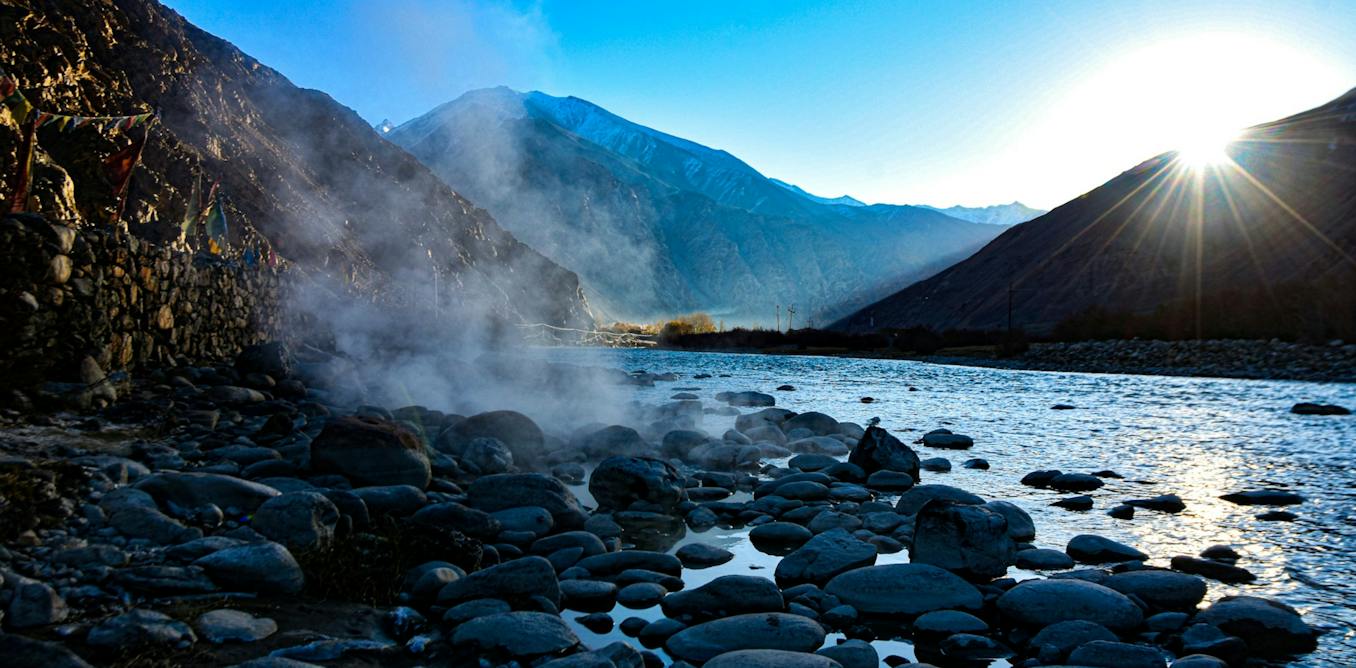
Is there life elsewhere or is Earth unique in the universe? This is one of humanity’s great unanswered questions. One way to address this mystery is to investigate how life began here on Earth. Our research explores the conditions under which a mixture of molecules somehow transformed from chemistry to biology. In a new study published in Scientific Reports, we shed new light on a possible step in this process: how a fragile sugar from outer space may have helped create the conditions for its own survival on Earth, where it eventually became the backbone of one of life’s most important molecules. Recreating the beginnings of life Scientists believe that life emerged from a complex mixture of water, minerals and carbon-containing molecules – the proverbial primordial soup. These mixtures may have been in oceans, lakes or hot springs. They would have been shaped by changes in temperature, flowing water, mineral surfaces and evaporation, creating conditions in which increasingly complex chemistry could develop. Researchers try to recreate these processes in laboratories, often using purified chemicals and carefully controlled mixtures. This situation helps isolate individual reactions and eliminate variables, but can leave out important interactions in the “messy” chemistry of nature. One molecule studied in these experiments is RNA. RNA plays a vital role in the storage and use of genetic information in modern organisms and is thought to have been important in the origin and early evolution of life. However, RNA is not formed easily. Its molecular backbone contains a fragile sugar called ribose. When heated, ribose can break down and form a brown goo, the same way table sugar turns into caramel. One thing that can protect ribose molecules is the element boron. In the form of borate (a molecule containing boron, oxygen and hydrogen), it binds to ribose and helps prevent its breakdown. Experiments investigating this effect typically use simple combinations of purified ingredients. We and our colleagues have tried to make these experiments more realistic, based on what we know about ancient rocks, minerals and fossils. The Puga Hot Springs We also study modern environments that we believe may resemble the places where life began. One of them is a hot spring field in Puga in India, high in the Himalayas. The waters of Puga contain so much boron that the crusts of borate salt crunch underfoot like snow. Still, these waters contain only a small percentage of the boron concentration used in some laboratory experiments based on purified ingredients. Borate salts form thick crusts on the ground around the Puga hot springs. Luke Steller, CC BY-SA This is because boron-containing minerals often dissolve poorly in water. Instead, they precipitate to form crystals, like the borate salt crusts on Puga, leaving less boron and other elements in the water for chemical reactions thought to be involved in the origins of life. So could high concentrations of dissolved boron really have existed in those ancient environments? A two-way relationship In a new study using real minerals, including Puga borate bark, we show that ribose itself can help explain how high concentrations of boron could have existed in Earth’s fluids before life began. We found that ribose helps borate minerals dissolve and inhibits the formation of solid grains. This means that more boron remains dissolved in the water and available for chemical reactions. This new research suggests a bidirectional relationship. Borate protects ribose from degradation, while ribose helps keep borate dissolved and available. The world before life Four billion years ago, when life is believed to have first formed, the Earth would have looked very different than it does today. There would have been little oxygen in the atmosphere and much more active volcanism, creating few volcanic landscapes and green, iron-rich oceans. A strong shower of meteorites from the young Solar System would have bombarded the earth. These meteorites would have transported molecules to Earth from space, including water and carbon compounds. Researchers estimate that around a million tons of carbon could have arrived each year during this first bombardment. The Murchison meteorite, which fell in Victoria in 1969, gives clues to what it may have been like. Locals who collected fragments reported a strong kerosene smell coming from carbon-containing compounds within the meteorite. Scientists have since identified ribose among its contents, along with other sugars. In the absence of microbes, carbon-containing molecules could accumulate wherever the supply exceeds chemical degradation. For example, evaporation in shallow lakes and pools could concentrate organic molecules from space into rich chemical soups. Primordial Soup, on Ice Much origin-of-life research examines how minerals helped the chemistry of these soups become more complex. Our study highlights how the soup in turn affected the minerals of the early Earth. Some of the boron that would otherwise have formed mineral crusts and been buried might have remained dissolved in primordial lakes and other waters. This could have changed the types of minerals formed on the Earth’s surface. Ribose itself was probably relatively rare. But other molecules, such as ethylene glycol and glycerol, also bind to borate. Their effects on natural mineral deposits need to be tested, while known interactions between sugars and other minerals suggest broader possibilities. The most abundant elements in Earth’s rocks, including silica and calcium, also interact with carbon molecules. This suggests that carbon-containing primordial soups could have influenced how other minerals and rocks formed. Today, organisms shape geology by building shells and coral skeletons through biomineralization. We propose that non-living carbon molecules may have begun to influence mineral formation even before life existed on Earth. Whether these interactions reshaped entire landscapes remains an open question. But exploring them can help scientists test their assumptions about a strange world in our distant past, improve experiments investigating our origins, and better understand where life might arise elsewhere.