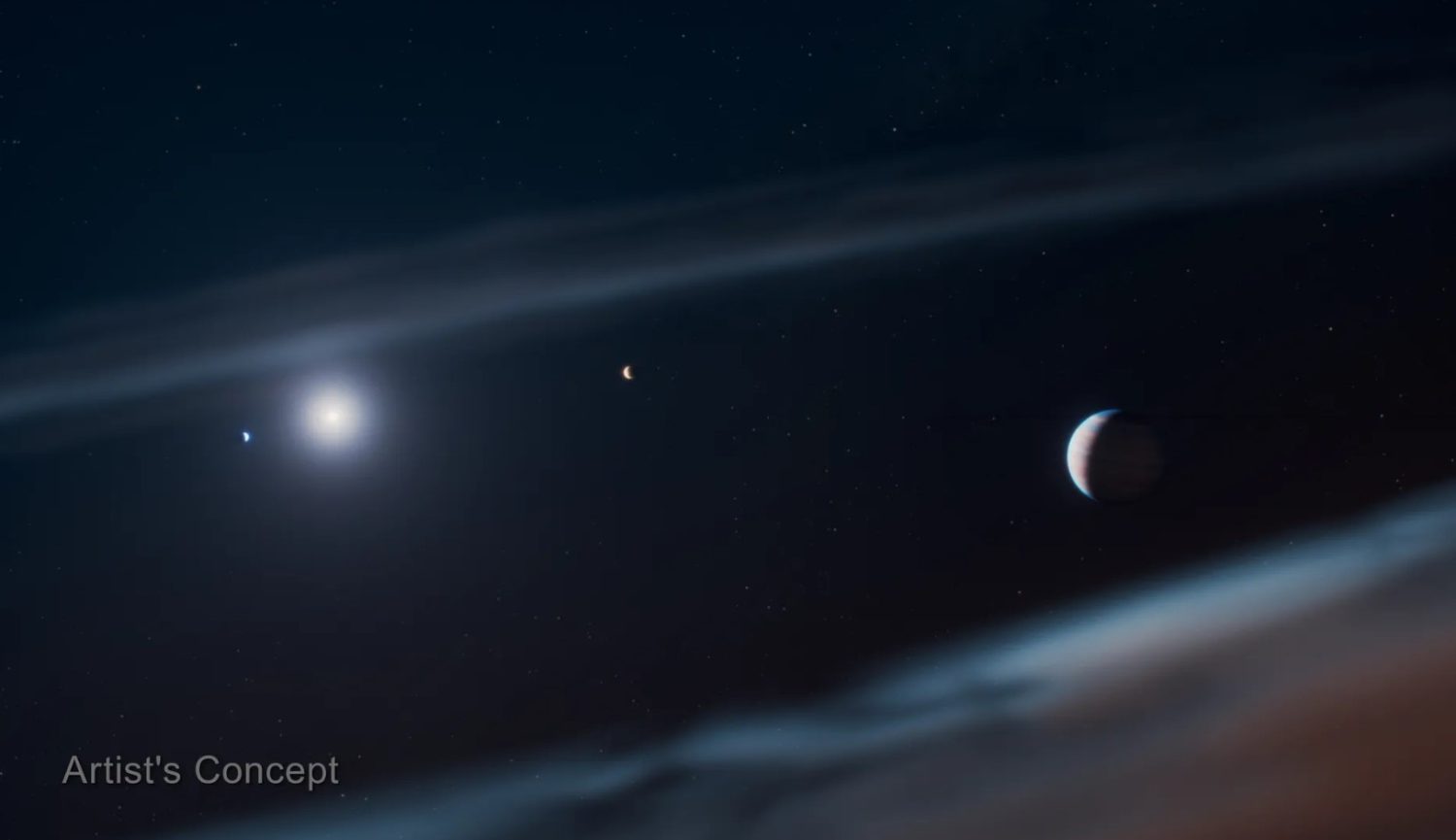
Astronomers may have directly detected auroral radio emission from a planet outside our solar system for the first time. The candidate signal comes from Beta Pictoris b, a young gas giant about 63 light-years away, captured by the MeerKAT radio telescope array in South Africa. The research, led by Kevin N. Ortiz Ceballos and collaborators from the Center for Astrophysics, Harvard and Smithsonian, and the University of Oregon, was published on arXiv on September 15, 2026, and has not yet been peer-reviewed. What MeerKAT heard The detection is based on a distinctive radio signature that physicists recognize as a direct signature of a planetary magnetic field. MeerKAT’s 64 antennas recorded fast, recurring data. bursts and persistent radio emissions in a frequency range of 0.85 to 3.5 gigahertz. The signal showed high circular polarization, consistent with electron cyclotron maser emission: coherent radio waves produced when energetic electrons spiral along magnetic field lines. That process is well understood on Earth and Jupiter, where it drives auroral radio activity similar in principle to the northern lights. There it generates some of the most intense natural radio signals in the solar system. The highest frequency detected implies a minimum magnetic field strength of approximately 1,250 gauss at the emission site. The Earth’s surface field is around 0.5 gauss, while Jupiter’s reaches approximately 14 gauss in its strongest regions. Beta Pictoris b, in this preliminary measurement, eclipses both by a wide margin in the radio emission region. The team’s preprint says directly: “Here we report the first direct detection of auroral radio emission from an exoplanet, the giant planet Beta Pictoris b, with the MeerKAT array.” Radio detections of β Pic b in four observation sessions and in two frequency bands. Full-track integrations of the full intensity (Stokes I, top) and circularly polarized (Stokes V, bottom) images centered on the position of β Pic b after orbital and proper motion propagation are shown. The contours indicate signal-to-noise ratios ranging from 3 to 21, in steps of 3 (dashed contours are negative flux), while red and blue colors indicate positive and negative flux densities, respectively. Negative flux densities in Stokes V indicate leftward circular polarization; in the first observation, the polarization is not constrained and instead we use a grayscale color map (Methods). — [astro-ph.EP]Why this detection is different Locating the emission on the planet rather than its host star is what distinguishes this result from any previous exoplanet radio search. A planetary magnetic field generates a magnetosphere, a region that deflects charged particles flowing from the host star. On Earth, that shield helps keep the atmosphere stable over geologic time, along with gravity, atmospheric chemistry, and other factors. Detecting one around an exoplanet is relevant to long-standing questions about habitability, although Beta Pictoris b itself is a huge hot gas giant with no solid surface. Discovered through direct imaging in 2008, Beta Pictoris b is about 12 times the mass of Jupiter and located about 63 light-years away. It is approximately 20 to 25 million years old, young enough that residual internal heat could be powering an unusually powerful magnetic dynamo. Unlike previous radio searches that yielded ambiguous results or no detections, MeerKAT’s interferometric design allowed the team to spatially separate the planet’s signal from its much brighter host star. That localization is the central distinction between this result and previous attempts. Observations were made through 2025 and early 2026, with follow-up sessions in May 2026. The upper observation limit of 3.5 gigahertz means that the figure of 1,250 gauss is a lower limit in the emission region. It is not a complete map of the planet’s global field. Peer review and independent follow-up observations will determine whether detection is sustained. If confirmed, the result would establish the first direct measurement of magnetic field strength for any planet beyond our solar system. It would also open up a new observational tool for characterizing distant worlds. Extending the method to smaller rocky planets will require much more sensitivity. Their weaker fields and denser atmospheres may eventually demand radio facilities on the far side of the Moon or in space.