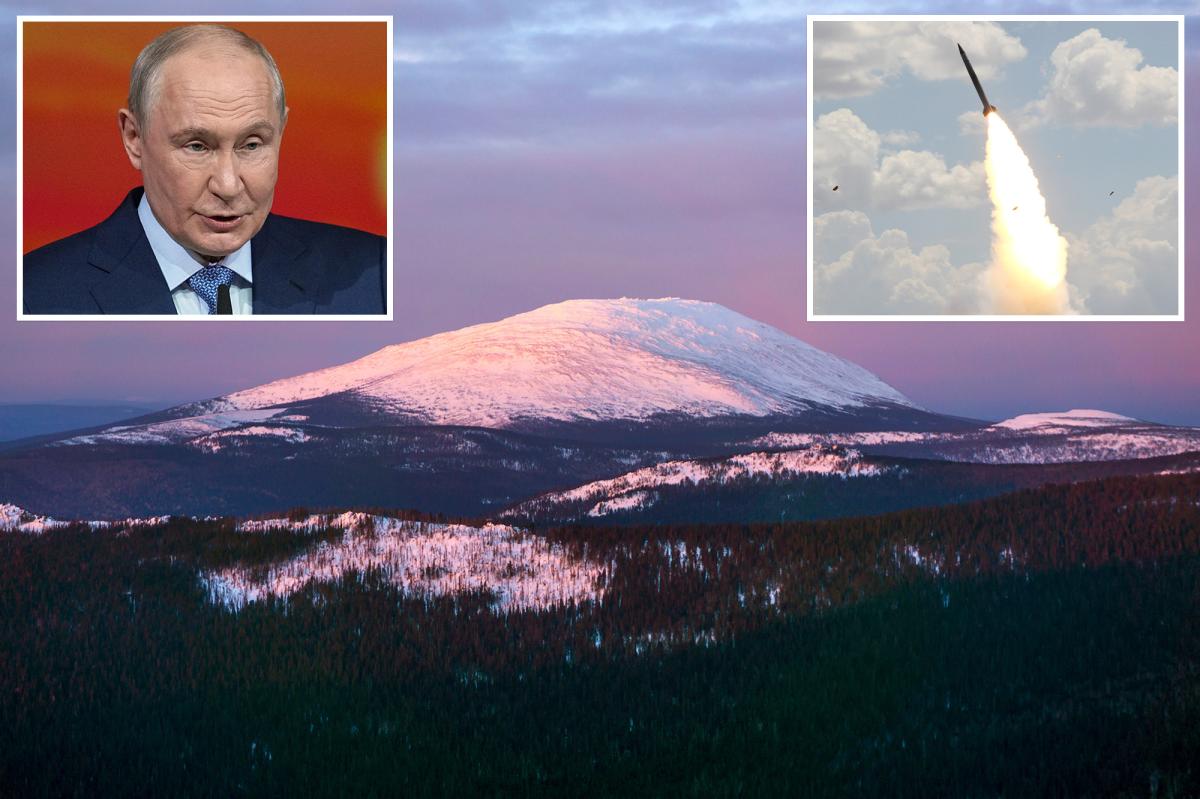
Russian President Vladimir Putin has been quietly upgrading a secret Cold War-era command center deep in a mountain that can withstand American bunker-busting bombs and ensure mutually assured destruction in the event of a nuclear war. A recent investigation into the Kremlin bunker on Kosvinsky Kamen Mountain in the Urals, 800 miles east of Moscow, revealed that the Russian Defense Ministry has been working on a major modernization project at the site since 2018, according to The Sunday Times, Danwatch and Dossier Center. The deep dive included the first images of the interior of the apocalyptic bunker, known as Installation 1335, which included an ominous staging area covered in posters of missiles, explosions and Russian troops. Russian President Vladimir Putin has been upgrading a secret command center beneath the Kosvinsky Kamen mountain. AP Photo/Dmitri Lovetsky Facility 1335 was one of several bomb shelters built across Russia during the Cold War as part of the Kremlin’s perimeter system, known as Dead Hand in the West, which was set up so Moscow’s nuclear forces could be activated no matter what in the event of an atomic war. Kosvinsky Kamen is buried under more than 1,000 feet of solid granite, meaning it is protected from the current US arsenal of bunker-busting penetrating bombs. While little was known about the base since its construction in the 1970s, the new report revealed that the facility has at least 24 underground rooms, with extensive tunnels measuring approximately 1.5 miles away from the entrances. An undated image from inside the tunnels shows a person standing in the massive hallway with no end in sight and tire tracks behind them. Mount Kosvinsky Kamen is home to a Cold War-era base capable of withstanding a nuclear war and America’s most powerful bunker-buster bombs. Evgeny – stock.adobe.com A series of new procurement contracts related to Facility 1335, dated between 2018 and 2024, also suggest that the Kremlin is working to upgrade the facility to withstand a modern war. The contracts included 24,000 tons of steel, more than 62,000 tons of cement, around 600 kilometers of electrical cable, 21 electrical substations, 160 ventilation units, 95 pieces of heavy machinery and 648 drilling tools. Russia has been upgrading its air defense system and testing new long-range missiles linked to its nuclear program in recent years. REUTERS Some of the ventilation units brought in were designed to protect against radioactive dust, and the Kremlin also added new blast-resistant equipment and communication systems to the bunker. Satellite images also revealed repair and construction work on different segments of the bunker, including the construction of new entrances between 2022 and 2025. Start your day with everything you need to know. Morning Report delivers the latest news, videos, photos and more. Thanks for signing up! The equipment being brought in likely means Russia is digging even deeper to expand facilities and bolster its defenses, Tom Roseth, an expert on Russian security policy at the Norwegian Staff College, told The Times. “The expansion of Facility 1335 follows a major upgrade of Russia’s nuclear forces, which has been given high priority within the Russian military,” Roseth said. “The perimeter will take priority again now, in a more tense geopolitical situation in which Russia sees itself in conflict with the West,” he added.