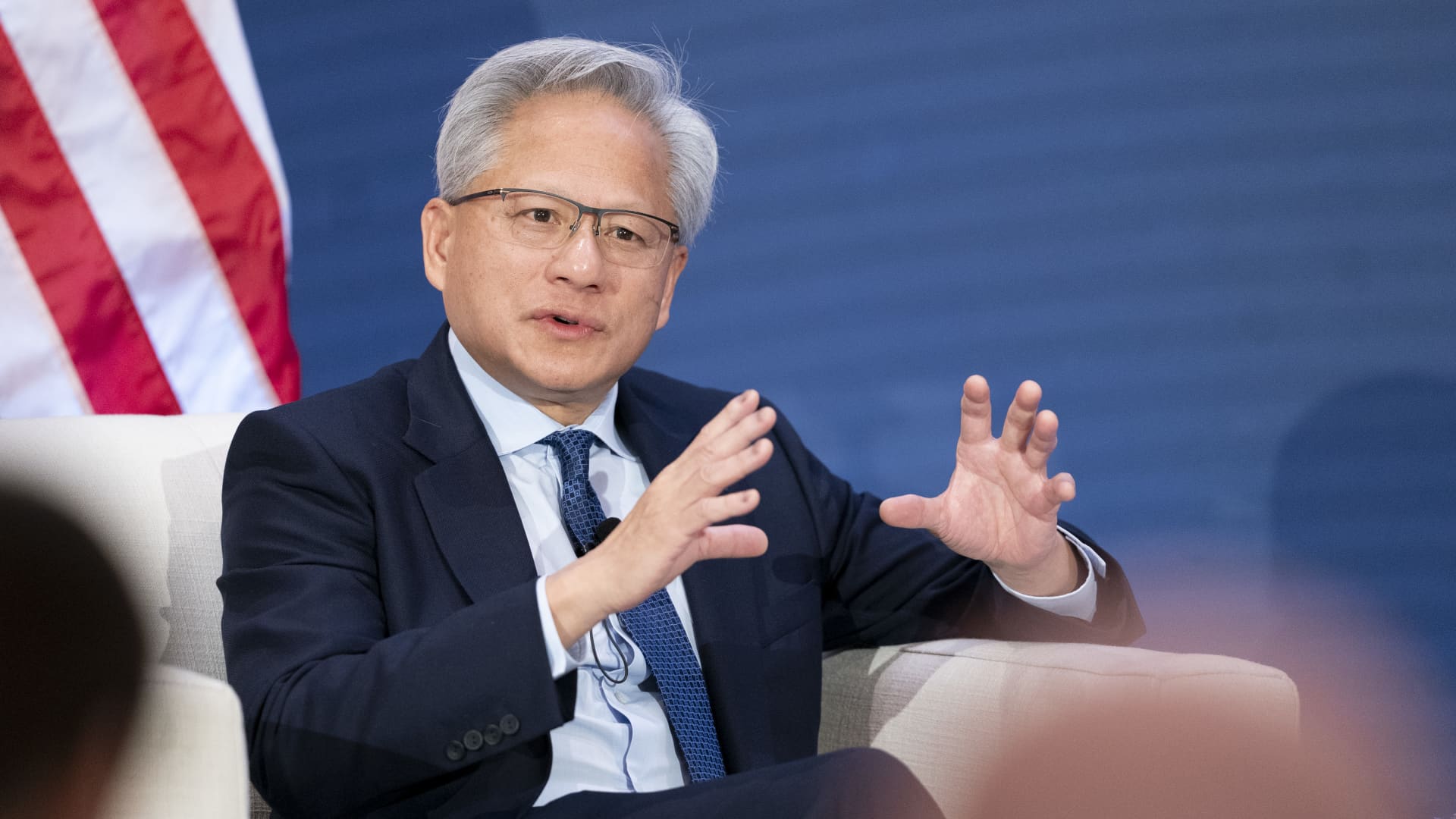
NVIDIA CEO Jensen Huang speaks during the G20 Innovation Ministerial Conference on September 2, 2026 in Chapel Hill, North Carolina. Sean Rayford | Getty Images Nvidia CEO Jensen Huang is putting his company’s money where his mouth is. When the chipmaker announced a record share buyback on Monday, its share price was, by one key metric, at its cheapest level in a decade. Huang told CNBC’s Jim Cramer last month that “buying back Nvidia stock is a tremendous opportunity.” Nvidia’s price-to-earnings ratio for fiscal 2028, which begins next February, stands at just 14.5, below all of its mega-cap peers other than Micron. Its current average P/E ratio over the past five years is 62.9, more than double what it is today. The low multiples for the world’s most valuable company, now worth more than $5.5 trillion, reflect the chipmaker’s historically sustained rate of profitability growth that fueled the artificial intelligence boom. The stock is up 23% this year, outperforming the Nasdaq, but falling short of expected earnings growth. On average, analysts expect Nvidia to reach net income of about $385 billion in fiscal 2028, up 60% from the previous year and more than fivefold in a three-year span. Then, on Monday, Nvidia said it had authorized an additional $150 billion to its stock buyback program. This is in addition to an $80 billion buyback plan announced in May, when the company also increased its quarterly cash dividend to 25 cents per share from 1 cent. The latest buyback is a “clear message” that management thinks its shares are undervalued, Karan Ramchandani, managing director of Post Oak Group, said in an interview. “If you look at the P/E ratio, earnings are growing faster than the share price,” Ramchandani said. “It’s a very healthy mark for a company that sees its own share buybacks as the best investment they could make next year.” Shares rose nearly 2% on Monday, as the company also announced new software and hardware solutions to control AI agents. ‘Growth Value Stocks’Nvidia is ramping up its capital return plans as its revenue and cash flow soar due to demand for the company’s graphics processing units used to build and run artificial intelligence models and services. The company has signaled continued growth through early 2028, telling investors in August that it expects 70% sales growth in its fiscal 2028, implying Nvidia will generate hundreds of billions more in sales than Wall Street had previously forecast. Huang told investors at a Goldman Sachs conference earlier this month that Nvidia was “misunderstood” and suggested it should be valued more for both its growth and its value as measured by future earnings. “We are the world’s first and only growth value stock,” Huang said. “People are trying to figure out who we are. We’re both.” Nvidia previously said it planned to return about half of its free cash flow to investors through buybacks and share repurchases. Its share count could fall 4% if the chipmaker spends all of its current authorization. Stock Chart Icon Stock Chart Icon Nvidia vs Nasdaq This Year “We’re going to generate a lot of cash over the next few years,” Huang said on CNBC’s “Squawk Box” on Monday. “As we generate more cash, we would like to be able to return it to shareholders.” Gene Munster, managing partner at Deepwater Asset Management, told CNBC’s “Fast Money” on Monday that investors seem concerned that growth rates will slow after a monster few years. “It’s really hard for investors to feel comfortable thinking this is going to continue,” Munster said. “That downward slope of the growth rate is the reason it trades at that compressed multiple.” Nvidia’s fiscal 2028 P/E ratio places it behind Apple (35.5), Alphabet (22.6), Microsoft (21.7), and Amazon (23.2), measured over a similar period. It is also less valued than its main rivals in AI data center chips, including Broadcom (18.2), Advanced Micro Devices (38.2) and Intel (54.7). None of Nvidia’s rivals are forecasting 70% sales growth next year. Broadcom’s silicon business is based on the development of custom chips with companies such as OpenAI and Google. AMD competes with Nvidia in GPUs, but with a small fraction of the market share. Intel makes central processors and has dabbled in AI chips, but it doesn’t have a competitive product for Nvidia’s GPUs. Melius Research analyst Ben Reitzes has a buy rating on the stock, saying it “deserves to be higher given its growth rate.” “Buying back shares more and more will really help solve that problem and get a better valuation,” Reitzes told CNBC’s “Closing Bell” on Monday. UBS analysts said in a note on Monday that Nvidia’s increasing share buybacks could add 8 cents per share to the company’s earnings in calendar 2027, which they estimate at $17.16. LOOK: Nvidia shows the market that it has confidence