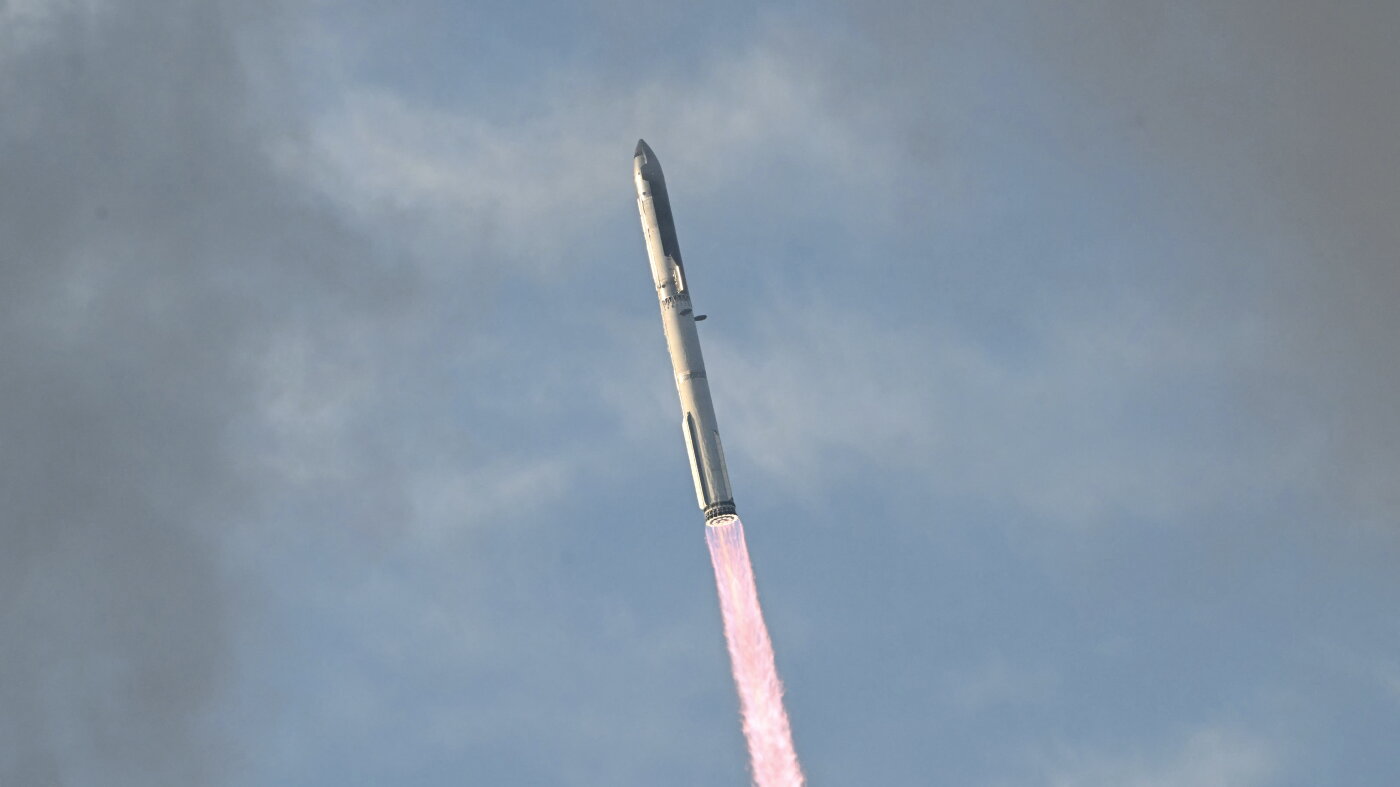
SpaceX Starship Flight 14 launches from Texas on Monday. Flight 14 was the first to send Starship into orbit around Earth and deploy Starlink satellites. Ronaldo Schemidt/AFP via Getty Images hide caption toggle caption Ronaldo Schemidt/AFP via Getty Images SpaceX launched its Starship spacecraft from the company’s Starbase facility in Boca Chica Beach in Texas, in a critical test flight that put the 171-foot-tall vehicle into orbit for the first time. At 7:48 a.m. CT, Starship’s Super Heavy booster ignited its 33 rocket motors to send the spacecraft on its 14th flight. Two and a half minutes after launch, Starship separated from the booster and continued into space. One of Starship’s six engines failed during ascent, leading SpaceX to decide whether to continue in orbit. About 22 minutes into the flight, the team decided it was safe to do so. Super Heavy is designed to be reusable by returning to its launch site, where it is trapped by the launch tower. This booster, however, simulated an offshore landing in the Gulf of Mexico. SpaceX is testing booster software and hardware updates during this flight. There was no one on board for this mission. SpaceX had planned a 10-hour flight that included six orbits around Earth at an altitude of about 170 miles. But after the launch, those responsible for the mission decided to reduce the flight to three hours. Previous Starship flights have been suborbital. Starship 14 is the first time the vehicle has reached orbital speeds: approximately 17,500 mph. SpaceX says the launch profile for this mission included parts that would allow Starship to abort its orbital trajectory and return to Earth safely. During its flight, SpaceX deployed 26 next-generation Starlink V3 satellites in its constellation of thousands of Internet satellites that provide broadband access around the world. SpaceX regularly launches Starlink satellites from Florida and California using its Falcon 9 rocket, but announced the final mission from Florida last month with plans to use Starship from Florida’s Space Coast in the future. Starship splashed down north of Hawaii. In a blog post, SpaceX explained why it decided to shorten the mission. “Out of an abundance of caution given the engine issue experienced during ascent, the flight control team decided to limit the time spent in orbit and proceeded to deorbit Starship to a landing site in the northern Pacific Ocean.” SpaceX is testing key systems of the Starship vehicle, such as its heat shield. Three of those Starlink satellites have cameras installed to capture data about Starship’s heat shield. Surviving reentry is key to SpaceX’s plans for spacecraft reuse. The company is betting on Starship to continue its growth. It is the only spacecraft that can launch the larger V3 version of its Starlink satellites. In its FEC filings ahead of SpaceX’s initial public offering in June, the company underscored Starship’s role in its growth plans. “Any failure or delay in developing Starship at scale or achieving the required launch cadence, reusability and capabilities thereafter would delay or limit our ability to execute our growth strategy,” it reads. Starship is also key to NASA’s plan to return humans to the moon. The agency turned to SpaceX to develop Starship as a human landing system to transport astronauts to the lunar surface for future Artemis missions. NASA plans to test the ability to dock its Orion human space capsule to Starship, along with another commercial lander designed by Blue Origin during Artemis III, scheduled for launch late next year. SpaceX announced plans to build a massive facility in Louisiana, with the goal of launching Starship. The company says the $100 billion investment includes plans for dozens of launch pads with the goal of sending Starship from Starbase, Louisiana, starting in 2029.