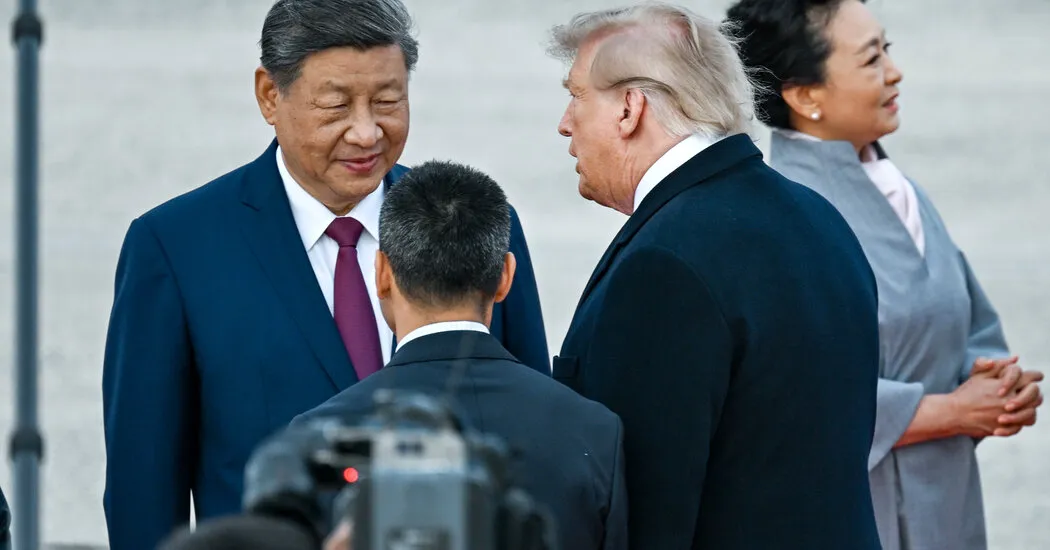
President Trump has asked Xi Jinping, China’s leader, if he would like to buy American weapons, David Perdue, the American ambassador to China, said in a television interview on Sunday. “President Trump keeps saying, ‘Hey, we sell weapons to other people around the world,’” Perdue said on “Fox News Sunday” while discussing Xi’s state visit to Washington last week. “In fact, at one point he asked President Xi if he would like to buy some.” Perdue did not elaborate or reveal Xi’s response. Admitting that the American president offered to sell weapons to China is extraordinary. Most American politicians and lawmakers of both parties consider the communist-ruled nation to be the United States’ greatest military, economic and diplomatic rival, the only real rival to the United States as a superpower. When asked for comment, the White House said through a US official that the United States had no plans to sell weapons to China. The State Department said in a statement that “U.S. law prohibits the sale of weapons to China and there is no offer or plan to sell weapons to China.” The Chinese embassy in Washington did not immediately respond to a request for comment. China has the world’s fastest-growing military, and for decades U.S. officials in every administration, including the current one, have warned of a possible military clash between the two nuclear-armed powers in the Asia-Pacific region, particularly over the island of Taiwan or China’s aggressive actions in territory claimed by U.S. allies in the South and East China Seas. Chinese defense companies, with the approval of the Chinese government, are supporting US adversaries, including Iran and Russia, selling them dual-use equipment and satellite imagery, as well as planning secret arms exports, according to US officials. The United States has imposed sanctions on some Chinese companies. The United States has been the dominant military power in the Asia-Pacific region, but that strength is waning relative to China’s, especially as the Trump administration diverts resources from the region to use in its war against Iran. In recent years, the U.S. defense industry has also struggled to manufacture weapons systems at a pace that U.S. officials consider sufficient for global needs. “If there was any ambiguity about whether President Trump views China as a security threat, this revelation from @USAmbChina Perdue puts the issue to rest,” Ryan Hass, a former career diplomat and White House national security official and director of the China center at the Brookings Institution, wrote on social media. “Trump’s offer to sell weapons to China will be unsettling for American partners on the pointed edge of China’s spear,” he added. Those partners include the Philippines, Japan and Taiwan, the de facto independent island and democracy that the Chinese Communist Party seeks to govern. Trump has been withholding a $14 billion arms sale to Taiwan, even though the U.S. government has been required by law since 1979 to send weapons of a defensive nature to the island. The latest weapons package was put together by State Department officials and approved by congressional leaders earlier this year, but it has languished in the department since then, The New York Times reported. Senators sent a bipartisan letter in May to Trump urging him to move forward with the sales. On Wednesday, hours before Xi arrived in Washington, four Republican senators led by Sen. Mitch McConnell of Kentucky sent a letter to Secretary of State Marco Rubio and Defense Secretary Pete Hegseth asking for the same thing. They also pressured the two men to allocate $300 million in arms purchase aid that Congress had already approved for Taiwan, as well as $1 billion for the Taiwan Security Cooperation Initiative, a U.S. defense program. When a Fox News interviewer asked Perdue on Sunday about widespread concerns regarding withheld arms sales and military aid to Taiwan, Perdue noted that Trump had approved $11 billion in arms sales to Taiwan last year. And he said, “There are ongoing talks about other sales. He and President Xi talk about it every time they meet.” That’s when Perdue said Trump had argued that the United States sells weapons to “other people around the world” and had offered such sales to Xi. China has said that Xi has told Trump that he opposes the United States selling weapons to Taiwan. In May, after leaving a Beijing summit with Xi, Trump told reporters that he had discussed Taiwan arms sales with Xi “in great detail.” Such talks – the existence of which Perdue highlighted in his comments on Sunday – are a violation of a 1982 document in which the United States agreed to expand its support for Taiwan; one of the assurances said Washington “has not agreed to consult with” China on arms sales to Taiwan. When asked in May about that commitment, Trump responded: “Well, I think the 1980s are a long way away. It’s a very, very far distance away.” Trump said he and Xi did not talk much about Taiwan. “Right now, it’s fine,” he said. “It’s just moving forward.” On Sunday, Taiwan’s de facto ambassador to the United States, Alexander Yui, said on CBS News’ “Face the Nation” that he was confident, based on public statements by administration officials last week, that “there is no change in Taiwan’s position for the United States.” However, he added that he hoped Taiwan could obtain the withheld $14 billion arms package “as soon as possible.” On Wednesday, reporters in New York asked Rubio about withholding the Taiwan arms package. He said the sale was being reviewed in light of the need to “balance our industrial capacity and our military-industrial base” and determine whether the United States needed the weapons for itself. It’s unclear how Trump’s offer to sell weapons to China is consistent with that reasoning. Trump said last week that he would meet Xi again in China in November during a regional leadership summit, and that the Chinese leader would return to the United States in December, also for a multilateral summit. Analysts say Trump is unlikely to approve any arms sales to Taiwan before the end of the year, for fear of upsetting Xi ahead of planned meetings.