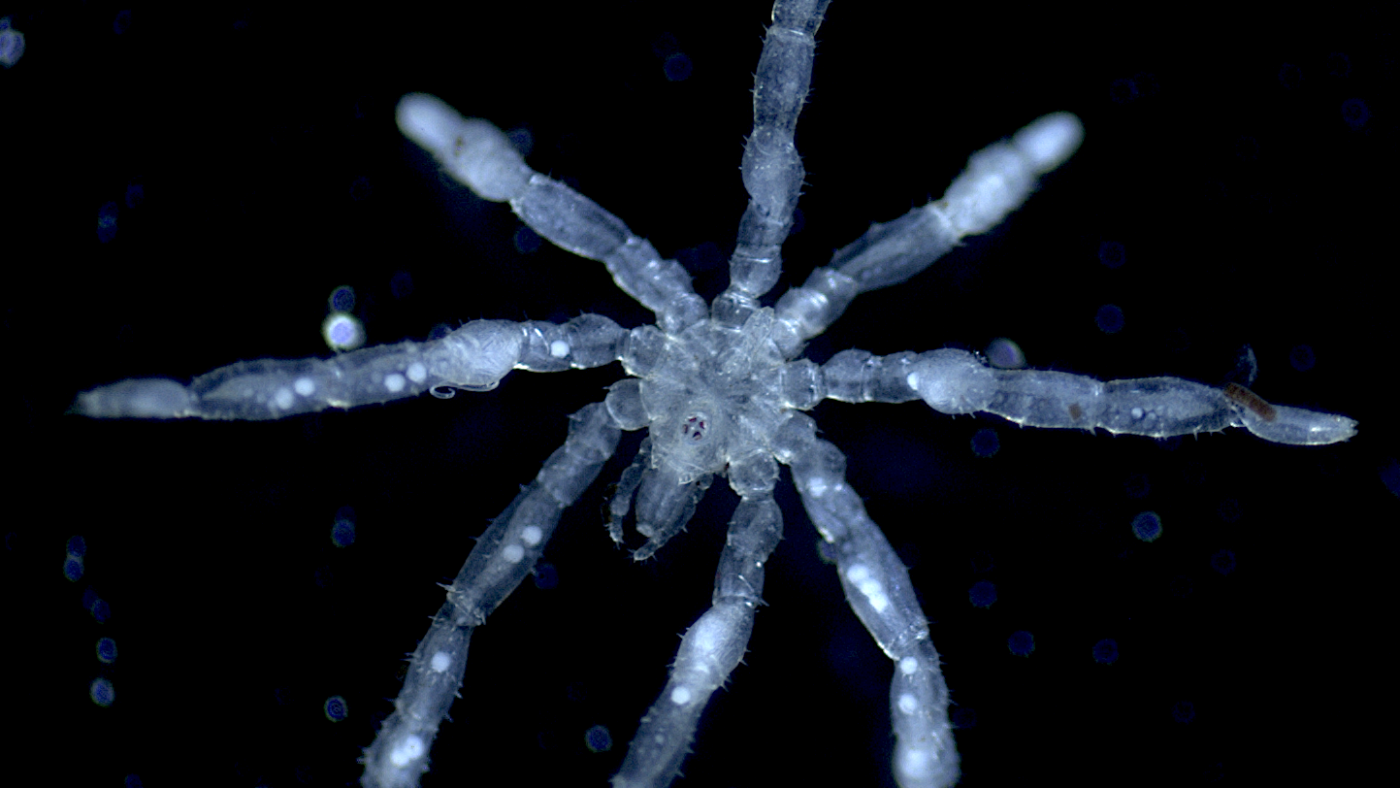
Tanystylum kiixin, a new species of sea spider, with round eggs inside its legs. Cormac Toler-Scott/The University of British Columbia hide caption toggle caption Cormac Toler-Scott/The University of British Columbia Researchers in Canada have discovered two new species that are related to spiders, but you don’t have to worry about them crawling around your living room. The new species is part of the sea spider family and was found in shallow waters of the Salish Sea, between Washington state and the Canadian province of British Columbia. These sea spiders are the first to be found in that area in more than 100 years, according to researchers. The newly discovered species, which measures about a centimeter across, was collected between September 2023 and August 2024 off Vancouver and Quadra Islands in British Columbia. Sea spiders are marine arthropods that are part of a class called Pycnogonida. Scientists have discovered more than 1,300 species of sea spiders. Cormac Toler-Scott, lead researcher on the University of British Columbia team that discovered the new species, told NPR that some sea spiders not only look like land spiders with eight legs, but are also related to them. However, sea creatures differ from land spiders in several ways. “They never made that transition to land,” Toler-Scott said. “They really need to be in the water. They move pretty slowly. They just crawl along the seafloor.” One of the new species of sea spiders, called Callipallene pilosuspedes, has red eyes, a three-lipped, triangle-shaped mouth and a curved spine covering its legs. They also have limbs coming out of their belly called ovigers that they can use to groom themselves and remove dirt and algae. “They are very clean and not all sea spiders can do this,” he said. Callipallene pilosuspedes, another recently discovered species of sea spider. Cormac Toler-Scott/University of British Columbia hide caption toggle caption Cormac Toler-Scott/University of British Columbia The other recently discovered species, Tanystylum kiixin, named after an ancient indigenous village near where it was found, has shorter, stockier legs extending from its chest. These cannot be used to clean themselves. The Tanystylum kiixin was covered in dirt and debris when he found it, Toler-Scott said. Sea spiders also reproduce differently than those that live on land. While the females develop the eggs, the males take on the responsibility of caring for them until they hatch. And when it comes to food, sea spiders don’t make a web and eat like a land spider. The newly found sea spiders were found attached to a hydroid, a marine animal that looks like a plant and lives in colonies. They feed on the hydroids like a parasite. “They both live and feed on it, they walk through it like it’s a maze, and they just make a hole in the hydroid and then suck out its juices, like the cells of the hydroid. That’s how they get their food,” Toler-Scott explained. Sea spiders have no venom or fangs, and the newly discovered species rely primarily on camouflage to avoid being eaten. Many sea spiders, including newly discovered ones, are transparent and take on the color of whatever they have eaten, he said. “Finding new species is everyone’s dream, but it’s pretty rare,” Toler-Scott said. “It’s hard to get funding for this kind of work because you do it without really knowing what you’re going to get.” With additional dives planned, British Columbia researchers hope to find more species of sea spiders in the future.