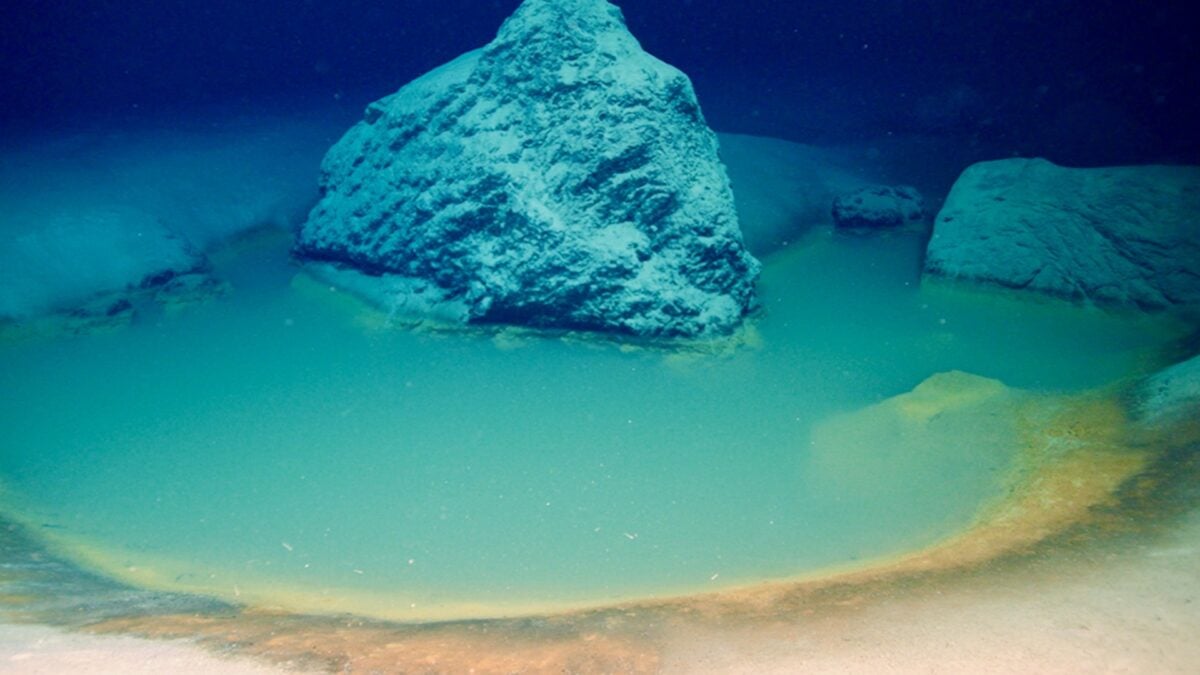
Marine ecologists used to call them “black puddles of death.” Just a decade ago, blue-green deep-sea brine pools were assumed to be oxygen-depleting dead zones, despite the wealth of deeply strange and extraterrestrial “extremophiles” that biologists have found living at their margins. But something was alive inside these phenomenally salty underwater lakes, and now researchers have found evidence of a once-active brine pool whose remains may explain how some of Earth’s earliest primordial life forms survived in the eons before oxygen gas became abundant. According to their new study, conducted with scientists aboard the research vessel (R/V) OceanXplorer, these even more extreme Extremophiles managed to make this now “extinct” brine pool in the Red Sea their home approximately 2,000 to 16,000 years ago. Species like these, as the team wrote in their study for AGU Advances, may have been “an early mechanism for energy production in the event leading up to the Great Earth Oxidation Event.” In other words, these microbes may have set the stage for the colossal flood of oxygen that burst into Earth’s atmosphere from its oceans between 2.4 and 2.1 billion years ago. These Extremophiles, including new forms of “slime bacteria” from the phylum Myxococcota and the no less disgusting genus Nitrospira, also appear to oxidize free-floating manganese and iron in minerals, offering “a rare glimpse into how early life on Earth may have worked” and a valuable clue to locating more extinct brine pools. Deep brackish Morgan Chakraborty, a doctoral candidate in marine geosciences at the University of Miami’s Rosenstiel School of Marine, Atmospheric and Earth Sciences, worked with her advisor Professor Sam Purkis, her academic colleagues and the nonprofit OceanX on the new study. OceanX’s R/V OceanXplorer, as well as its remotely operated vehicle (ROV) Mariner XL Argus, conducted three expeditions to investigate five brine pools between 2020 and 2023. Two of these sites proved to be the most useful for this study: one was an active deep-water brine pool, named “NEOM,” in the Gulf of Aqaba off the northern edge of the Red Sea, between Israel, Saudi Arabia, Jordan and Egypt. about 5,807 feet (1,770 meters) below sea level. The other was the so-called Hume’s Pond, 1,370 meters (4,495 feet) deep in the northern rift of the Red Sea. “Like the NEOM pool, this site has all the characteristics of an active brine pool,” wrote Chakraborty, Purkis and their co-authors. Hume’s seafloor depression included sedimentary layers rich in calcium carbonate skeletons of small multicellular metazoans, as well as a radically discolored “beach”, directly similar to the brightly colored microbial zones surrounding the NEOM pool.” “The only component missing from this site is the brine itself. […] Therefore, we consider our second ‘Hume Deep’ site to be an extinct pond,” the researchers said. Salty Characters You may now be realizing why this was a project led by marine geoscientists and not marine biologists. Chakraborty, Purkis and their collaborators collected samples of sediment mixed with organic matter from both Hume and the NEOM brine pond. In the case of Hume, they included echinoderm skeletons and other tiny fossils. In the case of NEOM, they displayed “Taken together, our data suggest that similar processes are likely to have occurred. “In other ancient salt giant basins,” the researchers wrote. But the researchers also performed geochemical analyzes and found that sediments in the brine pools were subsequently rich in metallic elements, including manganese, iron, molybdenum and copper, sometimes in concentrations more than 100 times higher than sediments outside these brine pools. The team now believes that these microbes may also be natural accumulators of certain precious metals. “[Many] “Many of these metals are essential for clean energy technologies, and understanding how they accumulate could help guide future resource exploration,” the researchers explained.