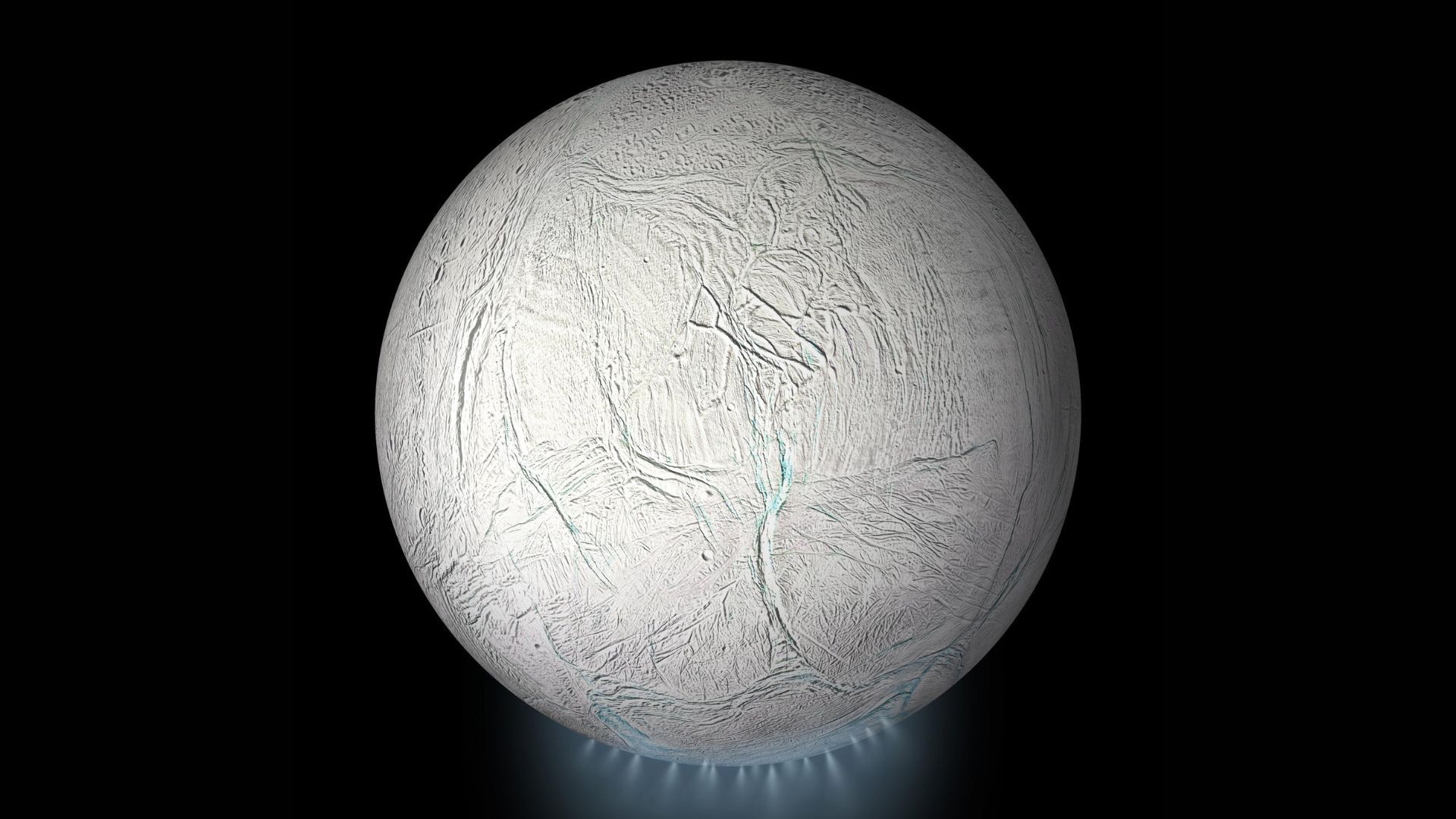
In the enduring search for life in the universe, new evidence is pointing researchers toward Saturn’s moon Enceladus. Enceladus is Saturn’s sixth largest moon with a diameter roughly equal to the width of Arizona, and is believed to have a huge underground ocean that spews columns of water into space. Enceladus, one of 145 known moons around the planet, has intrigued scientists searching for extraterrestrial life in our solar system. And, according to new research, they might be looking in the right place. New evidence from multiple new papers suggests that microscopic life could survive in Enceladus’s ocean and that the planet’s plumes essentially “organize” the compounds and minerals within it. What this means is that it might be easier than previously thought to explore what’s in the Moon’s ocean. “This is great news in the search for life,” Frank Postberg, lead author of one and co-author of the other of these new studies and professor at the Freie Universität Berlin, said in a statement. “Future spacecraft will have to analyze many individual ice particles in the plume. But if they find one that contains microbial material, they could identify biosignatures on the particle relatively easily with the technology already available.” Samples prepared by planets Enceladus is not the only place in our solar system with water; So why is it so exciting in the search for life? Well, it has to do with the seabed of its extensive liquid ocean. Deep within this body of water, scientists believe hydrothermal processes, or movements or reactions with hot water beneath the surface, are occurring. The plumes rising from the ocean also contain traces of salts and organic compounds. NASA’s Cassini spacecraft found these traces when it passed through the plumes more than a decade ago. Between hydrothermal activity and organic and mineral compounds in the water, this moon’s ocean has a number of aspects that could be involved in supporting life. What’s more, using a combination of Cassini data, theoretical models and laboratory experimentation, in Postberg’s new study the team found that water droplets from the plume shooting into space at up to 621 miles per hour (1,000 kilometers per hour) do not freeze as quickly as expected. Previously, scientists thought that freezing would occur instantly once the droplets reached space, but Postberg and his fellow researchers say they found that freezing would actually occur much more slowly. They also discovered that during this freezing process, the salt, organic compounds (and perhaps possible signs of life) in the water droplets separate from each other. Not only that, but the team says that as the particles are launched into space, they should often collide with icy cracks on the planet’s surface. Ultimately, this would leave small fragments of frozen droplets with individually separated components. Essentially, it’s as if the planet has organized its ocean ingredients into tiny fragments of frozen particles. “Enceladus actually does a lot of the work for us in preparing samples for analyzes that typically require a lot of effort in chemical laboratories on Earth,” Postberg said in the same statement. “The ocean components are separated from each other and simultaneously concentrated into individual ice particles.” Looking ahead, researchers could, in theory, take advantage of this knowledge to more easily collect samples from the planet. With Enceladus-bound missions like the European Space Agency’s L4 in development, we could learn more about what’s in Enceladus’s oceans (and whether there’s life) sooner rather than later. What to read next Creating Enceladus in a lab While we wait to see if future spacecraft are able to collect frozen droplet fragments from Enceladus’s ocean, researchers in another study replicated the conditions of the moon’s ocean in a lab and tested how well it supported life. While we don’t know everything about this ocean, and the mystery remains whether or not it contains life, or even the ingredients to support life, from previous observations with missions like Cassini, we do know something. things. For example, we know that the ocean is quite basic and alkaline, has very little oxygen, and hosts a lot of carbonates and hydrothermal activity. The team of researchers in this second article included all these elements to create a mini ocean of Enceladus in a laboratory. And to see if life could survive in Enceladus’ fake ocean, the crew added a microscopic species to the mix: Methanothermococcus okinawensis. On Earth, this microbe is often found near hydrothermal vents. Furthermore, the species does not need oxygen (it depends on hydrogen and carbon dioxide). It was a very reasonable choice of species to introduce, as Enceladus also has hydrothermal activity and very little oxygen. The group of microbes actually did well in Enceladus’ false ocean, growing and absorbing hydrogen from the environment. In fact, even though there wasn’t much carbon dioxide in the tank, the microbes persisted and adapted to the conditions relatively quickly. “This was really a surprise to us,” study collaborator Nozair Khawaja, a planetary scientist at the Free University of Berlin, said in the same statement. “This was an experiment from which we did not expect such a successful result.” Between this study showing that life can be sustained in an environment similar to Enceladus’s ocean and the other study showing how easily future spacecraft could examine samples from the planet, these new results give scientists hope for the continued search for life on this moon. “On Enceladus, specific geochemical conditions could allow one of the oldest known metabolic systems on Earth to function, even in very alkaline environments,” Postberg said. “While that doesn’t mean there is life on Saturn’s moon, our first study shows that if there is, future space missions could have a good chance of finding traces of it by analyzing individual ice grains from Enceladus’ plume.” This work is described in two new studies published in the journal Science Advances here and here.