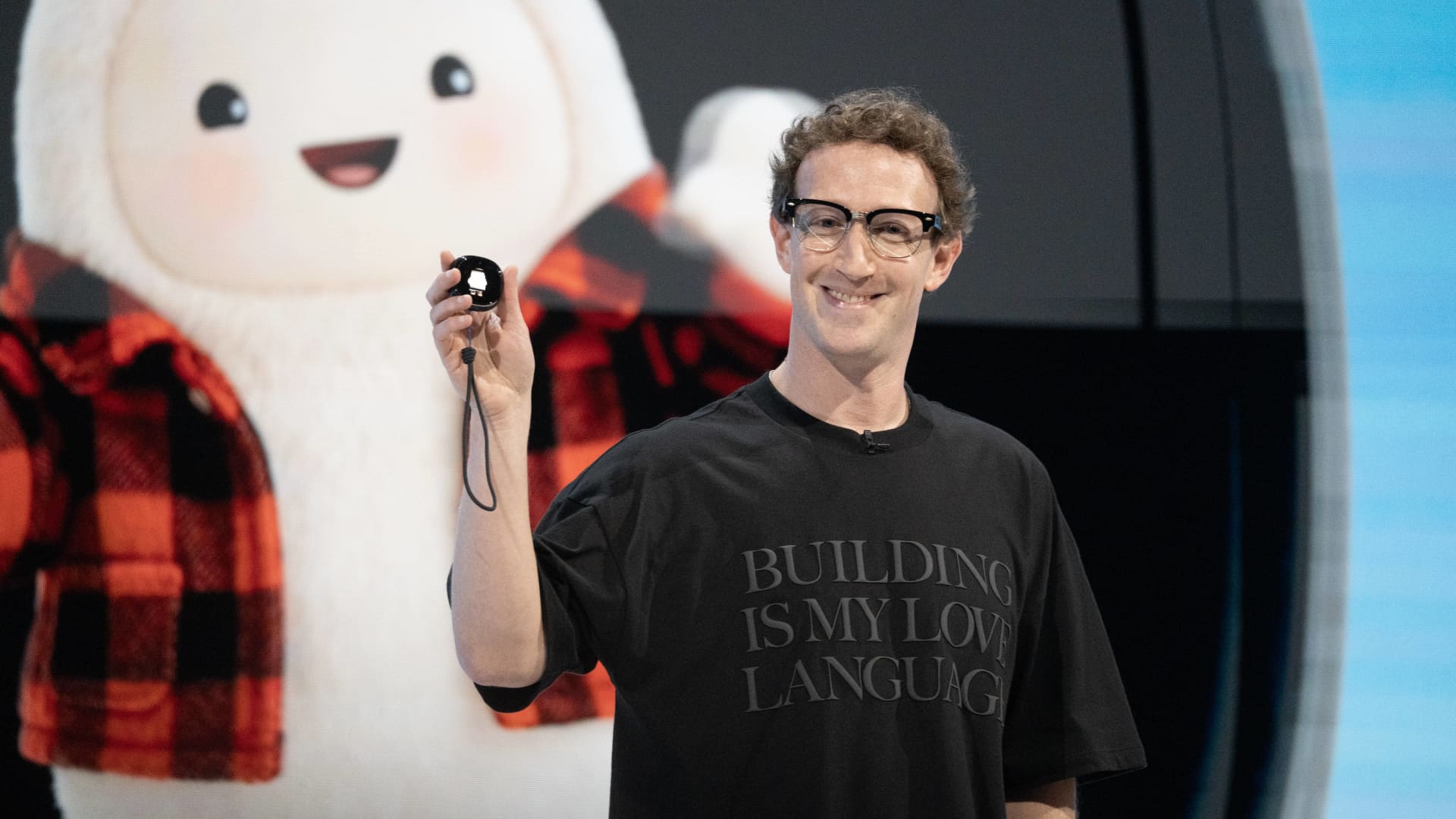
Meta CEO Mark Zuckerberg has long been determined to own the hardware that consumers use to access his company’s applications. As he strives to make the Muse AI agent the “centerpiece” of Meta’s AI strategy, he has a host of future devices to turn his dream into a reality. At Meta’s annual Connect conference, which took place a week before OpenAI’s big developer event, the company said that by the end of 2026, “there will be over 100 styles of AI glasses,” and Zuckerberg on Wednesday revealed a pendant called the Muse Charm, though he didn’t offer a price. Meta was late to the generative AI game, far behind OpenAI, Anthropic and Google, which have popular AI models and a number of services used by consumers and businesses. Zuckerberg is trying to make up for lost time with Muse, an app that can act as a personal assistant, answering emails, booking trips and shopping on a user’s behalf. Investors are buying, sending the stock up 4.5% on Thursday and up more than 25% since Meta announced Muse earlier this month. They’re betting that while Zuckerberg never found a big market for virtual reality after renaming his company Meta five years ago and shifting his strategy to the metaverse, he’s now on the right track. “Meta Connect 2026 more explicitly attached Muse AI as a killer application fused deep into the hardware strategy, starting with AR glasses and extending to Muse Charm, a dedicated keychain-like device that provides quick access to Muse,” Mizuho analysts wrote in a report Thursday. The firm, which recommends buying the stock, said advances in Meta’s AI will continue to “drive a multiple expansion of Meta’s stock.” The Muse Charm resembles a cross between a child’s Tamagotchi keychain and a portable medical bell. Zuckerberg said Meta still needs to finalize the “finishing material” and “design the components” to have it ready to ship during the holidays. As OpenAI, the creator of ChatGPT, prepares for its DevDay conference next week, expectations have risen that Sam Altman’s company may show off its long-awaited hardware product, which will reportedly be a hockey puck-like speaker. OpenAI did not respond to a request for comment. To get ahead of OpenAI, Zuckerberg is riding the momentum of Muse, which shot to the top of Apple’s App Store, eclipsing ChatGPT. Meanwhile, OpenAI and Anthropic are grappling with growing concerns about their market-leading AI models, as critics and company executives sound the alarm about potential harm to humanity. Leaving Apple For Zuckerberg, Muse Charm is just his latest hardware effort as he tries to end his company’s dependence on Apple for distribution. It’s been a particularly complicated issue since Apple changed its privacy policy in 2021, limiting app developers’ ability to target users with ads. Meta has had some success in smart glasses through a partnership with Ray-Ban parent EssilorLuxottica. The company said Wednesday that in the coming months it will add Muse to its smart glasses, offering “hands-free access, activated by saying your agent’s name.” Meta also introduced Meta VR Glasses, which are thinner and lighter than the older Quest-branded VR glasses, but they’re also more expensive, costing $1,299 when they go on sale next year. It’s Meta’s first VR device since 2024, when the company introduced the $299 Quest 3S. The pendant represents an entirely new category of device, but many experts say there is no clear sense of market demand given the ubiquity and capability of smartphones. Zuckerberg said it will contain a fingerprint sensor that, when activated, allows people to talk to its artificial intelligence agent. “Why would I carry another device?” said Anthony Ferry, CEO of e-commerce company Wayvia, in an interview after watching the Connect presentation. To be valuable, it has to be “easier than using my phone,” he said, adding that “if I still have to pull out my phone to finish work or fix the order, it’s just another thing to carry.” Anshika Jain, an analyst at Counterpoint Research, said she can see the appeal. “Meta’s Muse Charm reflects a broader shift in how consumers can interact with AI in real time, with a more convenient and simpler interface for everyday life,” Jain said in an email. “At the center is the Muse AI agent, which is designed to understand context and take actions more quickly rather than simply responding to queries.”Thomas Fuller | Light rocket | Getty Images Jain said Muse Charm could find “use cases like asking questions, getting reminders, planning, or accessing information while on the go.” In addition to proving that Muse’s sudden emergence is not just a fad, Zuckerberg also needs to find a viable economic model for the AI agent. Amazon blocked Meta’s Muse from scanning its site to purchase on behalf of customers, following similar actions against Perplexity, OpenAI and Google. Zuckerberg said he hopes that “over time we will benefit from charging a small fee for transactions.” Ferry said companies “will need to look at whether this is actually growing their business” and not just benefiting Meta’s bottom line. “If it brings you a client you wouldn’t have contacted, great,” Ferry said. “But if the same customer buys the same product through another channel, that’s not automatically a new sale. You have to understand what it costs and if you’re getting additional business for that money.” William Blair analyst Ralph Schackart wrote in a report Thursday that “Meta outlined a clear monetization framework, and the company expects to generate revenue primarily by charging a small fee for transactions completed through Muse while keeping the product free for most users.”