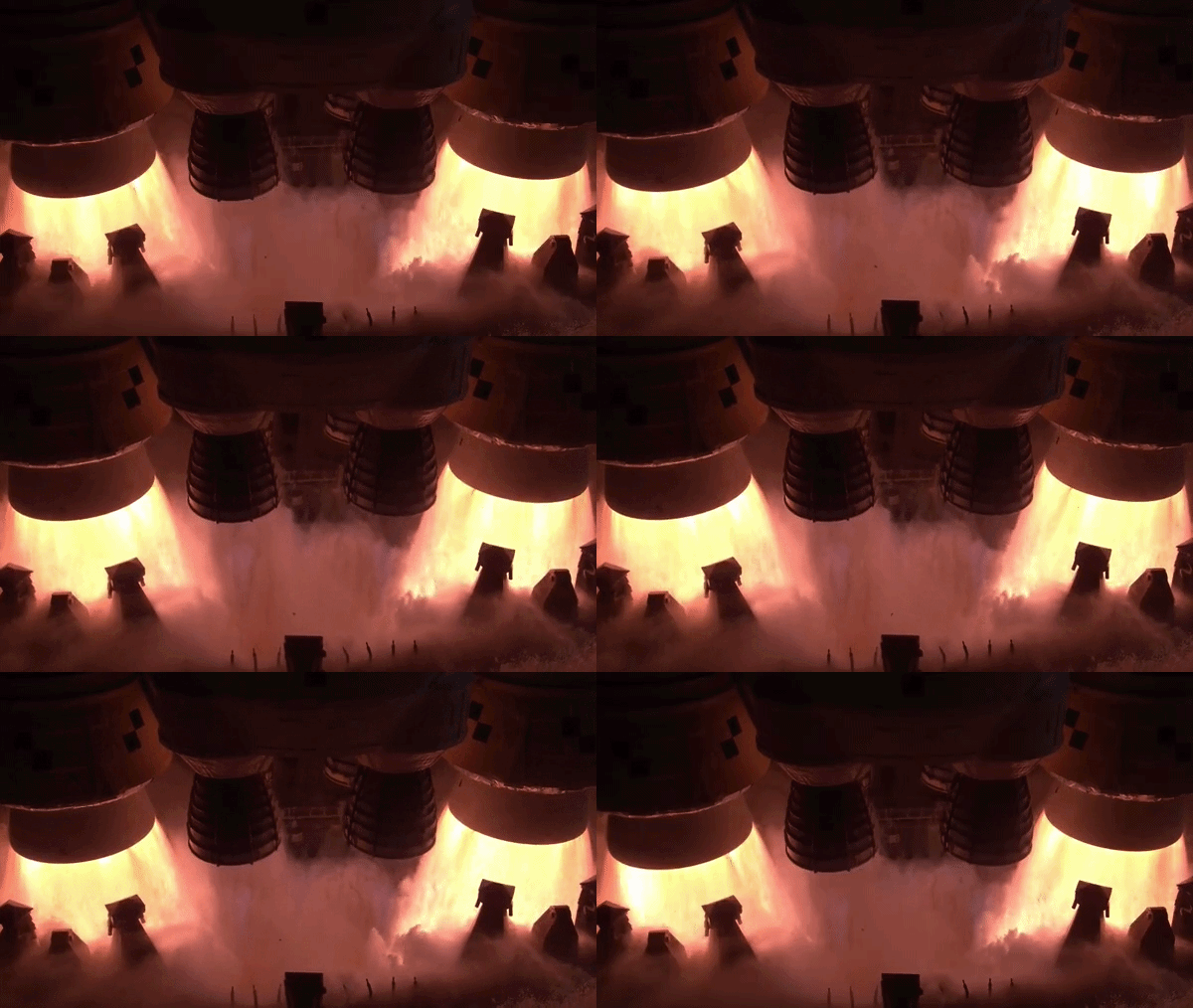
In case you’re feeling the void of Moon missions, empty since the return of the Artemis II astronauts from their trip around the far side of the Moon six months ago, NASA has you covered. The agency’s Space Launch System (SLS) rocket launched Artemis II on April 1, carrying a crew of four on the first mission around the Moon since the Apollo program ended in 1972. The SLS lifted off from Launch Complex-39B at NASA’s Kennedy Space Center (KSC) in Florida and, to the amazement of hundreds of thousands, climbed into the bright blue evening sky on a trail of smoke left by the boosters. solid rocket vehicle into space. More than 300,000 people traveled to the Space Coast to watch the launch from dozens of locations around KSC and surrounding cities. But the best views wouldn’t be seen until long after the rocket cleared the pad, when NASA technicians recovered a trove of engineering images captured by dozens of specialized cameras spread everywhere, from the base of the launch pad to drones placed in the air to track every detail of the launch. Now, NASA has made those images public. NASA’s Space Launch System rocket lifts off on the Artemis II mission on April 1, 2026. (Image credit: Josh Dinner) The newly released videos include a wide spectrum (literally) of views and angles following the SLS from just before engine ignition to separation of the solid rocket propellant as the rocket leaves Earth’s atmosphere. NASA teams used Scientifically Calibrated In-Flight Imaging (SCIFLI) to compile images ranging from the visible light spectrum to shortwave infrared (SWIR), near infrared (NIR), midwave infrared (MWIR), and infrared, to give you some useful acronyms for context as you follow these videos in NASA’s Artemis II album. These different wavelengths of light captured views imperceptible to the eye and typical camera sensors, and allowed NASA technicians to filter out things like the extreme brightness of the rocket engine flames. Artemis II was the first crewed mission of NASA’s Artemis program, which aims to establish a permanent base on the surface of the moon in the 2030s. It was also the first flight of NASA’s Orion spacecraft with astronauts on board. Essentially a test cruise for Orion’s life support systems, the mission took NASA astronauts Reid Wiseman, Victor Glover and Christina Koch, as well as Canadian astronaut Jeremy Hansen on a 10-day flight around the Moon and back to Earth. You may like The next mission in NASA’s lunar lineup, Artemis III, will last longer, but it won’t fly as far. Artemis III is scheduled to launch in mid-2027 with NASA astronauts Randy Bresnik, Frank Rubio and Andrew Douglas, as well as European Space Agency (ESA) astronaut Luca Parmitano of Italy. They will launch aboard Orion into Earth orbit, where their spacecraft will rendezvous with the two commercial lunar landers NASA has contracted for the Artemis program, SpaceX’s Starship and Blue Origin’s Blue Moon. Artemis III is expected to last about two weeks, as Orion will meet and dock with each lander separately to test the spacecraft’s interoperability. That mission will serve as a precursor to the program’s first real lunar landing with astronauts on Artemis IV, which NASA aims to launch in 2028.