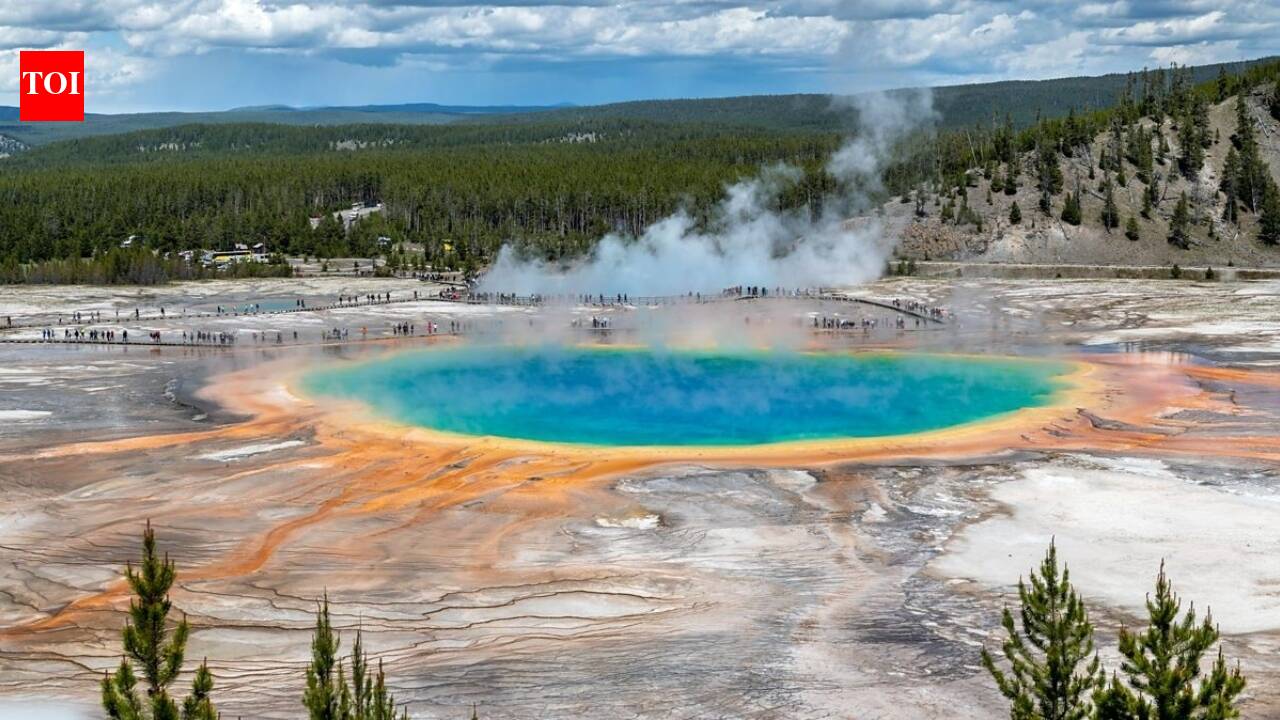
Can a volcano cause the end of humanity? What would happen if the Yellowstone supervolcano erupted now? What if Yellowstone suddenly went from bubbling geysers and spectacular landscapes to the site of one of the largest volcanic eruptions in human history? Yellowstone National Park in the United States of America may be famous for its geysers and wild beauty, but for some scientists and disaster thinkers, it is also the scene of one of the biggest “what ifs?” scenarios that exist. Imagine if, right now, the calm of Yellowstone were shattered by a massive supervolcano eruption. What would it really do to the park, to America, and to the world? The short version: It would be a disaster on a scale most of us can barely imagine. Before divulging, it’s important to first establish that this is a hypothetical worst-case scenario, not a warning that Yellowstone is about to erupt. A recent report published by Phys.org, based on analysis by disaster researchers Ilan Kelman and Matthew Blackett for The Conversation, imagines what could happen if Yellowstone experienced a large-scale supereruption today. The scenario draws on previous volcanic research and disasters to create a possible “T-minus” timeline. In reality, the Yellowstone Volcano Observatory is currently reporting a NORMAL volcanic alert status and an aviation color code GREEN. Its September 2026 update recorded 61 localized earthquakes in August, the largest of which had a magnitude of 2.0, while ground deformation remained at background levels. So what would happen if the nightmare scenario really played out? Two months earlier: Yellowstone begins sending unusual signals. If Yellowstone really started accelerating toward eruption, we’d probably get a warning signal within a couple of months. The scene: Scientists begin to detect earthquake swarms beneath the park. It’s not that strange, since Yellowstone experiences thousands of minor earthquakes each year, but they are different. They get stronger, group together and become shallower. The ground begins to bulge. Volcanic gases creep upward. Perhaps the geysers act strangely or new hot springs appear. Suddenly, emergency planners step in and update evacuation plans, while volcanologists rush to pinpoint what’s happening. Importantly, the U.S. Geological Survey says that a swarm of earthquakes, a deformation of the ground, or a change in gas emissions individually do not mean an eruption is coming. Scientists would be much more concerned if several unusual signals appeared together and intensified rapidly. Two weeks before: the evacuation begins. If, a couple of weeks after Doomsday, things continue to escalate with stronger, shallower earthquakes and the land rising faster, officials would probably pull the plug on everyone who lives, works or vacations in the Yellowstone region. Imagine evacuating everyone within a 100 kilometer radius: almost 200,000 lives disrupted, plus thousands of tourists. Airspace is cordoned off so planes avoid the threat of ash. This would be a huge logistical challenge. Evacuations would involve finding shelter, food, water, electricity, transportation and medical care for large populations, while neighboring regions and countries dealt with their own preparations. The day of the eruption: the first explosions The day of the eruption itself might not seem like a Hollywood explosion, at least not at first. Instead, the first violence could occur when rising magma encounters the park’s pressurized groundwater systems. The water quickly turns to steam, breaking up the earth with steam, rocks and mud. This is just the opening act. Shortly thereafter, as pressure drops, the gas-laden molten rock (magma) explodes upward and turns into fine ash and pumice. The ash cloud would shoot up: perhaps 30 to 50 kilometers into the sky. It is so high that it dwarfs the altitudes of commercial air traffic. In a matter of hours: pyroclastic flows and ash Now, a supereruption would not just be a local problem. Within hours, fast-moving pyroclastic flows—incredibly hot, choking clouds of rock, ash, and toxic gases—could sweep across huge swathes near Yellowstone, destroying everything in their path. According to the USGS, these flows would be mainly concentrated in Wyoming, Montana and Idaho, all areas closest to the heart of the supervolcano. Meanwhile, the ash plume from the eruption would catch high-altitude winds and begin to spread. Three days later: the ashes become a national crisis. A few days later, the layer of ashes becomes a national crisis. A USGS model estimates that a supereruption that ejected 330 cubic kilometers of material would create a deep layer of ash, sometimes a meter thick, across the Northern Rockies and accumulate in cities such as Billings, Salt Lake City and Boise. Further afield (the Midwest, the coasts) would still receive centimeters or millimeters of ash, enough to wreck cars, clog engines, cut power lines and contaminate drinking water. Planes would be grounded in entire states, perhaps more. Weeks later: Food, transportation and infrastructure come under pressure. Weeks after the crisis, the country would begin to encounter new obstacles. Roads, tracks and railway routes would be drowned in ash. No flights, no trucks, no trains that arrive on time. Farmers would rush to save crops wilting under the unforgiving, sandy blanket. Livestock would need clean water. Supply chains would struggle to transport food, fuel and medical supplies, while shortages could extend far beyond the areas directly covered by the ash. Months later: the rash fades, but the crisis does not. Months later, the eruption itself subsides, but the chaos is far from over. Fine ash does not stay still; The winds pick it up, creating a dirty, choking haze that makes breathing difficult, especially for anyone with asthma or lung problems. The rain would transform ash deposits into sticky sludge, blocking storm drains and flooding streets. Even international trade is beginning to feel the consequences when the United States, a wheat and corn superpower, sees much of its harvest destroyed. Years later: global cooling But probably the most lasting shock wave comes from what the eruption would affect the global climate. The sulfur dioxide released by the volcano rises into the atmosphere, where it is converted into sulfate aerosols. This material reflects sunlight, which means colder temperatures around the world. This is not an “instant ice age,” but true global cooling: perhaps around 1.5°C on average, according to some models. That doesn’t seem like much until you realize that some areas (or agricultural seasons) could be hit much harder, leading to worldwide food shortages and sharp price increases. It would take years, or perhaps decades, for the planet to fully recover. Would this end humanity? Honestly, no. The Yellowstone supereruption is a civilization-scale disaster, but it is not a doomsday device. The USGS is clear: the chances of another large caldera-forming explosion occurring in the next few millennia are extremely small, and Yellowstone has no fixed eruption schedule. If the volcano were to erupt again anytime soon, a slower-moving lava flow is actually the most likely scenario, and that would be a challenge, but nothing close to a global catastrophe. The final result? While Hollywood loves the “supervolcano apocalypse,” what is more likely (and what science shows) is less catastrophic. Yellowstone remains calm for now and if that changes we will get some warning. The site will remain under a microscope, and for good reason, but for now, geysers and hot springs are far more dangerous to selfie-taking tourists than to humanity as a whole.