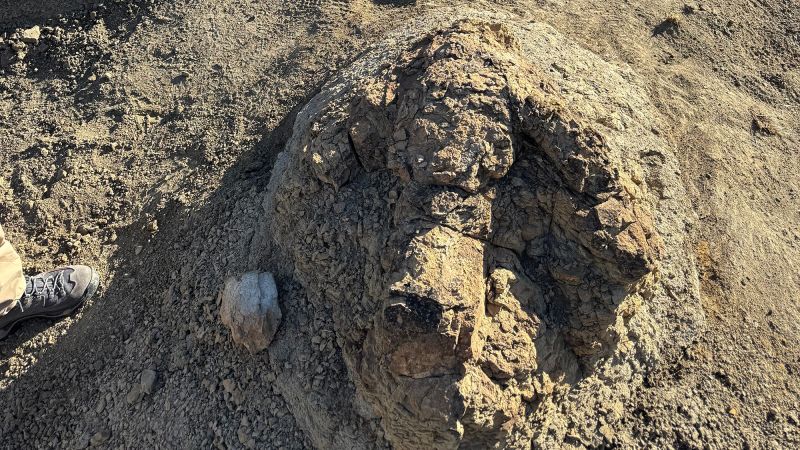
Kent Hups set out one morning on a research expedition into the famous Hell Creek Formation, a series of fossil-rich sedimentary rock layers in the western United States. The vast formation, spanning parts of Montana, Wyoming, North Dakota and South Dakota, is abundant with dinosaur bones from the Late Cretaceous, but finding footprints is a different story. The area’s sediments generally eroded before the footprints could be preserved. However, Hups, a high school science teacher in Northglenn, Colorado, found himself looking toward what ended up being the first known footprint left by a T. rex. “My first reaction was complete disbelief,” said Hups, a volunteer research associate at the Denver Museum of Nature and Science. “I sat and looked at it for a while before I was convinced it was a clue.” The two giant footprints he initially saw in July 2025 had three distinct impressions strikingly similar to other fossilized footprints. To determine which Cretaceous species would have left the marks, he measured the fossil trail from end to end. Hups explained that footprints with a length greater than width suggest that the footprint maker likely ate meat. With each footprint about 3 feet (0.9 meters) long and 2 to 2½ feet (0.6 to 0.8 meters) wide, Hups found evidence not only of a carnivore but also of the largest and most iconic carnivorous dinosaur to live on what was once a lush, swampy coastal plain: Tyrannosaurus rex. The extraordinary footprints are described in a study published September 8 in the Journal of Vertebrate Paleontology. Unlike bones, these footprints capture living movement from 66.5 million years ago, offering clues to the prehistoric predator’s behavior and gait, researchers say. “I hope more people will come out and look a little closer at those strange-looking rocks and this will lead to a better, more detailed understanding of what life was like in the past,” Hups said in an email. “It’s the closest thing we have to a time machine.” Hups, a co-author of the new report, had found two fossilized footprints in the open, one more eroded than the other, but the study’s co-author, Tyler Lyson, senior curator of vertebrate paleontology at the Denver Museum of Nature and Science, was looking for stronger evidence of a pattern to be convinced it was a dinosaur footprint. “Rocks can erode into different shapes and sizes, you know, some that look like Florida, some that look like Texas, some that look like T. rex footprints,” Lyson said. Lyson marked an X in the dirt where other footprints should have been. As researchers dug, they found not only a third, but also a fourth footprint. The prints had three thin toes and the middle toes were longer than the others, an anatomy similar to T. rex feet. Additionally, size was a key indicator, Lyson said. The Hell Creek Formation “is one of the best-studied rock units in the world, so we think we have a very good understanding of what dinosaurs lived there, and the two dinosaurs that are big enough to leave that footprint are the T. rex and then the duck-billed dinosaur called Edmontosaurus,” he said. “Their feet are very different.” The four prints are noted in the study. But this summer, the research team located a fifth footprint. “So, I have no doubt that it’s a print that belongs to a T. rex,” Lyson said. The discovery was a result of the dinosaur being in the right place at the right time, he added. What is now North Dakota was a plant-rich environment where dinosaurs could thrive 66.5 million years ago. The soft, muddy soil created the conditions necessary for dinosaur footprints to be buried, brought back to the surface, and exposed by erosion. Until now, researchers had only found two isolated footprints attributed to the tyrannosaur. The first specimen was discovered by a U.S. Geological Survey geologist in New Mexico and described in 1994, and the second was reported in a study by a University of Manchester paleontologist in 2008 in the Hell Creek Formation in Montana. Scientists have unearthed only a handful of footprints from other dinosaurs in the Hell Creek Formation. “Around the world, footprints are not that rare, but during this time range in North America, they are very rare,” Lyson said. Longer, better-preserved footprints of other large carnivorous dinosaurs are known elsewhere, but the first footprint likely attributable to T. rex is important, said Dr. Anthony Romilio, a paleontologist and research associate at the Dinosaur Laboratory at the University of Queensland in Brisbane, Australia. Romilio did not participate in the study. In the Hell Creek Formation, “even a poorly preserved example is a significant discovery there,” Romilio wrote in an email. “Any trace provides a record of actual behavior that their bones cannot: a few seconds of life, 66.5 million years ago.” Dozens of T. rex skeletons have been discovered in the Hell Creek Formation, which preserves evidence of North America’s last dinosaur ecosystem. But footprints can give scientists clues that bones can’t, including how fast the dinosaur moved and what its legs might have looked like. Multiple tracks can provide more information than isolated tracks and allow scientists to estimate how fast an animal was moving when its tracks were formed. In this case, the new discovery of footprints provides the first direct evidence of the stride length of a T. rex (about 13 feet (4 meters) total for the four footprints), suggesting it walked at about 3.5 to 4.5 miles (5.6 to 7 kilometers) per hour, Lyson said. However, the number is well below their maximum speed, since the preserved tracks were probably made in moist soil, and the animals move faster on dry land, explained Thomas Holtz Jr., a vertebrate paleontologist and senior lecturer in the department of geological, environmental and planetary sciences at the University of Maryland, College Park. He added that the footprints remain an important find for paleontologists. “The most important aspect is that this is perhaps the first definitive sequence of footprints from Tyrannosaurus rex,” said Holtz, who was not involved in the study. According to Lyson, the Denver Museum of Nature and Science plans to collect three North Dakota prints to further analyze them for tissue and skin print data. Publishing the trail gives other scientists the opportunity to analyze their measurements and reconstruct how the dinosaur moved, Romilio added. And knowing that clues like these exist could help researchers find more in the future, according to Holtz. Taylor Nicioli is a freelance journalist based in New York. Subscribe to CNN’s Wonder Theory science newsletter. Explore the universe with news about fascinating discoveries, scientific breakthroughs and more.