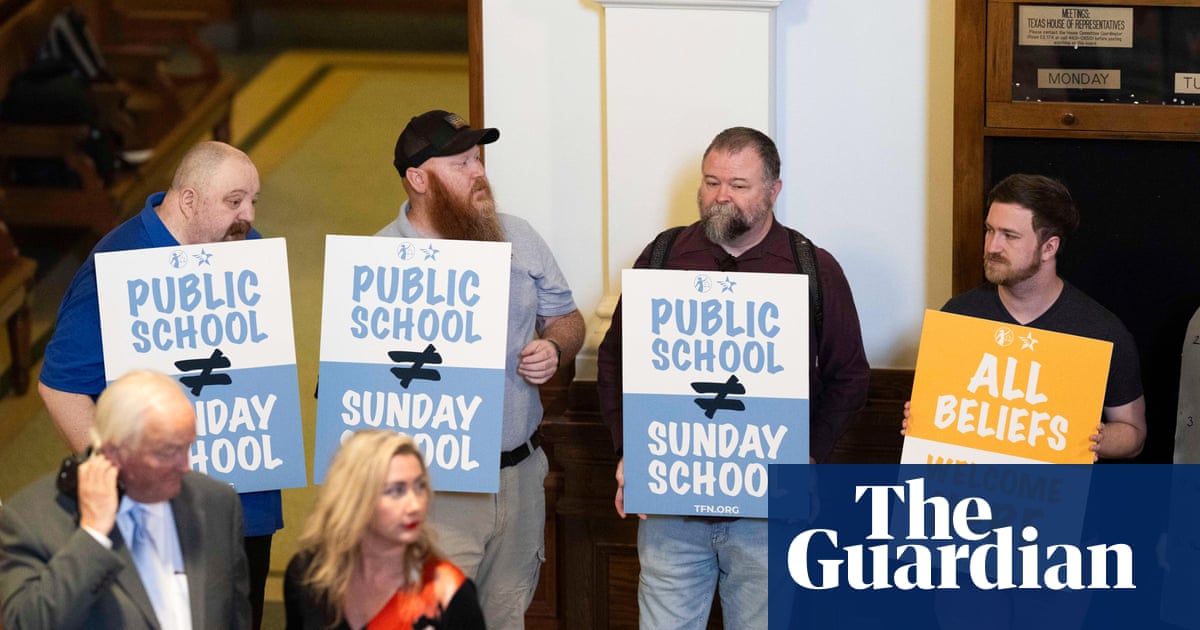
When history teacher Chris Dier sued Louisiana two years ago for requiring the Ten Commandments to be displayed in classrooms, he said it wasn’t about taking a stance against Christianity. “It’s a defense of many different types of values, including civil and religious liberties,” said Dier, who teaches at a New Orleans high school. “I spent more than 16 years teaching students that the constitution protects everyone of all faiths, as well as students of no faith.” While Dier’s lawsuit has stalled, posters of the sacred text have appeared in schools across the state. Dier said he wouldn’t hang a copy even if one was left on his door, and he’s willing to accept the consequences. Chris Dier, a New Orleans high school teacher who refuses to display the Ten Commandments in his classroom. Photo: Courtesy of Chris Dier “I want people to know that there are teachers who want to show that we can take a stand,” he said. “We must not allow schools to become battlefields.” Louisiana is one of four states (including Texas, Arkansas and Alabama) that have recently enacted laws requiring the Ten Commandments to be displayed in all public school classrooms, from kindergarten through college. A number of other southern states, including West Virginia, Mississippi and South Carolina, are debating similar legislation. The laws, which raise thorny questions about the separation of church and state, are gaining renewed attention as the Supreme Court is expected to consider a series of challenges, including Dier’s, in the fall. Public school teachers caught in the crosshairs of the growing culture war are fighting back, some taking the legal route and others by quietly defying the law in their own classrooms. At least two teachers in Texas, theater teacher Gigi Cervantes and band director Johnnie Cotton, resigned in protest. “I firmly believe that politics and religion have no place in public schools,” Cotton said in a Facebook post announcing his resignation. “I spent my 42 years as a teacher and administrator making sure my classroom/campus remained neutral on both counts.” ‘It’s Christian nationalist bullying’ Taria Usher, a kindergarten teacher in a district near Houston, said she was furious when copies of the Ten Commandments were handed out to her school in late May. By law, she is required to display one in her class. “Personally I am a Christian, but professionally I am a secular teacher,” Usher said. “Publicly funded classrooms are no place to espouse religious principles.” Instead of simply carrying out the mandate, Usher commissioned posters with different religious teachings (the five pillars of Islam, the five precepts of Buddhism, and the Yamas and Niyamas of yoga) and hung them around the Ten Commandments. He then launched a petition demanding that the school board join the ACLU’s lawsuit against the state or allow teachers to remove the signs without any backlash. Usher read the demands at a school board meeting this month. “To me, it’s Christian nationalist harassment,” he said of the state mandate. “I’m going to fight against it.” Other groups and opponents of the law have organized resources for teachers, including the website IllegalPoster.com, which offers free LGBTQ-themed posters of the Ten Commandments, as well as complementary posters explaining why the mandate is unconstitutional. The Ten Commandments displayed at Baghdad Elementary School in Leander, Texas, on Nov. 19, 2025. Photograph: Jay Janner/The Austin American-Statesman via Getty Images Texas law requires that the Commandments must be displayed in a “conspicuous place” on signs at least 16 by 20 inches in size, and the text must be easily read by anyone with “average vision.” One condition: Schools are not required to purchase the posters with district funds, but must accept donated copies. That hasn’t stopped some Texas districts from spending thousands of dollars to print their own signs. Well-funded Christian groups have also been raising money to purchase and send copies of the Ten Commandments to schools. Texas Attorney General Ken Paxton and other advocates of the law have argued that the Ten Commandments are “irrevocably intertwined with the legal, moral, and historical heritage of the United States.” It’s a perspective Usher said he “unequivocally” rejects. “As an African American woman, the American heritage has been oppression and slavery,” she said. “I see a push in certain ways that some people in this country want to go back to those things. The last thing I see is people obeying the Ten Commandments.” “But there is nearly half a century of Supreme Court precedent protecting this wall,” Mach said. In a 1980 ruling, the court ruled that a similar Kentucky law violated First Amendment rights, which prohibit the government from establishing or favoring religion. Texas Attorney General Ken Paxton greets the crowd during a campaign event at Glorious Way Church on September 21, 2026 in Houston, Texas. Photograph: Antranik Tavitian/Getty Images “The court said then what we are arguing now, that these laws violate the important constitutional protection we have against government religious favoritism,” he said. Many parents are also fighting back, joining forces with the ACLU and other legal groups to file a flood of lawsuits against the mandates. After seven Arkansas families with children in public schools sued the state last year over its Ten Commandments mandate, a federal judge struck down the law in March, arguing that “nothing could justify hanging the Ten Commandments – with or without historical context – in a calculus, chemistry, French or carpentry class, to name a few.” (The state has said it intends to appeal the ruling.) In Texas, two dozen families from multi-religious backgrounds last month asked the Supreme Court to take up their challenge to the state law, after the U.S. Court of Appeals for the Fifth Circuit ruled against them. The Supreme Court is expected to consider two challenges to the Texas law this fall. The Rev. Mara Richards Bim, a Dallas-based Baptist pastor and parent who is a party to the Texas litigation, said the law violates the principle of “separation of church and state” that is integral to her faith. “As a Baptist, I oppose the state imposing its version of the faith in classrooms,” Bim said. “Scriptures and religious traditions are best taught in homes and in church.” Two other plaintiffs, Ted and Rebekah Lowe, are raising their children in a Christian and Jewish family. They said they do not oppose the teachings themselves, but felt the government has no right to privilege one religion over another. “When it comes to religious instruction like the Ten Commandments, it is my job as a parent to teach it,” Ted Lowe said. “I don’t want government officials to interfere in the religious education of our children.”