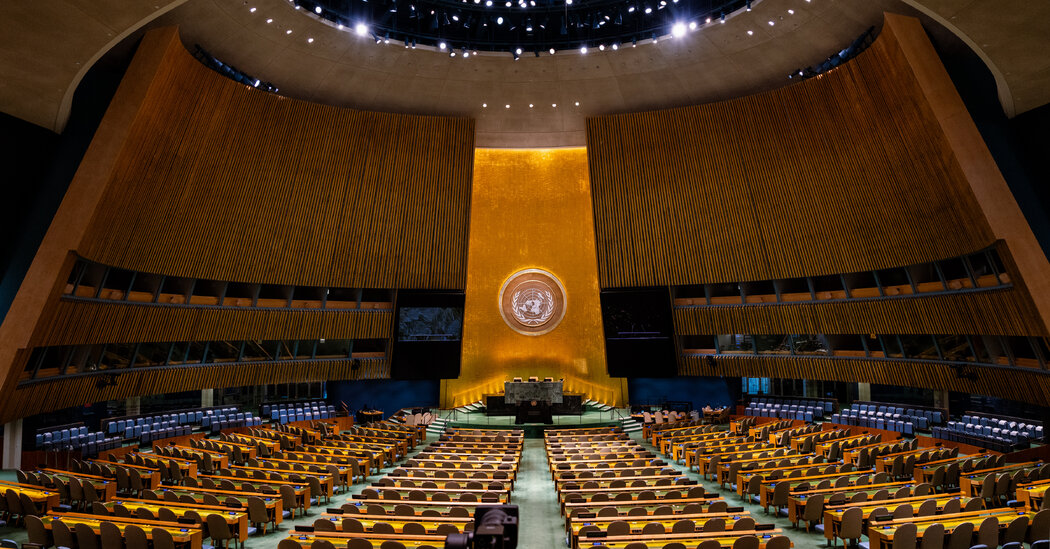
For almost a year, China has orchestrated a forceful campaign against Japan in retaliation for a comment by its Prime Minister, Sanae Takaichi, in defense of Taiwan. When Takaichi meets with President Trump in New York City on Tuesday, those tensions are likely to be high on the agenda. Takaichi, a longtime critic of Beijing, is expected to express concerns to Trump about China’s increasingly aggressive economic and security measures, according to two people familiar with his plans, including restrictions on the export of rare earth minerals. He will also emphasize his desire to reduce tensions with China, the people said. The meeting between Trump and Takaichi, on the sidelines of the United Nations General Assembly, comes a day before Trump welcomes China’s leader, Xi Jinping, for a state visit to Washington. Takaichi remains focused on persuading Trump to maintain his security commitments in East Asia, including the more than 50,000 U.S. troops stationed in Japan. Kenneth R. Weinstein, Japan chair at the Hudson Institute, a think tank in Washington, said Takaichi had a strong relationship with Trump and would likely seek to reaffirm their alliance as a buffer against Xi. “He wants President Trump to send a clear signal to Xi Jinping that there is no distance between the United States and Japan on a number of critical issues,” he said. Takaichi’s office did not immediately respond to a request for comment on tensions with China and his meeting with Trump. China and Japan have been at odds since November, when Takaichi said Japan could intervene militarily if China attacked Taiwan, a self-governing democracy that Beijing considers part of its territory. Beijing unleashed a wave of retaliation, restricting imports of Japanese seafood, discouraging tourism to Japan, and limiting the export of critical minerals to Japan. Chinese officials also cut diplomatic channels with Tokyo. Economic pressure has intensified in recent months, with tourism from China falling sharply (the number of Chinese tourists fell 59 percent in August from a year earlier) and Beijing further restricting the export of rare earth minerals used in a variety of essential technologies. In July, China exported 122 tons of rare earth magnets to Japan, according to Chinese customs data, a 52 percent drop from a year earlier. In August, rare earth magnets from China to Japan were 17 percent lower compared to the previous year. In recent months, Takaichi’s government has attempted to reengage with China, sending delegations of lawmakers and business leaders to Beijing. Sanae Takaichi and Xi Jinping shook hands during a meeting in Gyeongju, South Korea, last year. Takaichi and Xi will cross paths again in November at the Asia-Pacific Economic Cooperation forum meeting in Shenzhen. Credit… Agence France-Presse — Getty Images Those visits have led to some frank conversations. During a recent meeting in Beijing, Chinese officials peppered their Japanese visitors with questions about Takaichi’s plans to strengthen the Japanese military, asking whether he was doing so so he could defend Taiwan, according to a Japanese lawmaker who was present. The legislator asked not to be identified because the meeting was private. During another recent visit, Masahiro Komura, a Japanese lawmaker member of the ruling Liberal Democratic Party, pressed his Chinese counterparts on export restrictions and the recent detention of Japanese citizens on smuggling charges. Asked in an interview whether the talks had produced any progress, he joked that it was a positive sign that no Japanese lawmakers were detained in China during the visit. “The top priority is to continue the diplomatic relationship,” he said. “Without communication between two countries, both sides will become very skeptical and the negative situation will intensify.” Chinese officials have used recent visits by Japanese lawmakers as an opportunity to underscore their displeasure with Ms. Takaichi. Privately, they have remained fixated on Ms. Takaichi’s comment about Taiwan, according to Japanese participants in the meetings, demanding that it be retracted. China’s Deputy Foreign Minister Liu Bin lectured a group of Japanese lawmakers when they met last week. He said Ms. Takaichi’s “erroneous comments and actions” were the main obstacle and that Japan should “demonstrate through concrete actions that it is worthy of the trust of its Asian neighbors.” In a meeting with another Japanese delegation in late August, Lu Kang, deputy head of the International Department of the Chinese Communist Party, said that “China-Japan relations face serious difficulties and the root causes are clear.” Takaichi’s advisers say she has no intention of backtracking on her comments, given her long history of support for Taiwan and widespread anxiety about China among the Japanese public. Takaichi and Xi will cross paths again in November at the Asia-Pacific Economic Cooperation Forum meeting in Shenzhen. Neither side has yet commented on whether the two leaders will set aside time to meet one-on-one. Lian Degui, director of the Center for Japanese Studies at Shanghai University of International Studies, said recent meetings between Chinese and Japanese officials showed there is potential for relations to mend, depending on messaging from Ms. Takaichi’s administration. “If China finds the attitude acceptable, then Japan-China relations can move to the next phase of improvement,” Mr. Lian said. “The prerequisite for improving relations is for the Japanese government to admit its mistake.” The lack of a trusted intermediary between the two sides is another obstacle, analysts said. Under Takaichi’s government, the ruling Liberal Democratic Party has lost the support of the Komeito party, previously its main coalition partner, which had served as a conduit to China. “What’s missing,” said Chen Hong, director of the Center for Asia-Pacific Studies at East China Normal University in Shanghai, “is someone who Beijing can take seriously and who can genuinely influence Takaichi’s decision-making.” In New York, Takaichi and Trump have a full agenda, including questions about trade, defense and Tokyo. exchange problems. Takaichi is expected to highlight Japan’s efforts to fulfill its promise to invest $550 billion in the United States, part of a trade deal reached with the Trump administration last year. Japan has watched with concern as Trump has in recent weeks pressured allies such as South Korea to provide support for the war in Iran; Mrs. Takaichi seems eager to avoid the same fate. Takaichi also faces pressure at home to question Trump about his administration’s recent decision to sanction International Criminal Court President Tomoko Akane, a Japanese judge. The decision has sparked deep anger in Japan, with Takaichi calling it “very unfortunate.” It is unclear whether Trump wants to become more involved in China’s dispute with Japan, although he has previously promised to speak “praises of Japan” to Xi. Weinstein, the expert, said Trump is unlikely to ask Xi to “reduce pressure” on Japan. “The best thing the president can do,” he said, “is to continue to send the signal, in regular consultation with Prime Minister Takaichi, that the US-Japan alliance is critical to the United States, Japan and the Indo-Pacific.” Hisako Ueno contributed reporting from Tokyo and Pei-Lin Wu from Taipei, Taiwan.