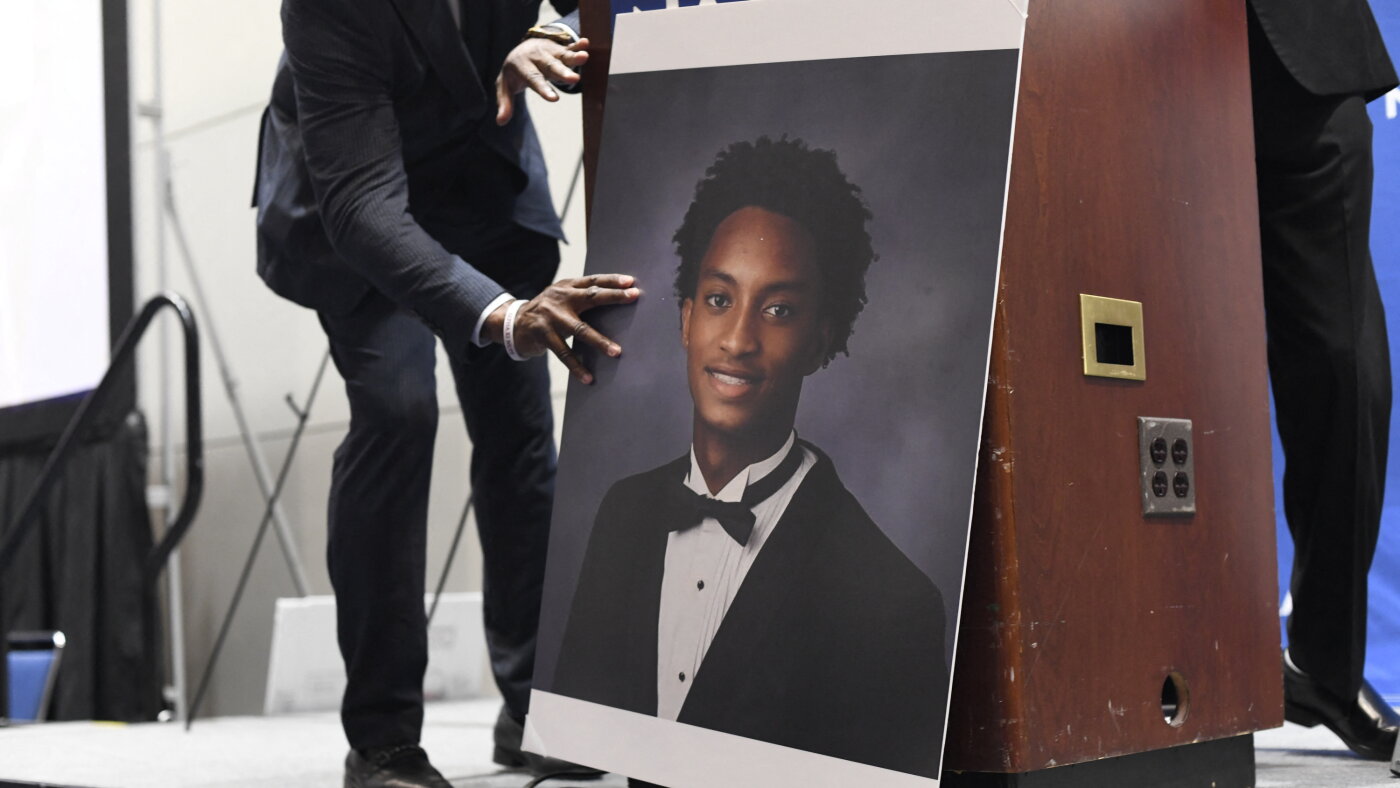
A man places a photo of Nolan Xavier Wells in front of the podium before a news conference at McCormick Place in Chicago on July 22. Wells, an 18-year-old college student from Mississippi, was found dead after a boat trip with friends on the Fourth of July. Octavio Jones/AFP via Getty Images hide caption toggle caption Octavio Jones/AFP via Getty Images A Mississippi grand jury decided not to return indictments in the case of Nolan Wells, a teenager who was found dead off the Mississippi coast in early July. “The Grand Jury finds no credible evidence to support public allegations that anyone who traveled to or from Horn Island on July 4, 2026 on Triton, Palm Beach or Tideline engaged in any criminal conduct related to the death of Mr. Wells,” the report reads. The grand jury met from September 14 to 18 and ultimately concluded that Wells’ cause of death was consistent with drowning, based on the location where her body was found and multiple autopsies. The cause of death is undetermined, but the clear absence of other causes of death makes drowning a likely “diagnosis by exclusion.” The 23 jurors heard from more than 40 witnesses and reviewed evidence ranging from GPS data to cell phone extractions and photographs and videos from Horn Island. The evidence reviewed also included findings from the team of civil rights attorney Ben Crump, who represents Wells’ family. “No real bill doesn’t resolve how Nolan Wells died,” Crump posted on Facebook, hours after the report’s release Monday, referring to the grand jury’s refusal to issue any indictments. Between July 4 and the grand jury report, Wells was found dead on Horn Island on July 6 after sailing there with several friends two days earlier to celebrate Independence Day. Wells was the only black friend in the group, and also the only friend in his group who did not return from that trip to the Mississippi barrier islands. He was not the only black individual on Horn Island that day, according to the grand jury report. The grand jury determined that Wells decided to stay on Horn Island on the afternoon of July 4, characterizing it as “not unusual or suspicious for persons to return from the island in boats on which they did not travel…”. The report found that the accounts of the occupants of the ships that left that day were true, including reports of one ship, the Triton, which took on water and had to be towed a short distance. “Nolan decided to stay on the island that day, and there is not a shred of evidence to contradict him,” District Attorney Angel Myers McIlrath said in a recorded statement released Monday night, along with the grand jury report. The grand jury concluded that there was an “exhaustive search” of Horn Island on July 5 prior to the discovery of Wells’ body the next day. “The Grand Jury is confident that if his body had been on the island at the time, it would have been discovered during the extensive search,” the report reads. The report does not include any other claims or statements from jurors about why her body was found a day later. In his recorded statement, Myers McIlrath stated that: “Crump’s family, team, and anyone close to Nolan knew that his disappearance and death were not the result of racial hatred or violence.” Questions about the state and independent autopsies The forensic pathologist who performed an independent autopsy, Dr. Roger Mitchell, concluded with the state medical examiner that the cause and manner of death are “undetermined” and that “drowning is a diagnosis of exclusion.” Crump previously claimed that Mitchell did not have access to parts of Wells’ body during the independent autopsy, but the grand jury report states that Mitchell confirmed that he received all body parts, except the internal neck structures, into the custody of the state medical examiner. Bruises were found on Wells, but injuries were not considered fatal. One was in the back of his head, which Crump addressed following the grand jury report Monday night. “Mississippi’s own pathologist found two bruises on the back of this young man’s head and reported them to investigators early in this investigation,” Crump wrote. “An independent autopsy documented traces of blood and recent blunt force injuries to the back of Nolan’s head and back. To this day, no one has explained how they got there.” Crump also released the team’s independent autopsy Monday night. That report recommends keeping the investigation open because of the uncertainties surrounding Wells’ death and the conditions he was in when he entered the water. “The available record does not definitively establish the condition of the deceased immediately before entering the water, whether he entered voluntarily or was forced, whether he was conscious or incapacitated, or why he would not have been able to get out on his own despite supposedly knowing how to swim and in the presence of other people,” the independent autopsy report reads. District Attorney Myers McIlrath said in her video statement, “After Crump’s team conducted and released the results of their independent autopsy and after receiving hundreds of tips, they informed my office that they had no evidence that a crime had been committed against Nolan Wells.” Cellphone search caused problems in investigation Questions have arisen surrounding Wells’ death since July: why he decided to stay on the island, as his friends have claimed, and why he was found without a cellphone. The Jackson County Sheriff’s Office initially investigated this as a death, not a homicide, according to a news release. Wells’ parents have expressed concern that authorities acted too quickly at the beginning of the investigation by assuming there was no foul play, while being slow to communicate with them and relay new information to the public. “The damage has already been done because that is the narrative that is being pushed by the general public,” Christine Wells-Wonsley, Wells’ mother, said at a July 22 press conference. His parents also said they believed the messages had been deleted from his phone when his parents found him, after tracking him to a friend’s house the day Wells’ body was found. Very little was answered during the investigation: everything, including the state autopsy, was kept under wraps while the investigation was ongoing and while the evidence was under grand jury review. It’s something Myers McIlrath has advocated for because it preserves the integrity of the investigation. “Grand jury secrecy is not a veil we hide behind,” he said in his video statement Monday night. “It is a shield that protects the integrity of the prosecutions of the guilty and is intended to protect the innocent from the destruction of false accusations.” In that statement, Myers McIlrath addressed several particular issues raised by Crump and his team during the investigation, particularly issues related to the review of Wells’ phone. “Crump’s team knew better, but allowed the public to believe, among other false narratives, that our medical examiner retained Nolan’s lungs and stomach when his body was released, that things had been deleted from Nolan’s phone before returning it to his family, that I refused to cooperate with the examination of Nolan’s cell phone, that I refused to provide Nolan’s autopsy results to the family,” he said. “All lies.” Myers McIlrath said a report his office received from Crump’s team indicated that nothing had been deleted from Wells’ phone since it was last used. “I never received the complete extraction data as promised, and I never received the complete extraction report from Nolan’s cell phone,” Myers McIlrath said. “After the grand jury convened in this case, Crump’s team provided a selection of 282 pages of reports from Nolan’s cell phone, which the grand jury considered.” The litigation can continue. It is still possible to continue civil litigation in the case. On the day of Wells’ funeral, the family’s attorneys sent letters to Wells’ friends and family as notice that litigation was “reasonably anticipated.” A former colleague of Wells could file defamation charges following social media attacks and an alleged death threat. “What we’ve seen happen in the Nolan case, where lives and reputations have been damaged, is reprehensible. People have suffered. Public offices have been harassed,” Myers McIlrath said. “Witnesses, public officials and others unrelated to this case have been subjected to threats of harm and intimidation by an angry mob.” Several of Wells’ friends have also threatened to sue figures such as the Rev. Al Sharpton and Sunny Hostin, co-host of “The View,” for defamation. The grand jury report called the allegations against Wells’ friends the result of “public outcry and private malice.” Mississippi does not have a statute of limitations for homicide cases, meaning new evidence that emerges could be considered.