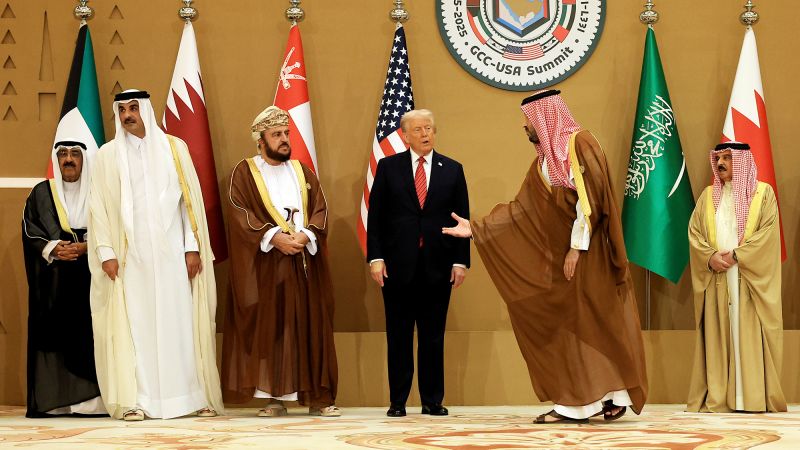
US President Donald Trump’s allies in the Persian Gulf will meet him in New York on Tuesday as he weighs whether to “annihilate” the Iranian regime. He’s already been talked out of a major escalation once before. This time they fear they will be drawn deeper into the war just as Washington seeks a way out. In early August, Trump said he had called off a major attack on Iran at the behest of Saudi Arabia, the United Arab Emirates and Qatar, whose leaders believed a deal with Tehran was within reach. More than a month later, no such deal has emerged, oil prices remain high, and the U.S. midterm elections are approaching. The US president told Axios on Thursday that he was facing a “big decision” about the war and wanted to hear directly from Gulf leaders. Your challenge is to give them a path forward that protects them from further attacks without dragging them deeper into the war. “Trump’s planned meeting with (Gulf leaders) could be one of the most important diplomatic meetings of this phase of the conflict,” Danny Citrinowicz, an Iran analyst at Israel’s Institute for National Security Studies, wrote in X. “The central question for Washington will be how they view the choice between renewed escalation and a diplomatic off-ramp.” Last month, a coordinated appeal from Gulf leaders helped persuade Trump to hold back. Now they are meeting as the war expands and Iran’s proxies attack Saudi energy infrastructure in Yemen and Iraq, raising the specter of a global energy shock. Saudi Arabia faces what could be its most far-reaching security threat since the 1991 Gulf War, even as Trump shows little desire to intervene directly on its behalf and Washington discusses a long-term reduction of its military presence in the Gulf. It’s a test of the U.S.-led security deal that took shape after that war: Gulf states host U.S. forces and buy American weapons, counting on Washington to help deter threats. It is still unclear whether Trump intends to follow through on his threat to “annihilate” the regime. He has reason to think twice: American missile reserves are severely depleted, while another escalation in an already unpopular war could hurt Republican candidates in the midterm elections just weeks away. If the United States intensifies its military relationship with Iran, the Gulf States could once again bear the brunt of Tehran’s retaliation, something they do not particularly want. Riyadh is already facing an attack on two fronts, while Qatar, Bahrain and Kuwait continue to face major disruptions to trade due to the closure of the Strait of Hormuz. Meanwhile, the United Arab Emirates has stepped up its engagement with Iran. The two sides agreed on the need to “turn the page,” according to Anwar Gargash, diplomatic advisor to the president of the United Arab Emirates. But Gargash has warned that trust could take decades to rebuild and said dialogue must be accompanied by deterrence. Gulf leaders will only be able to persuade Trump if they speak with “one voice” and ask him “very, very specific questions,” Bader Al-Saif, an assistant professor of history at Kuwait University, told CNN. Beyond Trump’s next move on Iran, Gulf leaders face a longer-term fear: a reduced U.S. military presence in the region. Senior Pentagon officials have made clear privately that they want to reduce the presence of US military troops in several Gulf countries as part of a broader effort to shift more of the defense burden to regional partners, three sources familiar with the discussions previously told CNN. For Gulf governments, even discussing a US military drawdown as attacks spread across the region risks handing a victory to Iran and leaving them more exposed. “This is not the time to have these conversations at all,” an official familiar with Saudi thinking told CNN, adding that this has been conveyed to the Trump administration. “The Gulf Cooperation Council is really trying hard to project a united front against Iran.” Just two weeks into the war against Iran, Trump questioned why the United States should shoulder much of the burden of protecting Gulf energy routes, when Iran began hitting Gulf states in retaliation for US and Israeli attacks. “You could argue that maybe we shouldn’t even be there,” Trump said in March, referring to the US military presence in the Gulf. For the official familiar with Saudi thinking, talk of a reduction in the US military footprint serves Tehran’s interests. “The Iranians want headlines like the one that appeared about the US withdrawal from Kuwait,” the official told CNN, referring to a Wall Street Journal report in late June that the US military was considering reducing its presence in Kuwait and Saudi Arabia. Iran has long viewed US bases in the Gulf as a threat on its doorstep. Throughout the war, Tehran has repeatedly demanded their closure, and Supreme Leader Mojtaba Khamenei has directed the argument to Gulf leaders, saying the bases have made their countries targets without providing the security Washington promised. “By now they must have realized that the United States’ claims to provide security and peace have been nothing more than a lie,” he said in a March statement. For Kuwait University’s Bader Al-Saif, the war is testing something bigger than the future of American bases. The 1991 Gulf War turned the region into a testing ground for American dominance at its global peak. Now, he said, the Gulf is a “test case” for a change in the opposite direction. “We have had three decades of an order led by the United States. That order is over,” he said. “Does that mean the new order will not feature the United States? No. But there will be a different type of relationship between the United States and the Gulf.” For Riyadh, the limits of that changing relationship with the United States were tested this month. Attacks on Saudi oil facilities and export routes threatened to cut off supplies, drive up global oil prices and raise the cost of gasoline for Americans. Yemen’s Iran-backed Houthis attacked Saudi oil facilities and declared a blockade of ships traveling to and from Saudi ports through the Red Sea. Iranian-backed militias in Iraq have also been accused of attacking the kingdom’s East-West oil pipeline, a crucial route that bypasses the Strait of Hormuz. However, when Crown Prince Mohammed bin Salman asked Trump to attack the Houthis, the president refused, CNN previously reported. The decision came less than a year after Washington signed a defense agreement with Riyadh and designated Saudi Arabia as a major non-NATO ally, although the United States continues to provide Saudi forces with intelligence and targeting support. The Saudi episode captures the dilemma that Gulf leaders could pose to Trump on Tuesday: They want American help against imminent attacks, but fear that another major escalation with Iran could make them less secure. Most Gulf governments would prefer stability to another round of war, Citrinowicz wrote. That doesn’t mean turning your back on Washington, he said: “American power is indispensable, but relying exclusively on Washington carries its own risks.” For Al-Saif, that case should begin with something less ambitious than a broad peace deal: freedom of navigation through the Strait of Hormuz, potentially in exchange for limited relief on Iranian oil sales and access to goods. Gulf leaders need specific demands, he said, before a war of attrition becomes “the new norm for the Gulf.” But even a closer agreement may prove elusive. In August, Gulf leaders reportedly told Trump that he was close to a deal with Iran; This time, Qatar’s own assessment as a mediator sounds much less hopeful. At a conference in Abu Dhabi this month, Qatari Foreign Ministry spokesman Majid Al Ansari raised doubts about the prospects for a deal. Iran could withstand a long war, he said. Washington can hope that increased pressure will weaken Tehran, while Iran can hope that the conflict will change the political calculus in the United States. For now, both sides can see more than gain by waiting. Even if they return to talks, Al Ansari sees no clear deal that both will accept as a victory. “What is the desired outcome for both sides in this war?” asked. “If anyone can answer that, I’m willing to pay a million dollars, of my own money.”