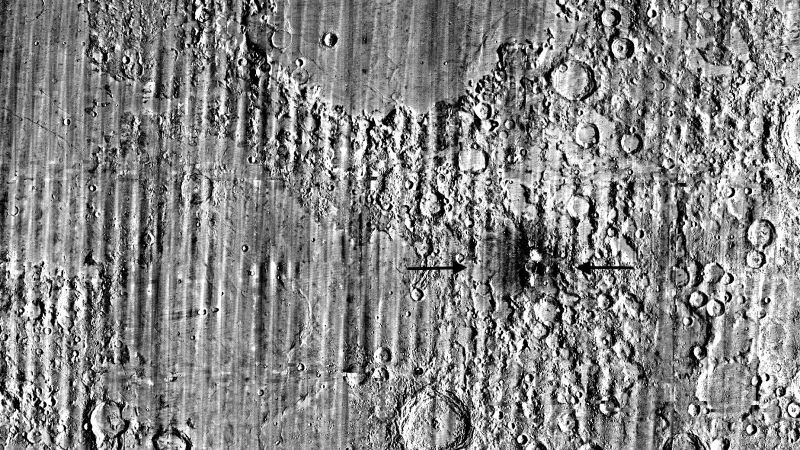
The moon’s surface experienced a violent encounter with a comet or asteroid, and it has a massive battle scar to prove it. The space rock, estimated to be the size of a three- to six-story-tall building, crashed into the moon’s eastern edge two years ago, between April 11 and May 22, 2024, although researchers did not notice it at the time. The impact left a crater that measured 728 feet (222 meters) wide, or just over the length of two football fields. Discovered last year, the crater also reaches 43 meters (141 feet) deep, room for three school buses stacked on top of each other. Scientists said the lunar feature marks the largest newly formed crater ever found in the solar system since humans monitored such features, according to a study published Wednesday in the journal Science Advances. “Crater production models indicate that an impact of this magnitude is expected to occur only once every 132 years on the Moon,” the authors wrote in the study. “As such, this event constitutes a statistically rare and effectively once-in-a-lifetime observation.” The study’s authors named the feature McGetchin crater after Dr. Thomas McGetchin, the last Apollo-era lunar scientist who contributed to a greater understanding of impact craters on the Moon. Prior to this discovery, the largest contemporary impact crater found on the Moon was approximately 230 feet (70 meters) in diameter. Unlike Earth, the Moon’s surface is heavily cratered and has no protective atmosphere to protect it from bombardment by space rocks for billions of years. Spotting a new crater among the multitude of existing features seems a bit like finding a needle in a haystack, but a NASA orbiter that has been orbiting the Moon for more than 17 years helped scientists zero in on the large bright spot surrounded by a dark halo. Scientists have used data from the Lunar Reconnaissance Orbiter to study the impact of the crater and to what extent the collision affected the surrounding area. The findings reveal that the Moon, a high-priority destination for NASA and other space agencies when considering sustained human exploration, remains a center of impact activity that needs monitoring as it could be a threat to any people or potential infrastructure on the surface. “I am surprised almost every day when I come to work and look at the latest images of the Moon, even after 17 years of operation,” study co-author Mark Robinson, principal investigator of the Lunar Reconnaissance Orbiter Camera at Texas-based aerospace company Intuitive Machines, wrote in an email. The Lunar Reconnaissance Orbiter, or LRO, has been a workhorse since its launch in 2009, using seven instruments to create maps of the Moon’s temperature, surface composition, topography, and radiation. It moves in a pole-to-pole loop, with two cameras to capture images 97 kilometers (60 miles) from the lunar surface. As a result, the spacecraft has also allowed scientists to track at least 1,000 new impact craters and another 100,000 surface changes, including landslides and even landers crashing into the lunar surface. Small space rocks, too small to see, create many of the moon’s markings and craters. About 140 new craters that appear on the Moon each year, some of which can measure about 30 feet (9 meters) across, are made by space rocks that measure about 43 inches (109 centimeters) across. But every few years, as scientists scan detailed images from the LRO, they look for larger features by comparing new lunar maps to older versions. Study co-author Robert Wagner, an image processing specialist at Intuitive Machines working with data from the Lunar Reconnaissance Orbiter Camera, spotted McGetchin on Oct. 24, 2025, while looking at stacked before-and-after LRO images that highlight unusually dark or bright surface changes. “I just stopped, dropped everything and started researching what that place was,” Wagner said in a statement. The process is not easy, since LRO software scientists use flags in every turn related to lighting or shadows. The team analyzes each detection and evaluates whether it is real or a false positive, Robinson said. But McGetchin stood out for Wagner. “It was by far the most obvious impact debris pattern I’ve seen in one of these images,” he said. To confirm the discovery, the team turned to sharp, close-up images captured by the orbiter’s narrow-angle camera, which also allowed researchers to measure the shape, size and impact of the crater on the surrounding terrain. A separate team of scientists analyzed data from LRO’s Diviner thermal instrument, which revealed a 6.4-kilometer (4-mile) wide area surrounding the crater that registers 16 degrees Fahrenheit colder at night compared to the rest of the region. They shared their results in a second paper published Wednesday in Science Advances. “Previous Diviner observations have shown that recent lunar impact craters are often associated with ‘cold spots,'” the study’s lead author, Tyler Powell, a planetary scientist and postdoctoral fellow at the Johns Hopkins University Applied Physics Laboratory, wrote in an email. “Its large extent indicates that impacts can modify the surface well beyond the crater,” Powell said. “We are very lucky that it formed during the life of the LRO mission and that we can observe the region before and after the impact.” Scientists believe the cold spots are due to disturbances on the lunar surface, “creating a fluffier layer that is less able to retain heat at night,” Powell added. Tracking changes on the lunar surface is crucial to determining how often space rocks hit the Moon and how asteroids break up when they hit a rocky body, Robinson said. Studying new craters can also provide information about what happens during the moment of impact, he said. Understanding the rate and magnitude of such impacts on the Moon could be critical to future planning for a lunar base and other infrastructure as NASA’s Artemis program works to return humans to the lunar surface for long-term exploration. Impact craters have also helped shape the surfaces of rocky planets and moons in our solar system, said Jeff Andrews-Hanna, a professor at the University of Arizona’s Lunar and Planetary Laboratory. Andrews-Hanna was not involved in any of the studies. “An impact like that should be rare on the Moon, but rare events do occur. The object that formed this crater may have been close in size to the Chelyabinsk meteor that exploded over Russia,” Andrews-Hanna wrote in an email, referring to an asteroid that entered Earth’s atmosphere over Chelyabinsk, Russia, in 2013. About 55 to 65 feet (17 to 20 meters) in size, the asteroid Chelyabinsk exploded in the air, releasing 20 to 30 times more energy than the atomic bomb dropped on Hiroshima, Japan, and generating a brightness greater than that of the sun. Debris from the space rock damaged more than 7,000 buildings and injured more than 1,000 people. “If something like that were to pass through our atmosphere and hit the Earth’s surface, it wouldn’t be catastrophic, but we would certainly notice it,” Andrews-Hanna said. “These events serve to remind us how vulnerable we are and how important it is to catalog and track near-Earth asteroids that could potentially hit Earth.” Subscribe to CNN’s Wonder Theory science newsletter. Explore the universe with news about fascinating discoveries, scientific breakthroughs and more.