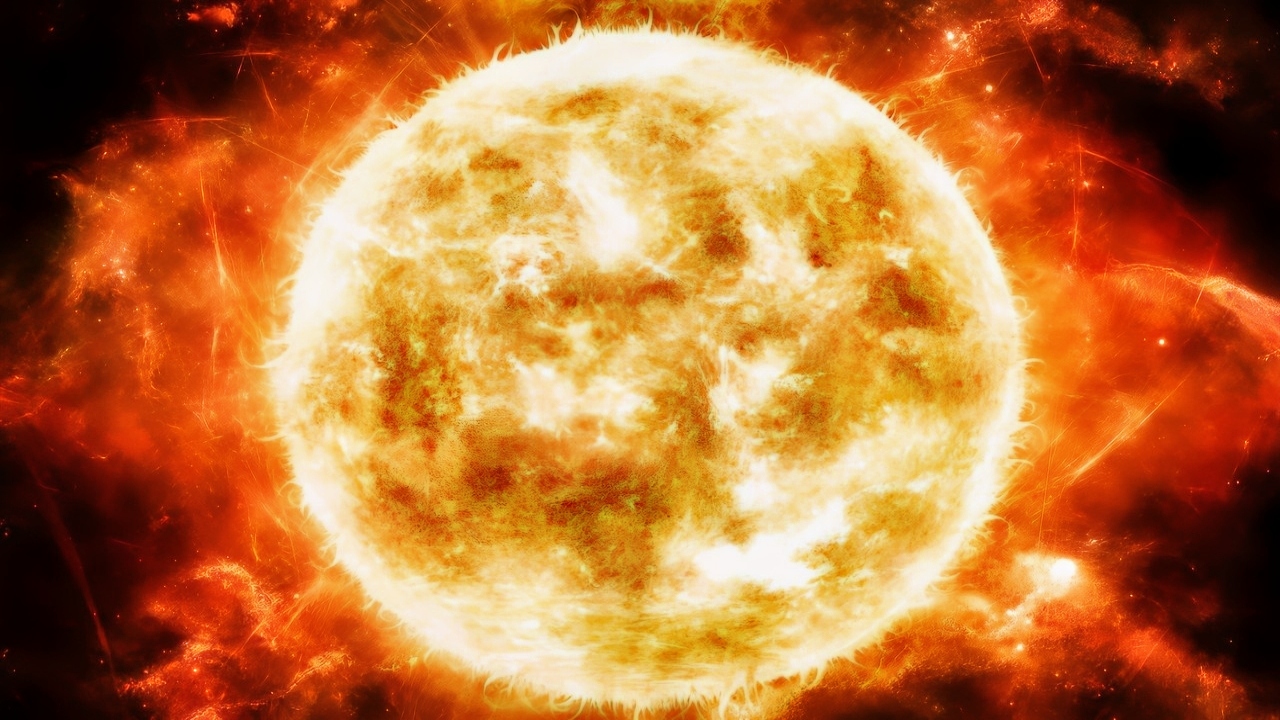
The Sun is approximately 4.6 billion years old and is about halfway through its main sequence lifespan. The popular conception holds that the destruction of the Earth will occur when the Sun becomes a red giant in about 5,000,000,000 years, but the Earth may become uninhabitable billions of years earlier, not due to a sudden solar catastrophe, but due to the normal evolution of an ordinary star. As the Sun ages, it gradually becomes brighter and more luminous. Within about 1,000,000,000 years from now, increased solar output could push Earth’s climate outside the envelope that allows life to exist here. What does this look like? The oceans evaporate. Water vapor increases. Plant life dies. And finally, Earth goes from the vibrant blue planet we know today to something closer to Venus, unable to support life as we know it. Getting hotter as it ages The Sun operates primarily by nuclear fusion at its core. Ultimately, four hydrogen nuclei combine to form helium through the proton-proton chain, converting a small amount of mass into energy. Every second, the Sun converts approximately 600 million metric tons of hydrogen into helium. Over billions of years, helium accumulates in the core of the Sun. The average molecular weight of the core increases and the core slowly contracts under gravity. Transit of Venus in front of the Sun NASA Photo Contraction increases temperature and pressure. The higher core temperature increases the rate of fusion in the surrounding hydrogen-rich material. The result may seem contradictory: as the Sun uses up its hydrogen, it becomes brighter. You might expect the Sun to dim as this process unfolds, but that is not the case. It is estimated that the Sun today is about 30 percent brighter than when it formed. During this phase, it should continue to become about ten percent brighter every billion years. Testing the Earth So far, the Earth has survived billions of years of increasing solar luminosity because our climate is not simply passive. The carbonate-silicate cycle acts as a geological thermostat for eons. So the Earth can adapt to changing levels of darkness or brightness from the Sun. But this mechanism has limits. Over time, the Sun will become too bright to handle. Space shuttle discovers. 19FortyFive Image taken at the Smithsonian. Discovery of the space shuttle at the Smithsonian. Original image from 19FortyFive.com. Discovery of the space shuttle at the Smithsonian. Original image from 19FortyFive.com. As the Sun brightens, the Earth needs less atmospheric CO₂ to maintain acceptable temperatures. But eventually, CO₂ concentrations will be too low for much of Earth’s plant life, which, of course, would be catastrophic for all of us. Death of plants Earth’s biosphere could be the first to fail. Photosynthetic organisms require carbon dioxide. C3 plants (including most trees and many important crops) would struggle as atmospheric CO₂ declines. More CO₂ efficient C4 plants could last longer. But the loss of photosynthesis means a decline in plant biomass, oxygen production, and terrestrial food webs. Complex animals, like humans, depend on these systems. So the initial problem would not be that the Sun got hotter and the oceans boiled. It would be more gradual, beginning with the slow death of the Earth’s plant systems. Increase in CO₂ As the Sun brightens and temperatures increase, evaporation would increase. This would cause more atmospheric water vapor, which in turn would intensify the greenhouse effect and accelerate warming, restarting the cycle. This would lead to something scientists call a wet greenhouse, where large amounts of water reach the upper atmosphere. Today, because Earth’s upper atmosphere is relatively cold, it holds water underneath, mitigating the wet greenhouse effect. But with enough warming, more water would rise, where ultraviolet sunlight would break down the H₂O into hydrogen and oxygen. Hydrogen, being so light, could escape into space, which would mean that the Earth would lose the building blocks needed to remake the oceans. Over time, the water loss would become permanent. Again, that would be a problem for life on Earth. Five Billion Years Of course, the billion-year estimate is speculative; It is not an exact countdown. Climate models produce different estimates based on dozens of sensitive variables. But either way, the Sun is dying. Within five billion years, the Sun’s hydrogen core will run out and leave the main sequence. The core will contract as the outer layers expand, forcing the Sun to become a red giant. Mercury and Venus will be submerged. The Earth could also be submerged. Even if the Earth were not submerged, the surface would be completely destroyed. Not that it matters, because by then the Earth will have been sterile for billions of years. About the Author: Harrison Kass Harrison Kass is a writer and attorney focused on national security, technology, and political culture. His work has appeared in Tablet, City Journal, The Hill, The Spectator and The Cipher Brief. He holds a J.D. from the University of Oregon and a master’s degree in Joint and Global Program Studies from New York University. More information at harrisonkass.com.