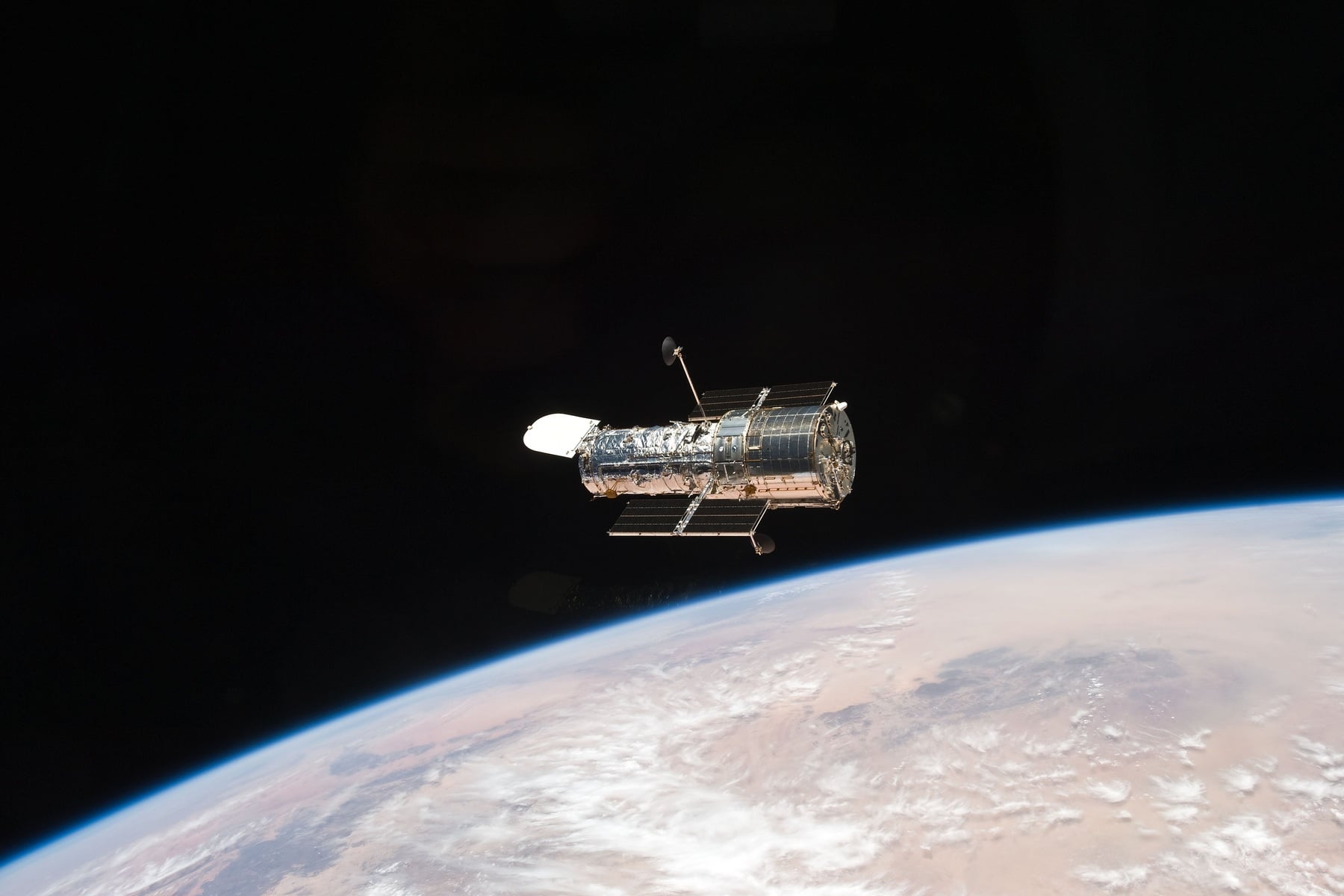
When the Hubble Space Telescope finishes observing one galaxy and turns toward another, nothing shoots into space. There is no hydrazine cloud or small rocket hiding behind the solar panels. The maneuver begins with electric motors that change the speed of the metal wheels inside the observatory. This is not simply a fuel saving technique. Hubble was built without thrusters for attitude control, in part because exhaust products could contaminate its field of view. Since the telescope was deployed in 1990, routine guidance has relied on two linked systems: reaction wheels that spin the spacecraft and magnetic torsion bars that prevent those wheels from building up too much momentum. A telescope rotates by accelerating something inside it. NASA’s description of Hubble’s guidance control lists four sets of reaction wheels. Each weighs about 100 pounds, or 45 kilograms, and is about two feet wide. An electric motor can accelerate a wheel or brake it. The principle of operation is the conservation of angular momentum. If one wheel gains angular momentum in one direction, the rest of the spacecraft must respond in the other direction. By accelerating the appropriate combination of wheels, Hubble begins to spin; Changing their speeds again slows the telescope as it approaches the commanded attitude. The wheels are not propellers and do not push air. They work precisely because the wheel and the spacecraft form a coupled mechanical system. The wheel rotates in one direction within the structure, while the approximately 12-ton observatory rotates in the opposite direction around their shared center of mass. Four wheels solve a three-axis problem A free spacecraft can rotate around three axes, which are conventionally called roll, pitch, and yaw. Three independently controlled reaction wheels are sufficient to control three axes. Hubble carries four so that the set of wheels has redundancy, and their orientations allow the control computer to combine their pairs into the required motion. The resulting rotation is intentionally slow. According to NASA’s mission operations guide, rotating Hubble 90 degrees takes about 14 minutes. NASA compares its fastest movement across the sky to the minute hand of a watch. A slow turn limits the forces imposed on the long telescope and gives the control system time to reach the next target accurately. Stopping in the approximate direction is only part of the operation. Mission planners must also allow the observatory time to identify guide stars and establish the stable orientation needed for an exposure. The Space Telescope Science Institute’s pointing primer describes a spin limit of about six degrees per minute and a separate guide star acquisition period. The time spent moving and acquiring guide stars is one reason why very close observations can be more efficient than repeated large spins. Gyroscopes detect movement; they don’t make it. Reaction wheels are often confused with Hubble gyroscopes because both contain rotating components and both belong to the orientation control system. Their jobs are different. Gyroscopes are sensors. They report the telescope’s rotation speed and help the computer determine how its attitude is changing. Reaction wheels are actuators. They apply the torque that makes the change occur. Other sensors provide different types of knowledge. Solar sensors establish a rough reference, magnetometers measure the local magnetic field, star trackers recognize stellar patterns, and fine guidance sensors lock on to guide stars for the precision needed during scientific observations. NASA’s Hubble overview puts the observatory’s pointing accuracy at 0.007 arc seconds, which is comparable to holding a laser beam over a small coin hundreds of kilometers away. This distinction is important when reading reports on gyro failures. SpaceDaily has previously covered Hubble’s move to single-gyro operations. That change reduced the sensor configuration used to set and maintain attitude; that did not mean that a gyroscope had taken over the physical work of rotating the observatory. Reaction wheels can be filled with momentum In an idealized system with no external torque, a reaction wheel could accelerate during a turn and then return that momentum. Hubble’s environment is not ideal. Even several hundred kilometers above Earth, traces of the atmosphere exert resistance. Sunlight produces radiation pressure and gravity can apply small orientation-dependent torques along an extended spacecraft. The signaling system continually corrects these disturbances. Each correction slightly changes the momentum stored in the wheels. If the ambient torque has a persistent trend, one or more wheels gradually move toward their maximum or minimum useful speed. Over time, a wheel would reach saturation, leaving very little speed margin to absorb the next disturbance or execute the next command. A closed spacecraft can’t solve that problem by simply spinning another internal part. The momentum moving between the wheels changes its distribution, but the total remains within the vehicle. To unload the wheels, Hubble needs to exert torque against something external to it. Magnetic bars provide an external purchase. That outer connection is the Earth’s magnetic field. Hubble has four magnetic torsion bars, located at 90-degree intervals around the spacecraft. Each is an iron bar about eight feet (2.4 meters) long and wrapped in coils of wire. Sending current through a coil gives the rod a controllable magnetic field. The interaction between that field and the Earth’s field produces a pair in Hubble. While the torsion bars provide the external torque, the control system can reduce the speeds of the reaction wheels and return them to a useful operating range without allowing the telescope to rotate. Engineers call the process impulse discharge or desaturation. The phrase “bleeding momentum” is convenient, but momentum is not destroyed. Hubble exchanges angular momentum with the Earth through magnetic interaction. The torque available depends on the strength and direction of the local field, so it is weaker and less direct than a rocket shot. However, it is sufficient for routine wheel handling in low Earth orbit. Why Hubble Doesn’t Use Thrusters for Pointing Many spacecraft combine reaction wheels with small thrusters. When your wheels approach saturation, brief bursts provide the external torque needed to unload them. That method is effective, but it consumes a finite liquid and releases exhaust gases near the vehicle. For Hubble, pollution was a central concern. A film deposited on optical surfaces could scatter light or reduce instrument performance, while material moving in the direction of view could interfere with observations. Magnetic discharge offered a clean alternative because it does not expel mass. Electricity from the solar panels powers both the wheel motors and the torque coils. This design eliminates a lifespan limit: Hubble cannot run out of attitude control thruster. It does not eliminate mechanical limits. Wheel bearings, motors, sensors, and electronics can wear or fail, and astronauts replaced one reaction wheel assembly during the 2002 servicing mission. NASA’s life extension work has included ways to operate with fewer reaction wheels in operation if necessary. Propellerless steering does not mean propulsion. The reaction wheels change where Hubble is pointing; they do not change the trajectory of their center of mass around the Earth. The magnetic torquers also control attitude rather than providing sustained orbital thrust. Hubble cannot raise its own orbit or replace altitude gradually lost to atmospheric drag. During the service era, visiting space shuttles performed restarts. The engineering achievement is narrower and more durable. For more than three decades, a telescope the size of a bus has crossed the sky without wasting fuel with each turn. Its wheels exchange momentum with the spacecraft, its magnet bars exchange accumulated momentum with Earth, and its sensors tell the system when the required attitude has been reached. The result is a steering architecture whose ordinary operation is almost invisible, although almost all Hubble observations begin with it. About this articleThis article is for general information and reflection. It is not professional advice. For your specific situation, consult a qualified professional.