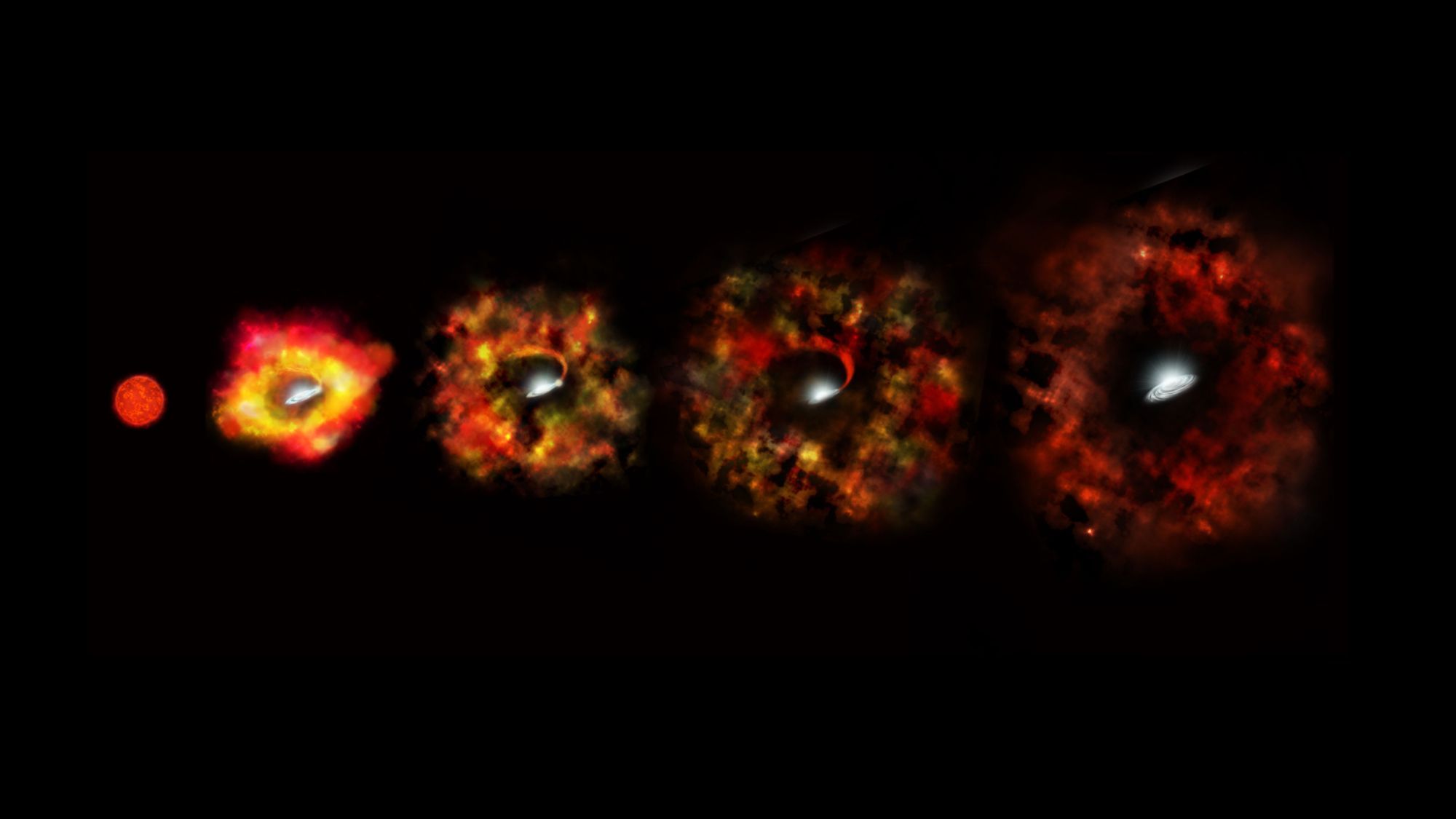
The way ghostly particles known as neutrinos can change from one type to another could help explain which stars explode and which collapse to form black holes, according to a new study. These new findings could also help explain a number of other cosmic mysteries, such as why astronomers have detected fewer supernovae than expected. When a massive star finally exhausts its fuel reserve, without nuclear reactions to drive the star’s expansion, its core will implode under its own weight. The extraordinarily high heat and pressure resulting from this collapse will crush protons and electrons, forming neutrons. This, in turn, releases an avalanche of ghostly particles known as neutrinos. Generally, neutrinos barely interact with all forms of matter. However, when the heart of a massive star collapses, it releases a staggering amount of neutrinos, enough for many to hit and heat the layers just outside the star’s core. In some cases, such neutrino heating can cause the rest of the star to explode as a supernova, leaving behind an extraordinarily dense cluster of neutrons known as a neutron star. In other cases, the heating of the neutrinos fails to cause an explosion and the star collapses, forming a black hole. “Neutrinos are not a secondary detail in supernovae,” study co-author Mariam Gogilashvili, a particle astrophysicist at the Niels Bohr Institute at the University of Copenhagen in Denmark, told Space.com. “They take with them about 99% of the energy released when the core collapses, and a small change in their behavior can decide the fate of the entire star.” You may like There is still a lot of uncertainty about which massive stars explode to give rise to neutron stars and which collapse to form black holes. Uncovering these details could help shed light on a wide range of activities in the cosmos, such as how dying stars filled the universe with the kind of matter that today makes up everything from planets to people. To shed light on these mysteries, scientists investigated the role that the strange nature of neutrinos could play. There are three “flavors” of neutrinos (electron, muon, and tau) that are named after the type of particle that generates each flavor if they ever collide with matter. In 1998, physicists discovered that neutrinos can “oscillate,” or change from one flavor to another, a finding that won the 2015 Nobel Prize in Physics. (There are three corresponding flavors of antineutrino that can change flavor in a similar way.) Muon and tau neutrinos (and antineutrinos) are much less likely to interact with regular matter than electron neutrinos (and antineutrinos). This suggests that changing the flavor of neutrinos could potentially influence the number of neutrinos that can heat matter in a dying star and trigger an explosion. Previously, scientists thought that the change in flavor would play only a negligible role in how dying stars collapsed. However, over the last decade, physicists have discovered that, given the staggering number of neutrinos that dying stars generate, many neutrinos are concentrated enough to interact with each other, causing flavor changes within the core of the collapsing star. In the new study, the researchers simulated the collapse of 195 stars, ranging in size from nine to 120 solar masses. They looked at different assumptions about where neutrino flavor conversion occurs in the cores of collapsing stars. What to read next Scientists found that changing the flavor of neutrinos could make dying massive stars much less likely to explode as supernovae and form neutron stars, and more likely to collapse to create black holes. “What surprised us most was that stars between 16 and 30 times the mass of the Sun, many of which comfortably explode in our standard simulations, turned out to be particularly sensitive to neutrino physics,” said study co-author Irene Tamborra, a particle astrophysicist at the University of Copenhagen. The Niels Bohr Institute in Denmark told Space.com: “A large number of them fail once flavor conversion is included.” These new findings could help solve a number of long-standing mysteries. For example, astronomers have detected fewer supernovae than theoretical predictions; The changing flavor of neutrinos could help explain these findings, Gogilashvili said. The changing flavor of neutrinos could also help reveal why the largest red supergiant stars seem to disappear without generating supernova explosions: they can collapse like black holes. Additionally, scientists estimated that changing the flavor of neutrinos could produce less massive neutron stars. This could help explain why astronomers have detected neutron stars with lower masses than previously theoretically predicted, Tamborra said. In the future, scientists want to include more realistic models of neutrino behavior in three-dimensional computer simulations of massive stars, so that the changing flavor of neutrinos begins and evolves over time as stars die. Gogilashvili and Tamborra detailed their findings in September in the journal Physical Review D.