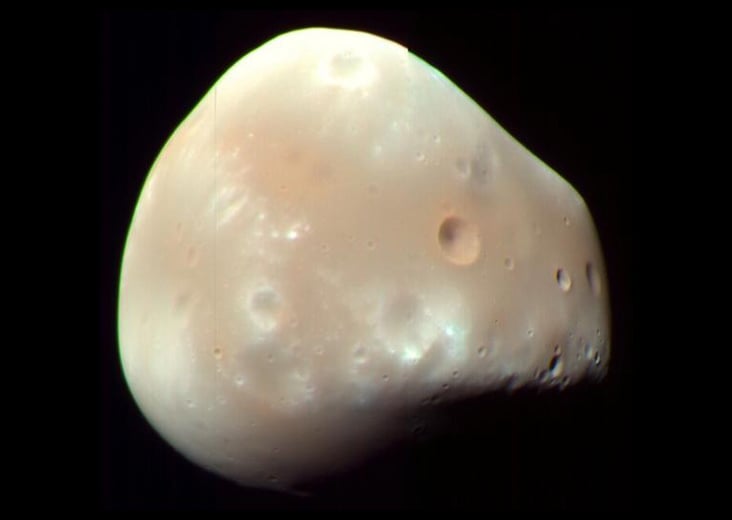
On Earth, orbit belongs to the realm of rockets. The International Space Station travels at approximately 28,000 kilometers per hour, and a projectile would need about 40,000 kilometers per hour near the Earth’s surface to escape without further propulsion. Around Deimos, Mars’ smallest moon, the same physics produces street-level numbers. A 2024 peer-reviewed study of Deimos’ gravitational field puts its gravitational parameter near 0.0000962 cubic kilometers per second squared, while the moon’s mean radius is about 6.2 kilometers. Put those values into the circular orbit equation and the result is approximately 3.94 meters per second, or 14.2 kilometers per hour, immediately above an idealized spherical surface. That’s in the range achieved by elite drag racers. The local escape velocity is just the square root of two majors: about 5.57 meters per second, or 20.1 kilometers per hour. The comparison sounds comical, but it exposes how different motion becomes in a world with almost no gravitational influence. A person cannot simply reproduce a terrestrial stride through Deimos. At these scales, running, jumping, orbiting, and escaping begin to overlap. Fourteen kilometers per hour comes from a small number. The governing quantity is called the gravitational parameter, usually written with the Greek letter mu. Combine the mass of a body with the universal gravitational constant. For a circular orbit, the velocity is equal to the square root of mu divided by the distance from the center of the body. Using JPL’s mean radius as the distance gives 0.00394 kilometers per second. Multiplying by 3,600 converts the value to 14.2 kilometers per hour. A circuit at that speed around a sphere with the average radius of Deimos would take about two hours and 45 minutes. The escape velocity comes from the same energy calculation and is exactly the square root of twice the circular velocity in the ideal two-body model. That produces about 20.1 kilometers per hour. NASA’s explanation of orbital mechanics derives the same relationship: the velocity separating a circular orbit from a free path is greater by a factor of about 1.414. The narrow gap is surprising. Only about 5.9 kilometers per hour separate the ideal surface orbit from the local escape. Around Earth, going from low orbit speed to surface escape speed involves a difference of more than 11,000 kilometers per hour. No spacecraft could safely graze a mathematical surface. The figure is a scale calculation, not a flight plan. Deimos is more lumpy than spherical. NASA gives its dimensions as approximately 15 by 12 by 11 kilometers, so the distance to the center changes substantially along the terrain. Local attraction also varies with the body’s internal mass distribution. A theoretical orbit at the mean radius would pass over high terrain in some places and over low terrain in others. Real vehicles require clearance, navigation margin, and a model of the irregular gravity field. Circular speed decreases slightly with altitude, but the growing influence of Mars makes the broader problem less like orbiting an isolated miniature planet. Deimos’ gravitational domain is minuscule. A calculation from its mass and distance to Mars places its Hill region, the area in which the material can remain primarily associated with the Moon, only a few tens of kilometers from its center. The exact useful space depends on the trajectory geometry and solar and Martian disturbances. That leaves little space between the surface and the boundary where Mars dominates. Stable operations would be designed with full three-body dynamics, not just the neat square root formula that produces the principal number. The pace of walking does not mean that an astronaut can enter orbit. Elite walking reaches approximately 14 to 16 kilometers per hour over long championship distances. The similarity is only in speed. Runners reach that pace because the Earth continually pushes them toward a firm path, producing the contact force necessary for the next step. Deimos’ surface gravity is only 0.0025 meters per second squared. An 80-kilogram astronaut would retain 80 kilograms of inertia but would press down with a force of only about 0.2 newtons. This is comparable to the Earth’s weight of approximately 20 grams. A brisk step would not produce a rapid sequence of steps. The astronaut would leave the surface and follow a slow ballistic arc, while there would be very little downward force available to create traction upon landing. Trying to accelerate harder could increase jump without improving control. Human movement would likely depend on restricted pushes, handholds, anchors, straps, and small propulsion systems. Robots face the same problem. A wheel that spins too aggressively can unload from the ground, while a sampling arm can push the entire spacecraft away from its target. Twenty kilometers per hour escapes Deimos, not Mars. Escape velocity always needs an indicated destination. Reaching about 20 kilometers per hour with respect to Deimos is enough in the simplified model to avoid returning to the Moon. This does not mean that the traveler has escaped from Mars, crossed interplanetary space, or returned to Earth. Deimos itself travels around Mars at about 1.35 kilometers per second, almost 4,900 kilometers per hour. A tool or spacecraft leaving the Moon at a few meters per second keeps almost all of that larger motion centered on Mars. It enters a slightly different orbit around Mars instead of darting out of the planetary system. Direction matters as much as speed once Mars is included. A departure to or from the planet behaves differently than one along Deimos’ orbit. The lowest energy path through the Moon’s gravitational limit is not identical in all directions, which is another reason to treat 20 kilometers per hour as a useful local reference point rather than a universal operational threshold. The distinction also explains why it would be risky to drop any Deimos. Many normal human throws exceed 5.6 meters per second. An unsecured tool could leave immediate control of the moon, but would remain astronomically close and could enter a path that would then cross back into Deimos. Deimos also moves and rotates Deimos completes one orbit around Mars in about 30 hours and rotates once in the same interval. It is tidally locked, presenting approximately the same hemisphere toward the planet. Therefore, the surface at its equator moves around the Moon’s axis of rotation at about 1.3 kilometers per hour. Throwing in the direction of that rotation provides a small advantage relative to inertial space; throwing it in the opposite direction subtracts it. The effect is modest by terrestrial standards, but is no longer negligible when the circular speed itself is only 14 kilometers per hour. Deimos is also located outside the synchronous orbital distance of Mars. Mars rotates faster than Deimos rotates around it, so from much of the Martian surface the moon follows the familiar pattern of rising in the east and setting in the west. Phobos occupies the opposite regime. It circles Mars more than three times per Martian day and appears to cross the sky backwards, as explained in SpaceDaily’s account of the inner moon’s unusual orbit. The uncertainty inherent in JPL provides uncertainties for both Deimos’ gravitational parameter and its mean radius. When taking into account the ranges mentioned in the calculation, the ideal circular speed is between 13.7 and 14.7 kilometers per hour and the escape speed between 19.4 and 20.7 kilometers per hour. These aren’t big enough errors to ruin the comparison, but they are important for spacecraft. Deimos has never been orbited at close range by a dedicated mission, and measuring the gravity of such a small body is difficult. Its irregular shape also means that a globally averaged figure cannot reproduce conditions at all points. The uncertainty connects directly to the unresolved interior of the moon. The JPL table gives an average density of about 1.47 grams per cubic centimeter, much lower than that of solid rock. Deimos may contain considerable pore space, although density alone cannot reveal exactly how the voids, rocks, and possibly ice are arranged. A recent SpaceDaily report on new impact simulations found that the Moon’s enormous south polar trough and its strangely smooth terrain could be reproduced if Deimos behaves like an exceptionally weak, porous pile of debris. That interpretation remains a model to be tested, but it offers a physical reason for the weak gravity behind these walking speed figures. Weak gravity changes every ordinary action. HiRISE observations show Deimos covered by a thick layer of fragmented rock, with subtle color differences around recent craters and topographic maxima. NASA notes that debris from the impact may leave the surface because the moon cannot hold it firmly, then linger around Mars and then return to Deimos. That cycle is an orbital version of the same event described in the headline. Dust doesn’t need rocket speed to get out. Material lifted by an impact can cross the line from falling back into orbit somewhere else after only a small change in velocity. For future visitors, the challenge would be not generating enough power. It would be applying minuscule forces with precision and ensuring that every person, instrument and fragment remained controlled. On Deimos, orbital mechanics start at a sprint pace, and an extra burst no faster than a modest Earth dash can make the difference between returning home and never touching the moon again. About this articleThis article is for general information and reflection. It is not professional advice. For your specific situation, consult a qualified professional.