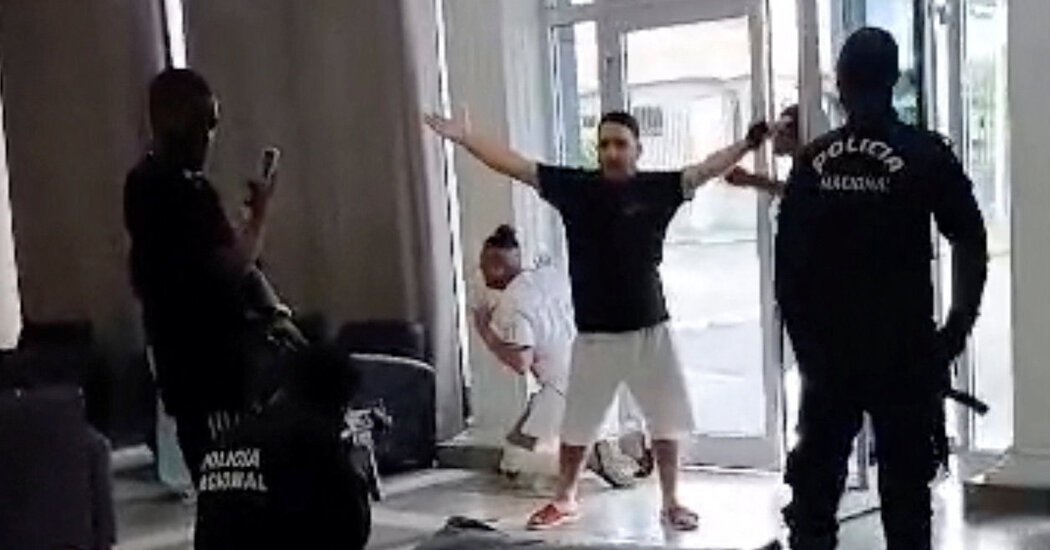
Two men deported to Equatorial Guinea by the Trump administration were hooded, tied up, pistol-whipped and pushed down a flight of stairs recently by police officers at a remote hotel where migrants are being held indefinitely, according to witnesses and lawyers. The deportees said the beatings and subsequent arrests were aimed at preventing them from telling the outside world about the deteriorating conditions and increasing violence inside the hotel, which has become a de facto prison for 29 men and women from different countries. Experts and human rights advocates predicted such abuses after the Trump administration began deporting people to authoritarian countries where they had no ties or, in many cases, legal rights. Equatorial Guinea, like other countries cooperating with the U.S. deportation program, is known for human rights violations, including torture and arbitrary arrests, according to the State Department. Equatorial Guinea, a small autocracy on the west coast of Africa, is one of many countries that have agreed to accept immigrants deported from the United States. Without legal status in the country, the deportees are being held at the Hotel Bamy, a dilapidated building on the outskirts of the city of Malabo. Armed police officers stand guard 24 hours a day and frequently harass and intimidate people there with impunity, deportees said. “We are now in imminent danger and we cannot continue living like this,” Ahmed Soliman, a deportee at the hotel, said in a text message to the New York Times this month. “I’m tired and I’m really afraid for my life.” He was one of two men who were later beaten and hooded, witnesses and the human rights group Amnesty International said. Although the hotel functions as a prison, none of the migrants are accused of any crime in Equatorial Guinea. Indefinite detention reflects a contradiction at the heart of many agreements between Washington and foreign governments. Equatorial Guinea has agreed to accept people, but has not given them legal rights or documents that would allow them to live or work there, even temporarily. American judges had ruled that most of the migrants at the hotel could not be deported to their home countries because they were likely to be tortured or persecuted. For years, officials allowed many of those people to remain in the United States by default, despite their lack of legal status. The Trump administration ended that policy and is working to find countries, like Equatorial Guinea, willing to accept them. Videos and interviews show that police aggression inside the hotel intensified in recent weeks and peaked on September 11. Police put burlap sacks over the two men’s faces, tied their hands with ropes, hit them with pistols, and pushed them down stairs while several deportees watched. The beatings were recounted by multiple witnesses and lawyers. The police officers shouted, “Where’s the phone? Where’s the phone!” the witnesses said. The migrants had been using mobile phones to talk to journalists and lawyers about the lack of running water, nutritious food or medical care. The beating, witnesses said, came after the release of a video, first reported by Reuters, showing the deteriorating situation at the hotel. Police also searched hotel rooms for mobile phones, the deportees said. The deportees spoke only on condition of anonymity because of the threat of retaliation. Western lawyers, including Bella Mosselmans, Alexandra Smolyar and Meredyth Yoon, who represent some of the deportees, discussed details of the beatings and arrests. A local attorney spoke on condition of anonymity for fear of retaliation. Messages seeking comment from the Equatorial Guinea government, left at its embassies in London and Washington, were not returned. Police arrested the two men, Mr Soliman, originally from Egypt, and Samson Birhane, from Eritrea, apparently over a broken mirror in the hotel elevator. Ms. Mosselmans said authorities were retaliating because the two had tried to make the public aware of the mistreatment they had received. They were held in a local jail and then disappeared for two days, their attorneys said, before being returned to jail. The State Department did not respond to a message seeking comment Friday morning. The government has said little about so-called third-country deportation agreements. In court papers, the Trump administration has argued that once someone is deported to a foreign country, it cannot control what that government does. Equatorial Guinea had promised the United States, in a diplomatic note, that it would not subject deportees to torture or other ill-treatment. The Department of Homeland Security, in a statement after this story was published, said that all people sent there were “deported to a safe third country” and that the administration was “enforcing the law as it is written.” The New York Times interviewed four deportees in recent weeks who described abusive treatment by armed police officers. The agents, mostly young, carry semi-automatic firearms and periodically arrive at the hotel. Sometimes, two of the deportees said, the guards are drunk. In July, police officers broke into five hotel rooms, grabbed people by the neck and knocked them to the ground, according to deportees and lawyers. The agents took the migrants out of the hotel, pointed guns at them and threatened to kill them (and bury them in a field across from the hotel property) if they did not voluntarily return to their home countries, they said. “They’re telling us, ‘The United States doesn’t know where you are,’” one witness said. “They say, ‘We’ll put them on a plane, kill them all, put them in prison, and no one will see them again.’” A video shared with The Times shows a separate incident in which a government official tells an Ethiopian man that his options are to “return to your home country” or “go to prison.” The government has already returned at least a dozen people to their home countries, despite legal protections in the United States and the risk of abuse there, according to lawyers. Many of these deportees have since disappeared or gone into hiding, lawyers said. In May, United Nations experts asked the Equatorial Guinea government for access to medical care and basic needs at the hotel. A video shared with The Times shows a bathroom faucet not dispensing water. A local attorney who visited recently said he found no medical supplies even though several people were suffering from serious health problems, including diabetes and a serious hernia. Recently, the government also used the hotel to quarantine a suspected Ebola patient, one of the lawyers said. Videos shared with The New York Times show healthcare workers in protective suits appearing to transport patients to the hotel. Soliman, in interviews with The Times before he was arrested, said nurses and police told him the patient had Ebola. The two men who were beaten and arrested, Birhane and Soliman, were taken to a detention center called La Luna, which is known to be severely overcrowded. A lawyer who was in contact with the men said they had been denied food and their bodies were covered in bruises. Soliman, 31, had a green card in the United States, where he had lived since he was three, according to records submitted to the African Commission. He lost that status after being sentenced to prison in 2023 for drug possession and aggravated assault. While Mr. Soliman was serving a prison sentence, a judge ruled that he could not be deported to Egypt because, as a gay man, he would most likely be tortured there. This year he was deported to Equatorial Guinea. Birhane, 47, came to the United States as a refugee at age 13. He was deemed deportable after a second-degree robbery conviction in 1998, while he was in high school. A judge ruled that he could not be returned to Eritrea given the risk of torture there. He had lived in the United States since then and communicated regularly with immigration officials. At one of those checkpoints this year, he was arrested and later deported. The lawyers sent several emails to David Gilmour, the U.S. ambassador to Equatorial Guinea, and others at the U.S. embassy, according to correspondence they shared with The Times. Emails have not been answered, they said. On September 11, the day Soliman and Birhane were beaten and arrested, Gilmour met with the vice president of Equatorial Guinea, who is also the president’s son. Vice President Teodoro Nguema Obiang Mangue also made a phone call to Stephen Miller, a White House adviser and key driver of the Trump administration’s immigration policy. The two discussed “different issues related to migration,” according to a statement posted on the ruling party’s website. Hamed Aleaziz contributed reporting.