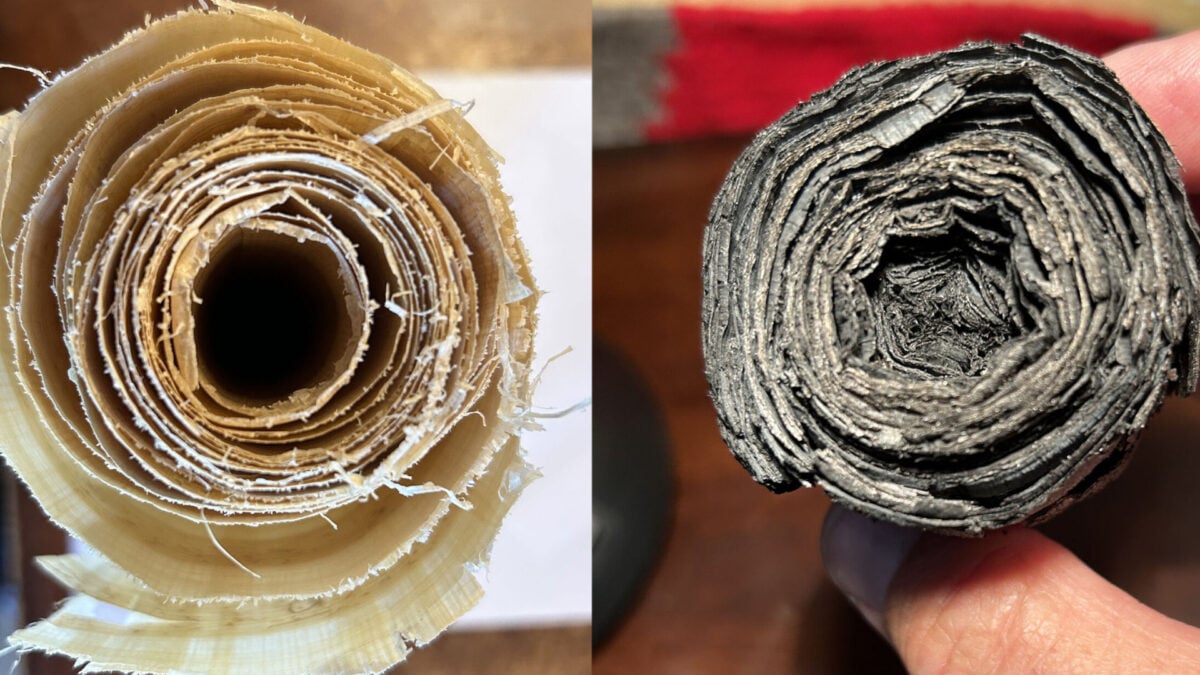
How do you test a theory about how to decipher a priceless archaeological artifact? According to a team of researchers, children are paid to make false versions. A team of scientists has proposed a new approach to reading the famous Herculaneum scrolls: 2,000-year-old texts that are impossible to unroll because Mount Vesuvius burned them to a crisp in 79 BC. They suggest looking for lead in the ink. In a study published yesterday in the journal PLOS ONE, the team writes that even small amounts of lead in the ink make the letters highly detectable using CT x-rays (an imaging technique). “If we know that the Herculaneum papyri contain lead (some do, some don’t), then when they do the CT scan, they can scan it with sensitivity for the element lead and we can see where the ink is,” Leah Packard-Grams, a papyrologist at the University of California, Berkeley, who was a consultant for the research, explained in a statement. “As you unroll it, you can map the letters much more clearly.” An intact ancient library The eruption of Mount Vesuvius triggered the most infamous ancient tragedy and, in Herculaneum, the only intact library from antiquity known today was preserved. The caveat is that all the ancient scrolls in the library are completely charred. After their discovery in 1751, “experts” attempted to physically unroll them, but mostly ended up with piles of ash. Only last summer did researchers manage to unroll and read virtually a complete Herculaneaum scroll, but they did not take advantage of the possible presence of lead. Above: The modern burnt papyrus scroll from the recent study. Below: an authentic Herculaneum scroll. © Douglas Seiler and EduceLab, Univ. of Kentucky © Douglas Seiler and EduceLab, Univ. “With lead in the ink, you would get a huge damn signature, so you really have to look for scrolls that have lead in them,” said Douglas Seiler, study co-author and retired inventor. “Many of them have trouble reading because of the low contrast of carbon ink on carbon paper,” he added, presumably referring to other scientists working on the scrolls. “We’re relatively confident that if they start looking for lead, or let us look for lead, it will help this whole process. This is the Holy Grail.” To test this theory, Seiler made his own crispy Herculaneum scroll with papyrus and reed quills from Egypt and traditional smoke black ink from Japan. He paid high school students to write on the papyrus with inks of various concentrations of lead, rolled it up, put it in a semi-sealed, low-oxygen steel container, and put the container in a high-temperature oven. Seiler hired high school students to write texts on new papyrus. © Douglas Seiler © Douglas Seiler The team then performed a 3D X-ray CT scan of this grilled imitation Herculaneum roll. The lead absorbs more X-rays than the surrounding papyrus, so the ink appeared shiny in the resulting 3D computer model. However, a 3D model of a burnt scroll is still illegible, so the team used a computer algorithm to virtually unroll the scroll and display the text, including excerpts from the Bible and Star Wars. Unquantifiable value The team that produced the first reading of a complete Herculaneum scroll a few months ago followed a similar process, but as mentioned above, they were not looking for lead ink. Researchers have previously discovered lead ink in two fragments of Herculaneum scrolls, but no one has searched thoroughly for it in the Herculaneum scrolls. On this front, Seiler and his colleagues showed that a cheap, portable X-ray fluorescence scanner (a technique for identifying elements in materials) can identify lead ink in charred parchment. They found that even ink with a low concentration of lead was easily detected by X-ray CT and X-ray fluorescence. “The value of this project is virtually unquantifiable,” Packard-Grams said. “Doug had a great scientific idea in creating a model,” he added. “If you damage a model, that’s fine. If you damage a 2,300-year-old ancient artifact, you’ll have a group of archaeologists ready to attack you.”