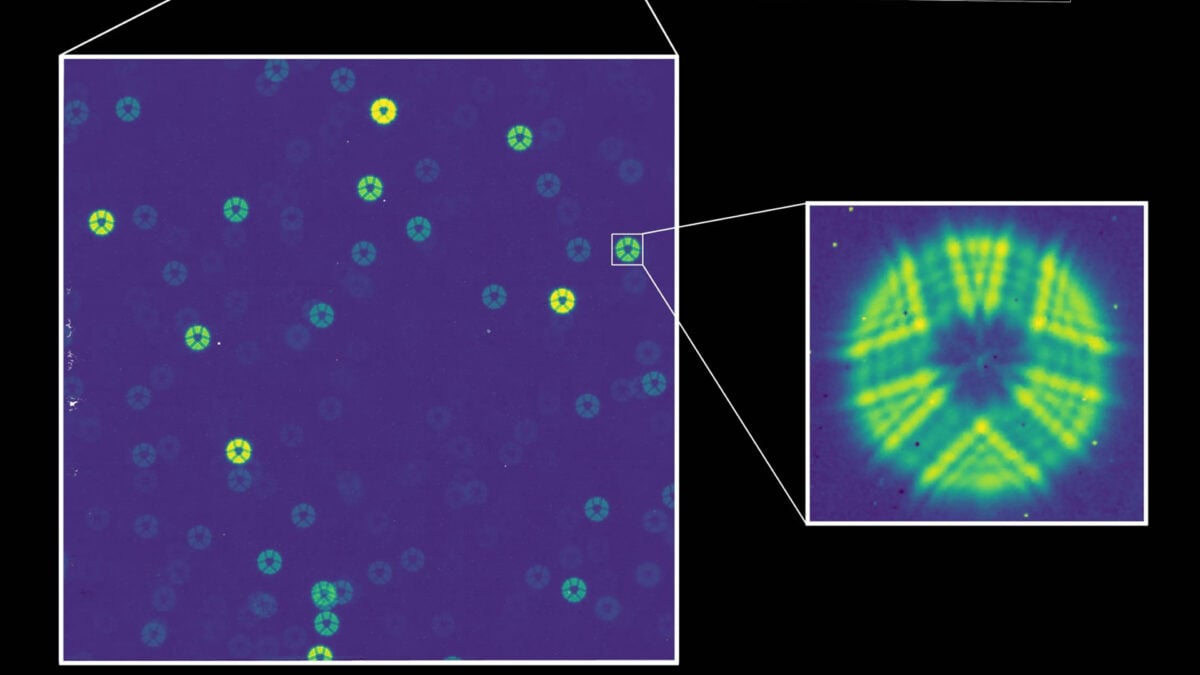
The road to launch was long and arduous, but NASA’s Nancy Grace Roman Telescope finally reached space in late August. While Roman is still en route to his final destination, on Thursday he reached an important milestone: the first light of day. In a blog post, NASA reported that Roman’s technical team successfully activated the telescope’s wide-field instrument, the 300-megapixel infrared camera programmed to take wide, high-resolution images of the deep cosmos. As a treat to the public, the team shared the first test images taken by the camera, showing the first starlight photons reaching Roman’s extremely sensitive sensor. Additionally, the team was able to confirm that the telescope’s thermal control was working as expected. Investigators will continue to monitor Roman’s condition for the next 30 days, but the message is clear. Romano is operational! Images of the first starlight to hit Roman’s wide-field instrument, taken as an initial assessment of performance with the detector array still stored as it was for launch, far from best focus. The team will soon activate the instrument’s fine guidance system, which will mean Roman will be able to set targets. Credit: NASA-GSFC/Tyler Desjardins (STScI) Initial photographs show a field of blurry green, yellow and blue stars on a blue background, with individual stars looking more like halos or donuts than points of light. Don’t worry though, the camera is still cooling in its housing and hasn’t been properly focused or calibrated yet, so once it’s fully deployed those pretty donuts will be shining. “After years of efforts to build and test the instrument on the ground, we now have confirmation that it is operational in space,” said Josh Schlieder, instrument scientist at NASA’s Goddard Space Flight Center. “There is a lot to do, but we are on the path to innovative science.” Flying over tough times Those who follow spaceflight news may know the budget storm Roman had to endure, even in 2025. Fortunately, the telescope, which some experts say brings the power of “200 Hubbles,” was not canceled and, in fact, took off ahead of its initial launch plan for 2027. As of now, Roman is making its million-mile (1.5 million kilometer) journey to the second Sun-Earth Lagrange point, or L2. A SpaceX Falcon Heavy rocket launches with NASA’s Nancy Grace Roman Space Telescope on board from Launch Complex 39A, Sunday, Aug. 30, 2026, at NASA’s Kennedy Space Center in Florida. Credit: NASA/Joel Kowsky Like the James Webb Space Telescope, Roman studies the universe by searching for infrared light and will have an observing range approximately 100 times greater than the Hubble Space Telescope. Given the immense contributions to astronomy we’ve seen from Webb and Hubble, it goes without saying that Roman will further advance our understanding of the universe and how we got to where we are today. First Light and Beyond The $4 billion space telescope is obviously designed to withstand the uninviting conditions of deep space, but scientists keep their eyes peeled to check, double-check and triple-check that every part of the telescope is in order. To put this in perspective, before activating the wide-field instrument, the team had to let it dry and cool for 10 days at a specific temperature, so as not to overload Roman’s laptop-sized infrared detectors. This was one of many preliminary tests conducted in recent weeks, according to NASA. Technicians and engineers use a crane to lift the agency’s Nancy Grace Roman space telescope into a specialized workstation on Friday, June 26, 2026. Credit: NASA/Sydney Rohde (Rocz) Once Roman formally begins his mission (which was extended from 10 to 22 years thanks to a better-than-expected launch), he will observe the universe for three main goals: dark matter, the expansion of the universe, and planets outside our solar system. All three are very important, complicated and challenging to approach in different ways; Basically, they are the questions that give astronomers the worst headaches. So, as the old wisdom of physics goes: to answer big questions, build big machines.