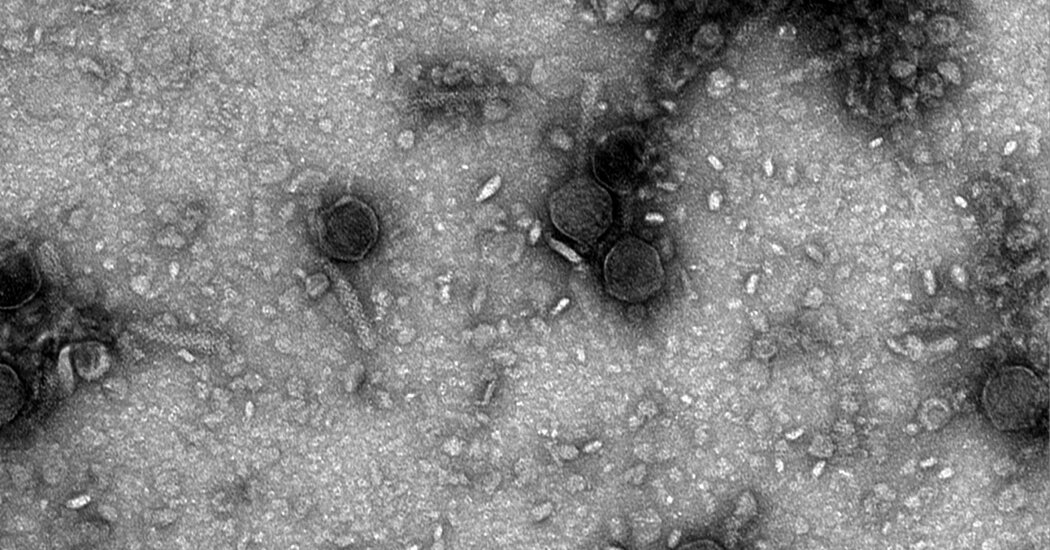
Over the past decade, the gene-editing technology known as CRISPR has become a familiar scientific tool, used to create life-saving cures, make crops more productive, and even engineer allergy-free dogs. But scientists didn’t invent CRISPR from scratch. They discovered it in bacteria and other microbes, which use it as a defense against invading viruses. On Thursday, scientists reported that they had found another gene-editing defense in nature, this one in viruses themselves. This system, called VIPR, appears to be more than four billion years old and appears to be the evolutionary ancestor of CRISPR, the researchers wrote in two papers published in Science. It may prove to be the most powerful gene editing tool, with certain advantages over CRISPR. VIPR appears capable of targeting a wider variety of genetic sequences, allowing it to alter more parts of the genome. And these molecules are smaller, making them potentially easier to get into cells. “VIPR’s incredibly small size makes these systems transformative tools for genome engineering,” said Philip Kranzusch, a microbiologist at Harvard Medical School who was not involved in the research. Jennifer Doudna, a biochemist at the University of California, Berkeley, who authored the studies, shared the Nobel Prize in 2020 for harnessing the power of CRISPR. After that breakthrough, he began to wonder how the natural version of the gene editor evolved. “It had to come from somewhere,” he recalled thinking. “Maybe it was being used to do something else before, and maybe there’s still evidence of what it might have been doing.” CRISPR is made up of proteins and RNA molecules that come together to destroy viral genes. The RNA molecule consists of a sequence of building blocks that exactly matches the genetic sequences of certain viruses. The RNA attaches to the viral genes and the protein it has brought cuts the DNA chain, deactivating the virus. Since the first CRISPR systems were discovered in the 1990s, scientists have found them in an increasing number of microbes. By comparing their genes, scientists have gained insight into the evolution of CRISPR. In 2024, researchers concluded that the common ancestors of all living things carried CRISPR molecules. But where did this defense to destroy DNA come from? When biologists try to look that far back, the picture becomes confusing. It’s like looking through a telescope: the farther you look, the blurrier the stars become. Two years ago, Peter Yoon, then a graduate student working with Dr. Doudna, set out to build a better telescope. Instead of examining CRISPR genes, he studied the molecules encoded by those genes. A gene serves as a model for a protein. When a gene mutates, the protein it codes for can also change, but sometimes a genetic mutation will have no effect. Its protein may still retain the same general shape, even after billions of years. The shape of a protein determines the chemical reactions it can carry out. Once a protein evolves to do something, it typically keeps doing it. “Nature is very vague,” said Dr. Yoon, who is now a member of the technical staff at Anthropic, the artificial intelligence company. Working with Kenneth Loi, a graduate student, Dr. Yoon examined 2.3 million proteins and found hundreds that looked like CRISPR molecules but were not part of the gene editing systems in microbes. No one had figured out what any of these CRISPR-like proteins were doing. But Dr. Yoon and Mr. Loi discovered a surprising fact: almost all of them came from viruses. “It was a complete reversal of what we expected,” Dr. Yoon said. CRISPR is a weapon that microbes like bacteria use against viruses. Now scientists were finding viruses that seemed to carry a version of it themselves. Kranzusch noted that this discovery would have been impossible just a few years ago. Artificial intelligence systems now allow scientists to discover ancient connections between proteins that until now were hidden. “It is a beautiful demonstration of the power of these methods,” he said. Yoon and his colleagues named these proteins VIPR and set out to discover how they worked. That required conducting experiments with real viruses. On their list of candidates, they noticed a strain that Dr. Doudna had stored in her lab’s freezer for other experiments. “We were very lucky,” Loi said. “We just thawed the virus and infected some cells and said, ‘Let’s see what we find.’” Infected cells produced VIPR proteins, which then bound with viral RNA molecules. And like CRISPR, these molecules targeted viral DNA, the researchers found. While CRISPR proteins cut genes, VIPR proteins wrap them. The effect is the same: specific genes are deactivated.Dr. Doudna and his students see this biochemistry as a weapon that viruses must deploy against other viruses. “Everything is starting to make sense,” he said. “This is some kind of ancient viral war.” The idea is that when two viruses infect the same cell, they have to compete for control of the cell’s molecular machinery. A virus carrying VIPR genes can destroy its rival. Only the triumphant virus manages to replicate within the host.Dr. Doudna and his colleagues propose that VIPR emerged early in Earth’s history, more than four billion years ago. As viruses competed to infect early microbes, they fought each other with gene-targeting molecules. That fight continues today. CRISPR emerged from this viral weapon, the researchers suggest, when microbes took over the system for their own use. It is quite common for viral genes to accidentally end up in the genomes of their hosts. (Our own DNA is riddled with them.) “You can imagine VIPR is a weapon that viruses target each other,” Dr. Yoon said. “If the bacteria just steal that, it becomes an immune system.” It remains to be seen whether VIPR can become a gene editing tool. But its discovery has left scientists wondering whether the long battle between viruses has produced other genetic weapons that have not yet been found. “I would be very surprised if VIPR was the last unexpected localization system we discovered,” said Rafael Pinilla-Redondo, a virologist at the University of Copenhagen who was not involved in the studies. Doudna said she was honored to think that an ancestor of gene-editing systems was in her lab’s freezer for years: “It’s a great reminder of how little we still understand about biology.”