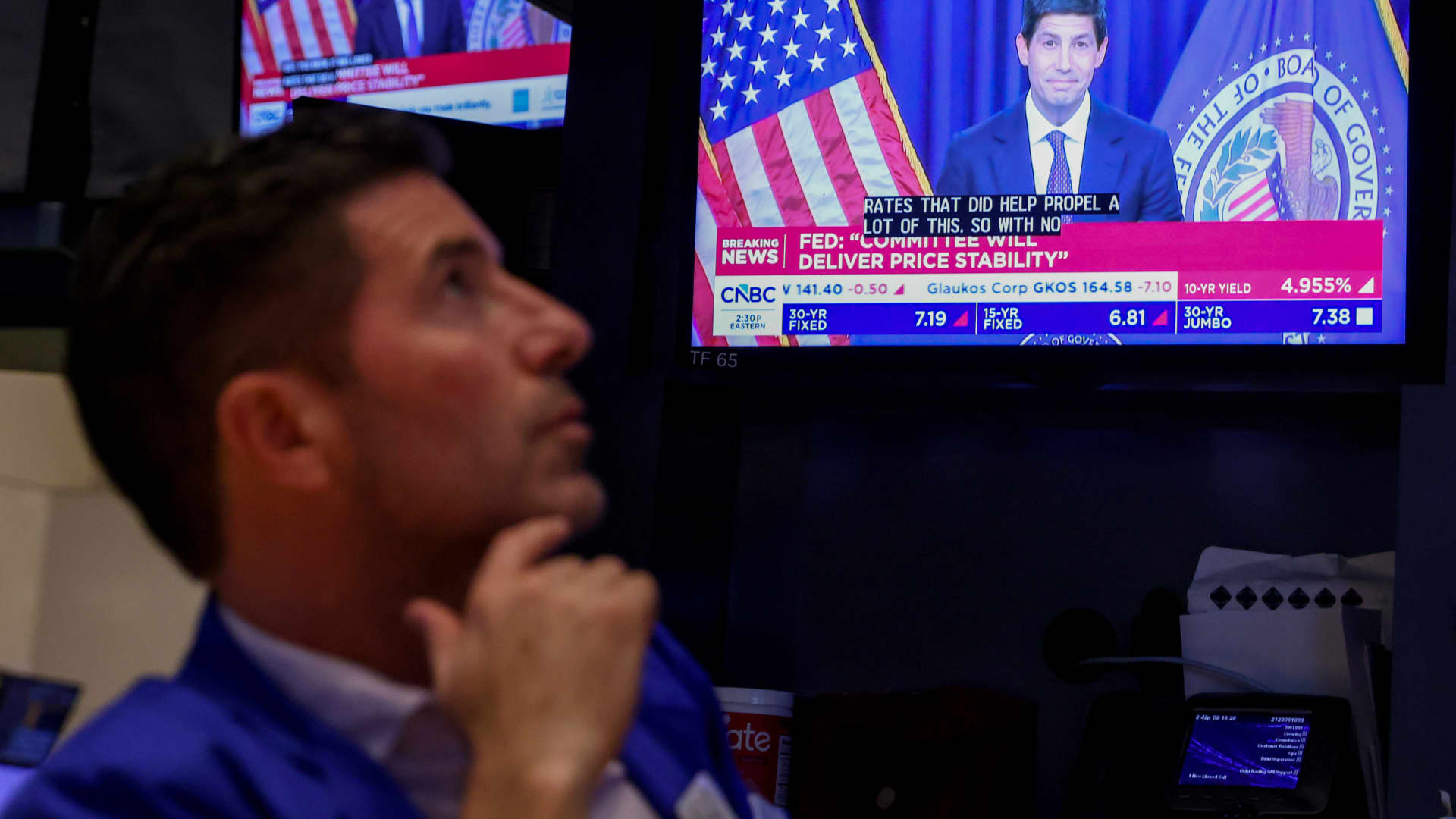
Treasury yields fell slightly on Thursday after the U.S. Federal Reserve raised interest rates for the first time in three years. The benchmark 10-year Treasury yield was 2 basis points lower at 4.984% as of 4:55 a.m. ET. The 30-year Treasury yield fell 1 basis point to 5.334%, while the 2-year bond yield fell 2 basis points to 4.705%. One basis point is equal to 0.01%, and yields and prices move in opposite directions. The Fed raised its benchmark interest rate by 25 basis points to a target range of 3.75%-4% on Wednesday, its first increase since July 2023. Markets widely expected the central bank to approve an increase, after a series of hot inflation data and pressures on the bond market. Federal Reserve Chairman Kevin Warsh said during a news conference Wednesday that inflation has been “too high… for too long.” “We must be confident that core inflation is moving toward our target clearly and at sufficient speed,” he said, adding that the Federal Open Market Committee had decided that “this standard has not been met.” Federal Reserve officials also signaled that another rate hike is likely this year. The dot grid of individual officials’ expectations indicated that 16 of the 18 participants expected another rate increase, and four saw two more increases as a possibility. Traders are also keeping an eye on the working relationship between Federal Reserve Chairman Kevin Warsh and President Donald Trump, with the latter continuing to push for interest rate cuts. “Interest rates in America should be 1 percent, or less, because we are the best credit in the world, by far,” Trump said in a social media post. He also told reporters Wednesday that the Federal Reserve board is “very hostile…very political” and “doing the wrong thing.” Bob Edwards, chief investment officer at Florida-based Edwards Asset Management, said in an emailed note Thursday that larger bond market moves are “likely now in the rearview mirror.” “If the Fed raises rates again, it would likely be at the December meeting, as the Fed is unlikely to announce interest rate changes at the October meeting, days before the midterm elections, for fear of appearing political.” CNBC’s Jeff Cox and Justina Lee contributed to this article.