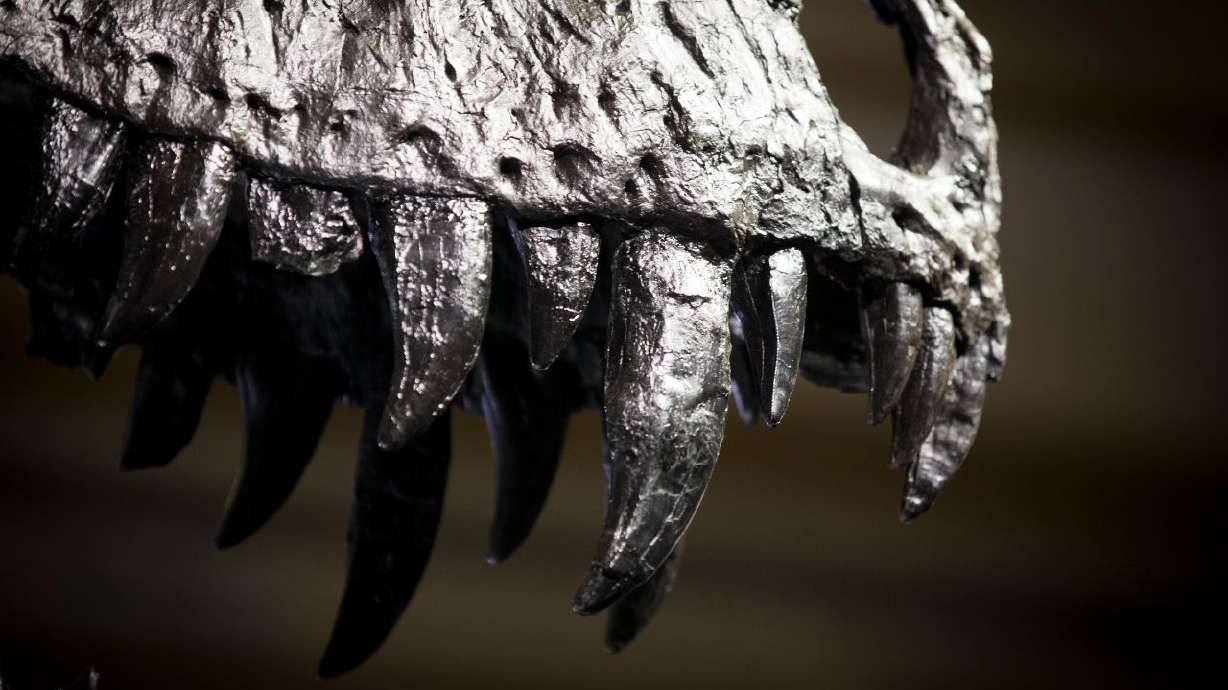
ATLANTA – Scientists have suspected for almost 60 years that Tyrannosaurus rex was warm-blooded. When a fossilized T. rex footprint turned up in Alaska in 2022, it added to evidence that these predators could thrive in frigid environments, where most cold-blooded reptiles could not. Now, researchers have put a figure on the temperature that tyrannosaurs were likely running: about 97 degrees Fahrenheit, or 36 degrees Celsius, similar to that of humans. A new study published Wednesday in the journal Science Advances provides the first direct estimate of T. rex body temperature, using a technique that analyzes chemical signatures preserved in fossil teeth. The find adds crucial evidence to decades of research suggesting the giant predator was warm-blooded and capable of maintaining an active metabolism even in cold climates. “It’s probably the most direct and least complicated constraint on the actual body temperature of a T. rex that has ever been possible before,” said study co-author Robert Eagle, a geobiologist and associate professor at the University of California, Los Angeles. Having an estimated body temperature for the T. rex provides a better look at what life was like for the dinosaur 69 million to 66 million years ago. “This was a warm-bodied organism, which really put new constraints on its behavior, its physiology, how it interacted with other species and how much food it needed, for example,” Eagle added. So far, the technique has been used on a handful of ancient species, including other dinosaurs, woolly mammoths and megalodons, giving scientists a clearer picture of how extinct animals regulated their body temperatures in ancient climates. The temperature is unusually high for a reptile, but Eagle said the number itself was not surprising. Dinosaurs, although classified as reptiles, share an evolutionary link with birds. The new issue reveals that T. rex falls between the two (warmer than reptiles but cooler than modern birds) and allows scientists to formulate new hypotheses about how exactly the prehistoric predator might have moved and lived. body temperature from chemical bonds preserved in tooth enamel. {#Thomas the T Rex}Researchers spent more than a decade perfecting the method to make the measurement possible. Over the years, their work reduced the amount of fossil material needed by about 90%, allowing the museum to provide small samples of two teeth that were not on display. “No one can measure a T. rex tooth unless you can show them that you only need a few milligrams,” said the study’s lead author, Aradhna Tripati, a climate scientist and professor of geochemistry at UCLA. “For such a famous animal, it’s surprising how little we actually knew. We had guesses about T. rex metabolism, mostly from bones and biomechanics. We had no temperature,” Tripati added in an email. “The enamel chemistry recorded the temperature at which it formed and 66 million years later we can read it.” The researchers essentially used the teeth of the T. rex as a prehistoric thermometer. Within tooth enamel there are different forms of the elements carbon and oxygen, called isotopes. These isotopes form bonds with each other at rates that depend on temperature: colder temperatures produce more bonds, while warmer temperatures produce less. By drilling a few milligrams of enamel and measuring those bonds, scientists were able to determine the temperature at which the enamel formed, revealing the T. rex’s body temperature. This technique can be used on any part of the skeleton, but teeth work best because their hard enamel is less likely to change over millions of years, Eagle explained. “We’ve been wondering whether dinosaurs were warm-blooded or not literally since the first time dinosaurs got their name,” said vertebrate paleontologist Thomas Holtz Jr., referring to Richard Owen’s 1842 paper, which introduced the name Dinosauria and suggested that dinosaurs might have had characteristics of warm-blooded animals. Holtz added that while there has been several pieces of evidence supporting the idea that dinosaurs were endothermic, or warm-blooded, this new method offers another way to examine the question. Comparing the body temperature of T. rex to that of cold-blooded crocodiles and clams from the same time and place “gives great confidence that the values they find for Tyrannosaurus actually show a high body temperature,” said Holtz, a senior professor in the department of geology at the University of Maryland. He did not participate in the study. In the future, Holtz said it would be interesting to explore the question of whether all dinosaurs were warm-blooded. Using this method next on groups like Triceratops, Stegosaurus and Brachiosaurus, which have sometimes been considered “colder-blooded,” could help answer the question, he added. rex was hotter than some modern mammals. Although T. rex was a reptile, its estimated body temperature of 97 F falls within the range seen in modern warm-blooded animals. Warm-blooded species vary considerably in body temperature. Some mammals, including sloths and anteaters, can have temperatures in the 90s Fahrenheit (about 32 C), while small, high-metabolism birds can exceed 104 F (40 C), Eagle said. Modern cold-blooded reptiles typically have body temperatures of around 82 F to 86 F (28 C to 30 C). Eagle added that these temperatures align with the animals’ energy levels: Reptiles tend to be more inactive, while birds have to expend a lot of energy while flying. A higher, regulated body temperature would also have helped the T. rex stay active for longer periods. “I don’t think T. rex would be thought of as a particularly fast sprinter, but the implications of this are perhaps that it could maintain energetic output for longer periods, probably, than a cold-blooded organism would be able to,” Eagle said. For example, “crocodiles can run short distances, but they can’t keep up for a long time.” A warm-bodied T. rex supports the idea that tyrannosaurs were active predators with fast metabolisms. The dinosaur’s ability to maintain a high body temperature would also have allowed it to survive in colder climates where cold-blooded animals could not. “What the teeth tell us is that the T. rex was warmer than the environment around it,” Tripati said. “A warm-blooded T. rex is a T. rex that can go almost anywhere on the continent, including the Arctic. It’s a very different animal from a sunbathing reptile.” To explore where the dinosaur might have lived, researchers used paleoclimatic models to reconstruct what temperatures were like in North America about 66 million years ago during the late Cretaceous. The researchers then considered those conditions along with the T. rex’s estimated body temperature. Their models suggested that the dinosaur could have inhabited a wide swath of North America, from present-day Mexico to Alaska. The high body temperature also means that T. rex would have had to chase prey and eat more than other reptiles, such as the giant cold-blooded crocodiles of the Mesozoic, to keep up with its high metabolism, Holtz added. “I think the ancestors of mammals are particularly interesting to look at. There are no big constraints on when warm-blooded mass occurred in mammalian evolution,” Eagle said. “That in itself is an extra challenge because then we’ll go even further back in time. But it would be really exciting if it works.” Key findings in this article were generated with the help of large language models and reviewed by our editorial team. The article itself is written solely by humans.