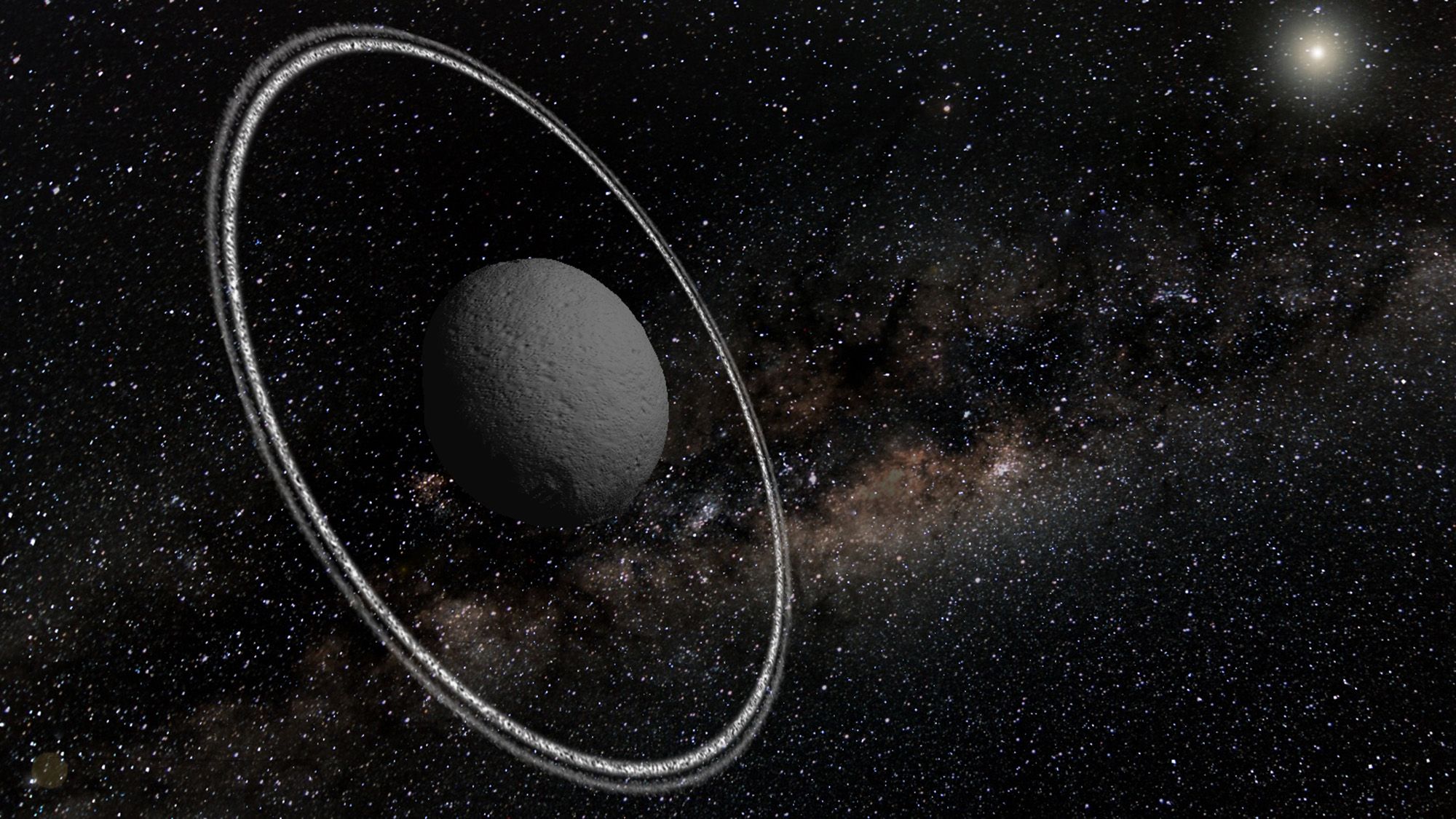
The rings around a strange small body orbiting between Saturn and Uranus look eerily different from previous views, new observations from the James Webb Space Telescope (JWST) suggest. The rings surround Chariklo, which is a centaur, a strange type of object that shows characteristics of both asteroids and comets. Chariklo is only about 400 miles (250 kilometers) in diameter and is part of a large group of tiny objects in the distant solar system. Scientists first discovered Chariklo’s rings in 2013, making it the first small body in the solar system to have rings, and studied them with ground-based telescopes again in 2014 and 2017. When JWST took another look at Chariklo in 2022, a decade had brought many differences, according to a study published September 9 in the journal Science Advances. Latest videos from Live Science “Comparing observations of the JWST with those obtained… during the last decade, we discovered opposite changes in the two rings: while the inner ring shows a significantly greater opacity, the outer ring shows a lower opacity,” Pablo Santos-Sanz, researcher at the Institute of Astrophysics of Andalusia and first author of the study, said in a statement. Researchers don’t know exactly how the changes occurred, but the study authors offered three suggestions. The first is that JWST, which has fine resolution, was able to see areas of the rings that were both denser and more dispersed than previous observations showed. The second is that there were changes in the material of the rings or in the grains themselves. Finally, a third possibility is that JWST could see “grains with wavelength-dependent optical properties,” meaning that the telescope saw effects in the composition and size of the grains that explain the variability. You might like Santos-Sanz said research suggests that small ringed bodies, even those orbiting far from the gravitational influences of planets, may have more changes to their systems than scientists previously thought. “Our results force us to rethink how they form, how they evolve and what mechanisms maintain their stability,” he said. A theoretical follow-up observation, made the next time Chariklo passes in front of a star, would help confirm the new JWST results, the researchers added, especially the apparent decrease in the opacity of one of the rings and the increase in the opacity of the other. Get the world’s most fascinating discoveries delivered straight to your inbox. “These observations would help disentangle the temporal evolution of wavelength-dependent scattering effects and clarify the physical processes that shape the Chariklo rings,” the researchers stated in the study. A JWST Milestone The new Chariklo observations also mark the first time scientists have planned a JWST observing campaign specifically around a stellar occultation; That is, the researchers timed the observation precisely when Chariklo passed in front of a distant star from the telescope’s point of view. All observations of the Chariklo rings, on the ground and in space, have used stellar occultations. This is because the rings are too faint to be imaged directly, so astronomers must learn more about the rings by measuring the dips and rises in brightness as Chariklo passes in front of the background star. Scientists use a similar method to study the atmospheres of alien planets with JWST’s infrared instruments. Chariklo’s speed relative to JWST was low, 1.5 miles per second (2.5 kilometers per second), which allowed for fine images of the rings. To time the occultation, the researchers used data from the European Space Agency’s Gaia mission, which precisely maps the locations and movements of more than 2 billion stars, and also calculated JWST’s orbit at a location about 930,000 miles (1.5 million kilometers) from Earth in the direction away from the sun. According to researchers, the planning and execution of the mission required “extreme precision.” Santos-Sanz, P., Gomes-Júnior, AR, Morgado, BE, Kilic, Y., Kalup, C., Kiss, C., Pereira, CL, Holler, BJ, Morales, N., Ortiz, JL, Sicardy, B., Rizos, JL, Stansberry, J., French, RG, Hammel, HB, Lin, Z., Souami, D., Desmars, J., Milam, SN, . . . Vara-Lubiano, M. (2026). JWST stellar occultation reveals unexpected changes in the Chariklo ring system. Scientific Advances, 12(37), eaeh4794. https://doi.org/10.1126/sciadv.aeh4794 TOPICS James Webb Space Telescope Solar system