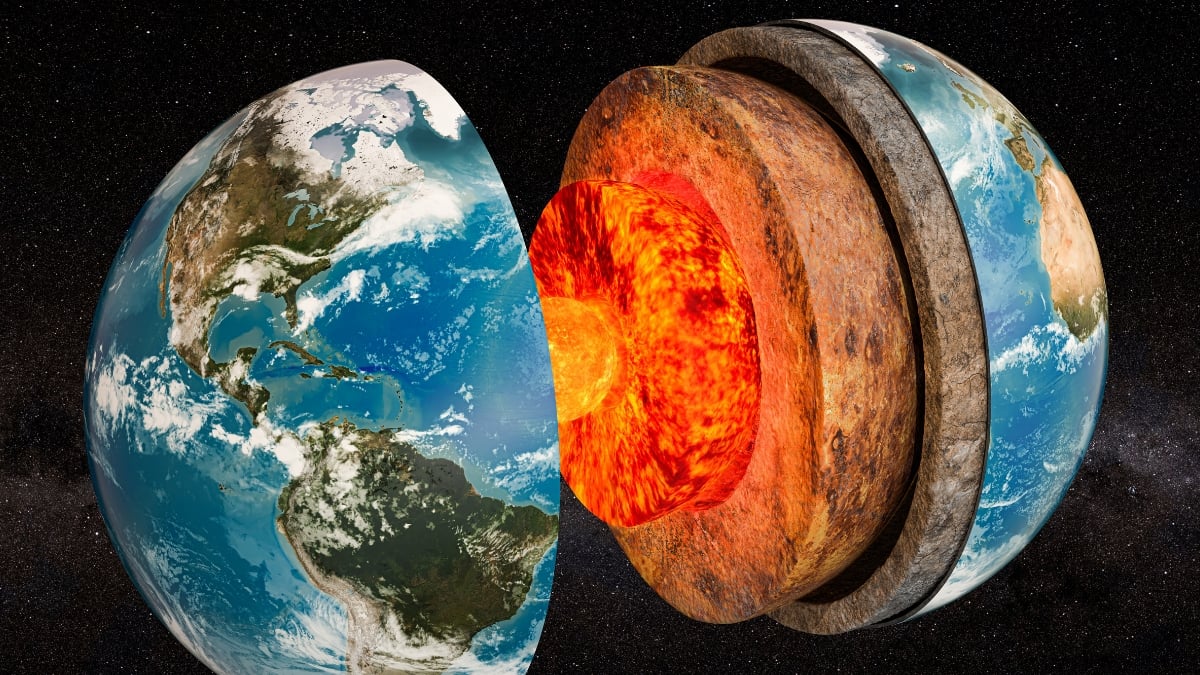
The phrase “water is life” is true: water makes all known life on Earth possible. It’s also a key component in lubricating the super-slow motion of Earth’s mantle layer, hydrating those layers of rock enough for them to ooze and slide over each other. This is important for the tectonic cycle, which in turn helps regulate climate over geological time. This water also allows for important recycling of rocks and volatile compounds through the mantle. “Liquid water is the key component of Earth’s habitability,” writes geoscientist Alfred Wilson of the University of Leeds in the United Kingdom in a commentary accompanying a new study on Earth’s interior waters. How did that water get to the mantle? One model suggests that asteroids brought water to Earth and it remained hydrated while the planet formed. Or perhaps the water arrived later, hydrating a previously dry mantle. Where exactly that water is located within the miles-deep mantle layer of the planet’s interior has not been well understood until now. The new research suggests the water is likely located near the boundary between the mantle and its liquid outer core, where seismic testing has shown there are mysterious “ultra-low velocity zones.” The lower mantle extends from approximately 660 to 2,900 kilometers (373 to 1,802 miles) below the surface. Its most abundant minerals, including bridgmanite and ferropericlase, are believed to be largely dry. Other minerals can retain water at depth, but many need unusual compositions to remain stable or break down at the high temperatures found in the deeper mantle. So the researchers looked for another possibility. They used laser-heated diamond anvil cells (devices that compress small samples between two diamond tips separated by just a paper width, while lasers shoot them with heat) to recreate high temperatures. and pressures. Pressure-temperature conditions for the formation of iron oxyhydroxides. (Yuan et al., Nature Geoscience, 2026) Under these conditions, scientists have identified two previously unknown iron oxyhydroxides (Fe5O12Hx and Fe7O12Hx), which could hold huge amounts of water. The experiments show that these phases can exist in deep mantle conditions, but do not directly demonstrate that they are present within the Earth. “Identifying these iron oxyhydroxides is important because they are apparently stable and dense phases that capture and retain water over a wide range of lower mantle conditions,” Wilson writes in his commentary. These minerals formed even when water was scarce. In some experiments, the starting material contained less than 0.1 percent water, but even those trace concentrations of hydrogen were enough to stabilize the new phases. This is important because the Earth’s deep interior is not like a giant underground ocean. Any water stored there would have to be incorporated into minerals, often under conditions where free water is essentially absent. These new minerals seem unusually suited to the job. Both are stable in the extreme conditions of the lower mantle and substantially denser than the surrounding mantle rock. That means that when a primordial molten “basal magma ocean” cooled and crystallized early in Earth’s history, these water-bearing minerals could have formed and then sunk toward the boundary between the core and the mantle. frameborder=”0″ enable=”accelerometer; autoplay; writing on clipboard; encrypted media; gyroscope; picture in picture; web-share” referrerpolicy=”strict-origin-when-cross-origin” enablefullscreen> This hidden water may not necessarily stay hidden, because as water-bearing material is dragged upward by the mantle circulation, the decrease in pressure could destabilize the minerals, releasing their water into other phases of the mantle. Over time, some of that water could, and probably will, return to the surface through the mantle columns and the volcanism. The discovery also sheds light on a previous mystery. The mineral known as “H phase”, observed in previous high-pressure experiments, appears to match one of the newly identified oxyhydroxides. The researchers suggest that hydrogen contamination from traces of moisture, rather than a completely new dry mineral, may have helped produce the puzzling phase in previous experiments. Leonid Dubrovinsky of the University of Bayreuth. The colossal “anomalies” in the Earth’s mantle are not what we thought. Big questions remain unanswered, and the picture is “incomplete”, according to Wilson. It is necessary to determine exactly how much water these minerals contain, and what happens when they reach the boundary between the core and the mantle remains uncertain how easily and for what periods the water stored in these deep minerals can eventually return to the surface. Earth’s water can extend all the way to the edge of the core and, according to Wilson, these newly identified minerals “represent a breakthrough in the mystery of how the Earth obtained and retained its water.” The research is published in Nature Geoscience. This article was verified by Rebecca Dyer and edited by Rebecca Dyer.