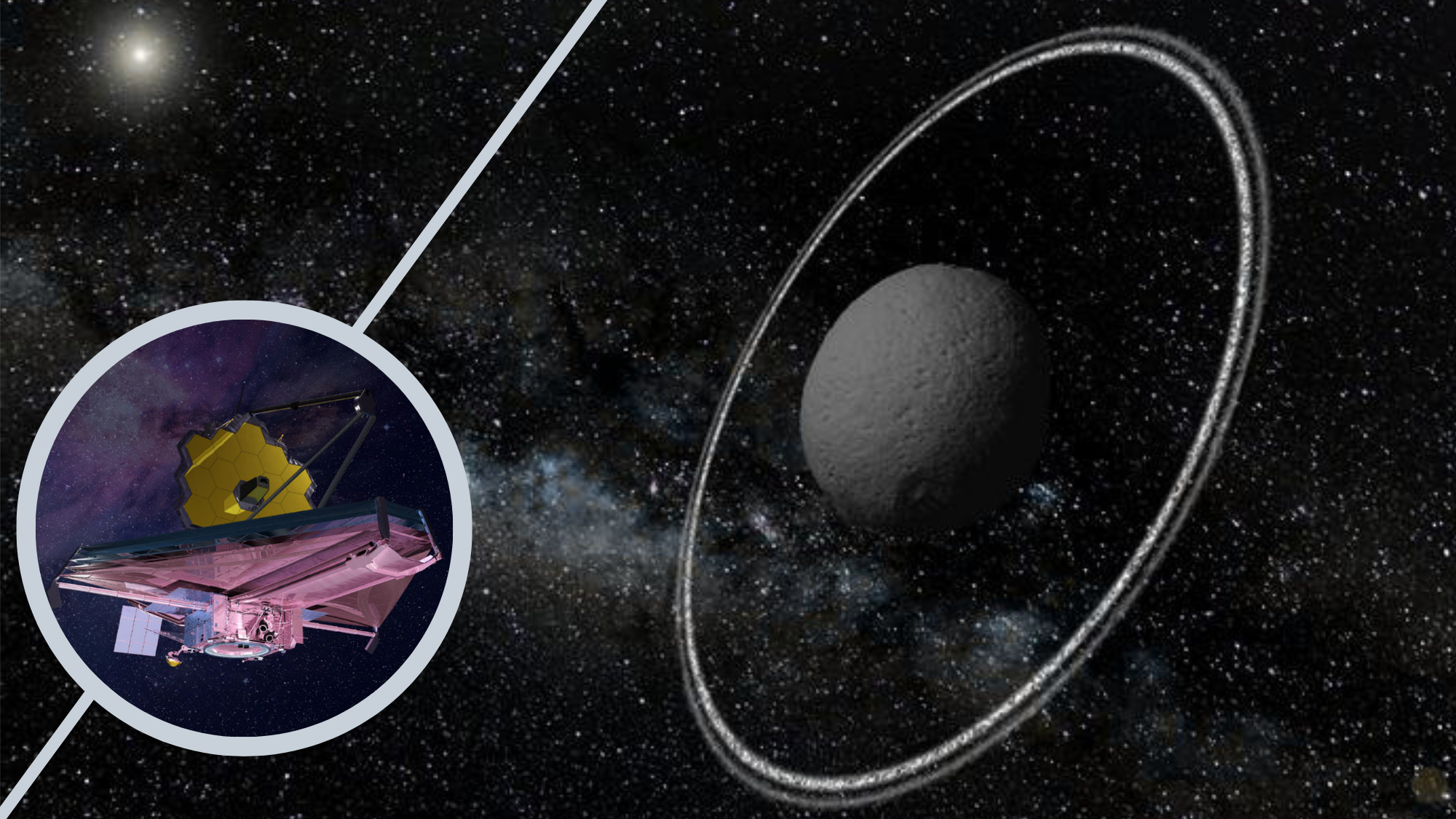
Using the James Webb Space Telescope (JWST), astronomers have discovered that the ring system of a small solar system body is even more interesting than they thought. The object in question is Chariklo, which orbits the sun between Saturn and Uranus, about 17 times the distance between the Earth and the sun. Despite being only about 250 kilometers (155 miles) wide, Chariklo, part of the Centauri family of asteroids, has two thick rings. Although Saturn is the solar system body most famous for its rings, other planets also have ring systems, although less prominent. That includes Uranus, Neptune and Jupiter. However, Chariklo and the even smaller body Chiron show that even the tiniest bodies can develop rings. Now, thanks to the incredible sensitivity of the JWST, scientists know that Chariklo’s rings are even stranger than their initial discovery in 2013 suggested. The team, led by researchers from the Institute of Astrophysics of Andalusia (IAA-CSIC), began observing Chariklo with the JWST in October 2022. They used a technique called stellar occultation, which measures the dimming of a star’s light when an object passes in front of it. “Compared to observations obtained during other stellar occultations over the last decade, we discovered opposite changes in the two rings: while the inner ring shows significantly higher opacity, the outer ring shows lower opacity,” team leader Pablo Santos-Sanz of the IAA-CSIC said in a statement. The asteroid’s shifting rings suggest it experiences more complex physics than previously thought. This is important because scientists previously believed that small bodies had relatively stable rings. You may like “Our results force us to rethink how they form, how they evolve and what mechanisms maintain their stability,” said Santos-Sanz. “The ability to detect these changes opens a new window for understanding the evolution of these systems and, possibly, that of other ring systems in the solar system.” The cause of these changes remains a mystery. Another milestone for the JWST and GaiaThe research not only represents an important step in our understanding of the asteroids and rings of the solar system, but it is also an important milestone for the JWST. “To achieve this, it was necessary to know with extraordinary precision the orbit of Chariklo, the position of the star, thanks to the Gaia mission of the European Space Agency, and the trajectory of JWST itself around the L2 Lagrange point, a region of space located about 1.5 million kilometers beyond Earth, far from the sun,” explained team member Yücel Kilic of the IAA-CSIC. “The JWST follows an orbit around this region that requires periodic corrections through station-keeping maneuvers.” Light falls from a distant star caused when Chariklo and its rings occult it (Image credit: ESO/Felipe Braga Ribas/M. Kornmesser) During the occultation the team used in their research, Chariklo was traveling at around 5,600 miles per hour (2.5 kilometers per second) relative to JWST. This is incredibly fast by Earth standards, but relatively slow for objects racing through the solar system. This low speed allowed the Chariklo rings to be resolved in unprecedented detail. Astronomers currently rely on occultation to study Chariklo and its rings, as not even JWST is powerful enough to directly image this small, distant asteroid. The team’s research was published Tuesday (September 9) in the journal Science Advances.