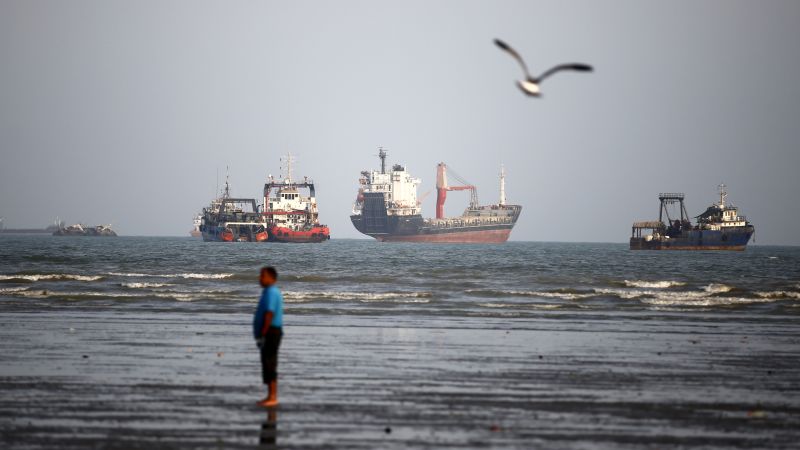
Iranian state media has claimed that an Iranian commercial ship was attacked in the Strait of Hormuz on Saturday night, killing one person, amid an ongoing battle between the United States and Iran for control of the crucial energy chokepoint. It comes as Iran-backed rebels in Yemen step up their attacks and advance their efforts to control a second vital waterway in the region, which could put further pressure on global oil prices. The Hormuz attack, which Iranian state broadcaster IRIB said injured four other people, took place early in the morning local time near Qeshm Island in the strait and comes a day before Tehran meets with regional leaders in Oman to discuss the management of maritime traffic through the vital waterway. Iran’s state news agency IRNA quoted the governor of Qeshm as blaming a “terrorist enemy” for the attack. The United States has not commented on the reported attack and CNN has contacted US Central Command for comment. US forces have previously attacked Iranian-flagged vessels while maintaining a blockade of Iranian ports and facing the renewed threat of Iranian ballistic missiles launched against their warships. Qeshm Island, which is about 22 kilometers from the Iranian port city of Bandar Abbas, is key for Iran to assert control of traffic through the vital Strait of Hormuz, through which some 20 million barrels of oil passed each day before the war. Traffic remains approximately 90% below pre-conflict levels. Separately, another ship was hit by an unknown projectile in the strait late on Saturday, according to the UK Maritime Trade Operations Center (UKMTO). The UKMTO said a fire broke out and local authorities were helping to evacuate crew members. He did not provide details on what state the vessel is registered in. Top diplomats from Arab Gulf states are expected to meet Iran’s foreign minister in Oman on Monday to discuss the management of maritime traffic in the Strait of Hormuz, Iranian Foreign Ministry spokesman Esmail Baghaei said on Saturday. However, Bahrain has said it will not attend and it was unclear which other nations would be there. Iran has been negotiating for months with Oman, which controls the opposite bank of the strait, over an agreement that could regulate shipping through it. However, Iran has downplayed prospects for a breakthrough. President Masoud Pezeshkian told broadcaster India Today TV on Saturday that: “The waterway would be opened on the condition that the United States ends its blockade.” Ebrahim Azizi, head of the national security committee of the Iranian parliament, said in X: “As long as the American side does not accept all of Iran’s conditions, dialogue and negotiation are of no use.” Yemen’s Iran-backed Houthi rebels on Sunday claimed responsibility for an attack on a Saudi military base in the Sharurah region. The Houthis have recently intensified their fight against Yemen’s Saudi-backed government and expanded their area of control to near a vital Red Sea waterway linking Asia to Europe. Houthi spokesman Yahya Saree said a “barrage of ballistic missiles and drones” were used against “weapons depots and command and control rooms,” but did not specify when the attack took place. On Saturday, the Houthis had claimed that Saudi forces launched 129 airstrikes on Houthi-controlled areas of Yemen. Last week, the Houthis captured the island of Perim, at the mouth of the Red Sea. The island bisects the vital Bab al-Mandeb Strait, giving Tehran de facto control over another key sea route besides the Strait of Hormuz. Earlier this week, a source told CNN that Saudi Crown Prince Mohammed bin Salman had spoken twice to US President Donald Trump to urge him to attack the Houthis as the militia advances through Yemen towards the Red Sea, but Trump refused. Saudi Arabia said on Saturday it had temporarily closed its East-West oil pipeline as a precaution after a drone attack. Both Baghdad and Riyadh said the attack originated in Iraq, where Iranian-backed militias operate. When asked about Saudi concerns following the closure of the pipeline and the movement of maritime traffic through the strait, Trump said everything “will be fine.”