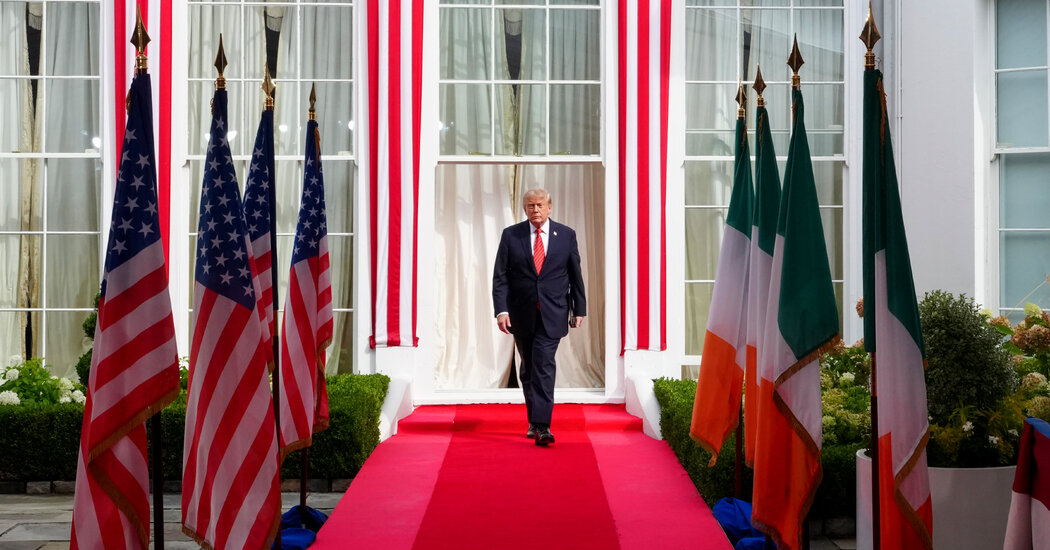
Shortly after setting foot in Dublin, President Trump said Saturday that it would be “fantastic” if Northern Ireland and the Republic of Ireland united, breaking with decades of American neutrality on an issue rooted in a long history of violence. “I don’t want to cause any problems. I will tell you that I would love to see it unified,” Trump said in Dublin alongside Micheál Martin, the taoiseach or prime minister of Ireland. “It’s going to happen eventually.” He later seemed to acknowledge that he had entered into a politically problematic topic. The US president said he still believed it “would be a great thing” if Northern Ireland split from the United Kingdom, but joked that half the room would clear after hearing his comments. “No matter how well you say it, there is no good answer,” Trump told a crowd of embassy staff and business leaders gathered at Deerfield Residence, where the U.S. ambassador lives. The 1998 U.S.-brokered Belfast Agreement, also known as the Good Friday Agreement, brokered a fragile peace that ended roughly three decades of violence between those seeking a united Ireland and unionists who wanted Northern Ireland to remain part of the United Kingdom. Part of that peace agreement was that Northern Ireland would remain part of the United Kingdom until a majority of its people voted otherwise in a referendum. For the island to be reunified, a majority of voters in the Republic of Ireland would also have to vote in favor of the initiative. Reunification is highly divisive in Northern Ireland, a nation taken from the island of Ireland by the British after the Republic of Ireland became independent, because some fear a return to violence. And although the majority of citizens of the Republic of Ireland support the initiative, successive Irish governments have approached this delicate issue with caution. In keeping with his freewheeling approach to the global stage, Trump has mulled Irish unification before. Earlier this year, he suggested there should be a “merger” between Northern Ireland and Ireland because of how well Martin got on with Northern Ireland deputy first minister Emma Little-Pengelly. He later said that the comment was made in jest and should not be taken seriously. Trump’s comment on Saturday came just days after Andy Burnham, the newly installed British prime minister, said there was not enough public support for a referendum on Northern Ireland leaving the United Kingdom and until there was “there won’t be one.” Trump himself acknowledged on Saturday that the London government would probably “have something to say” about his comments on reunification. Patrick Dwyer-Cummins, spokesman for 10 Downing Street, said Burnham’s position remained unchanged and that she was committed to upholding the Good Friday Agreement. But Trump’s comment sparked some immediate criticism, including from right-wing allies such as Nigel Farage, leader of the populist Reform party. United Kingdom “Northern Ireland is an integral and proud part of the United Kingdom,” Farage wrote on social media. “The people of Northern Ireland do not want a referendum or unification. I do not agree with President Trump.” Gavin Robinson, a member of the British Parliament and leader of Northern Ireland’s main party that supports remaining in the United Kingdom, said on social media that “President Trump knows better than most that elections matter.” “The constitutional future of Northern Ireland will be decided by the people of Northern Ireland, not by commentaries in London, Dublin or Washington,” he said. “Northern Ireland is part of the United Kingdom because that is the established democratic will of its people.” Claire Hanna, also a Northern Ireland lawmaker and leader of the Social Democratic and Labor Party, which supports joining the Republic of Ireland, received applause from a crowd on Saturday when she said Trump was “for a united Ireland.” He said Robinson’s party, a right-wing party that has long aligned itself with the American president’s politics, was probably “burning those Trump flags while we The reference to reunification was not the only unconventional aspect of Trump’s comments. American presidents, when speaking abroad, typically refrain from picking on their domestic rivals. But Trump used his speech in Dublin to repeatedly attack Democrats, even describing former President Joseph R. Biden Jr., who has cancer, as physically ill. Biden traveled to Northern Ireland in 2023 to mark the 25th anniversary of the Good Friday Agreement. Before his speech to embassy staff, Trump met with Martin and discussed trade and possible aid to the Gaza Strip. Martin has faced some pressure domestically in Ireland to pressure Trump to do more to help the Palestinians. Trump also began his trip by meeting with Ireland’s head of state, Catherine Connolly, who protested his visit to Ireland. her first term and in the past called Trump a “bully.” She continued to criticize his foreign policy in the Middle East. However, Ms. Connolly ceremoniously received him at the Irish presidential residence. She also gave Trump gifts, including some that seemed to convey a deeper message. Atlantic from Ireland. Some researchers and writers have speculated that their trip took them to Greenland. Trump almost brought down the Western military alliance when this year he suggested a US takeover of Greenland. Connolly also gifted Trump a 2006 volume of poetry written by Belfast’s Michael Longley. One of his most famous poems, published during the unrest, is “Ceasefire.”