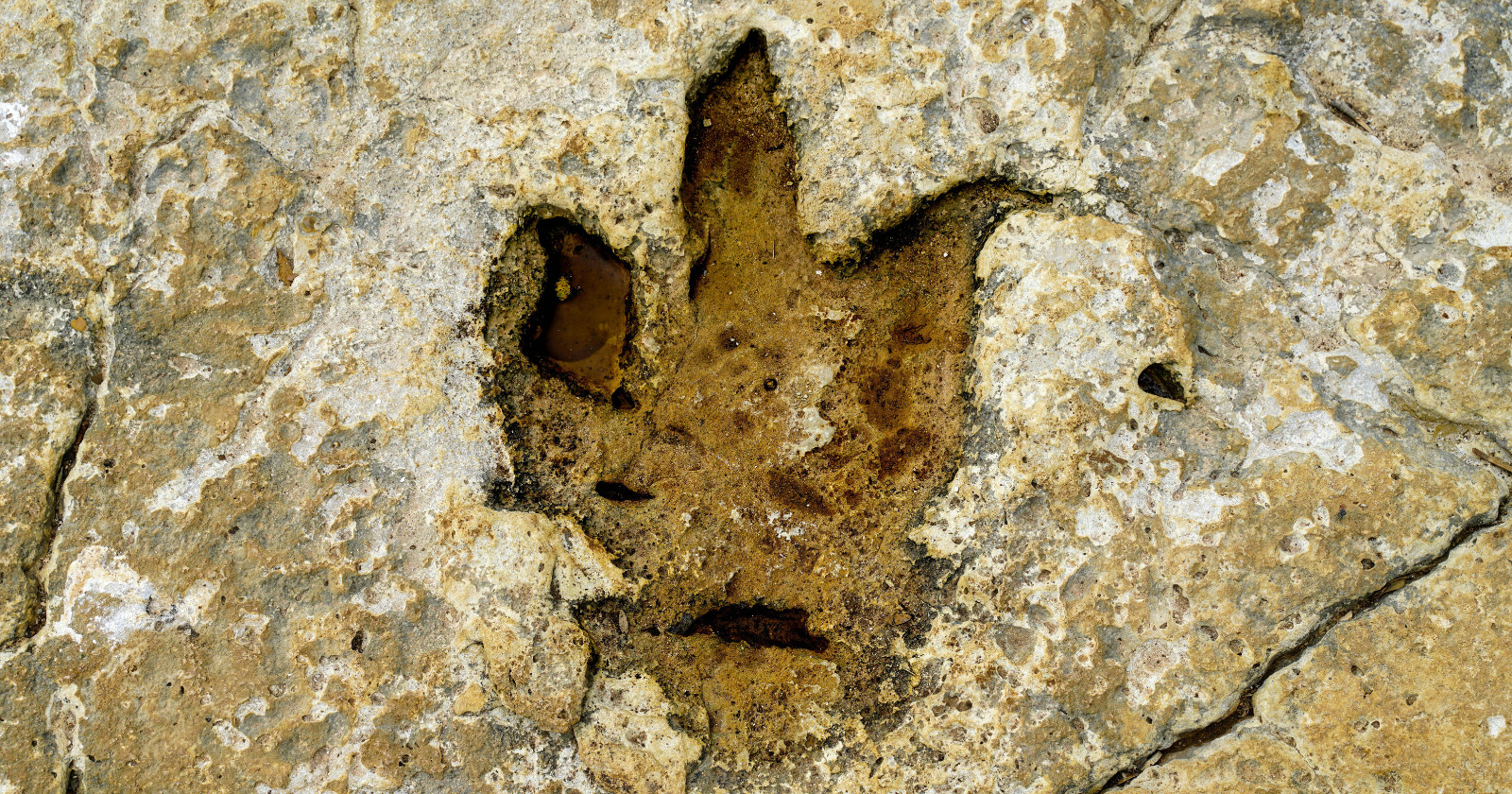
Paleontology has thousands of Tyrannosaurus rex bones, dozens of skeletons, and exactly one thing it had never had until this week: a recorded walk. In a study just published in the Journal of Vertebrate Paleontology, researchers from the Denver Museum of Nature and Science and Liverpool John Moores University describe the first footprint attributed to an adult T. rex: four enormous three-toed footprints in sequence, two on the left and two on the right, pressed into what was the mud of Hell Creek about 66.5 million years ago, in the species’ final act before the asteroid. Bones are anatomy. A track is a behavior: a preserved moment of an animal actually doing something. “With a trail, we can follow an animal as it moves across the landscape,” said Denver Senior Curator Tyler Lyson. “That’s incredibly rare in T. rex.” Reading the Walk The footprint, found in 2025 on U.S. Forest Service land near Marmarth in the fossil-rich southwest corner of North Dakota, runs about 23 feet, with each footprint about three feet long and a stride (the gap between successive footprints of the same foot) about 13 feet. Plug stride size and footprint into standard locomotion equations and you get the top number: The animal was moving between 3.5 and 4.5 mph, the pace of a fast human walk. Seven tons of super predator, for a walk. The team is careful to say the figure is approximate, as the tracks are well worn, but the pace fits comfortably with other large theropod tracks and the biomechanical consensus that a walking T. rex preferred exactly this type of unhurried gait. Attribution is based on elimination. The footprints of tyrannosaurs found earlier (in Canada, in Wyoming) were left by smaller animals: juveniles or smaller related species. The large size of these footprints, the narrow angle between the toe impressions, and the abundance of adult T. rex bones in the surrounding rock leave no other known animals in the formation matching the feet. Isolated individual footprints had previously been attributed to adult rex; a walking sequence, which produces a stride and therefore a speed, never. The expert who never saw the footprints The project’s methods are as modern as the subject is ancient. The prints survive in an unusual medium (sandstone molds cemented with hardened calcium carbonate, natural sculptures of the original silencing) and the field team documented each print with high-resolution 3D surface scanning. Which enabled the study’s charming structural joke: lead author Peter Falkingham, one of the world’s leading dinosaur track experts, analyzed the track without ever seeing it in person; His colleagues scanned the stones in the badlands of North Dakota and sent the models to Liverpool. The find itself, according to accounts circulating with the study, was first discovered not by a professional but by a high school teacher working with the museum’s field program; Hikers and fans are, as athletics specialists have long pointed out, the discipline’s best engine of discovery. Three of the four prints will be transported by helicopter this fall and installed at the Denver Museum. Why a slow walk is big news There’s mild comedy in the fact that the scariest animal to ever walk in North America is making headlines for wandering, but the pedestrian pace is precisely the scientific payload. How the T. rex moved has been debated for decades: the jeep hunter from Jurassic Park versus biomechanical models showing that a running rex would have required impossible amounts of leg muscle, with modern estimates converging on a fast-walking animal whose long legs made walking efficient rather than fast. However, these conclusions were built from bones, models and footprints of other species. This is the first time the real animal has intervened: an adult rex, caught in the middle of a trip, moving at exactly the relaxed pace the equations predicted. A piece of information, and slow, but from the only witness who was there. And that is the true gift of the Marmarth stones. Each skeleton is a death; one track measures twenty-three feet on a Tuesday. Sixty-six and a half million years ago, in the last few hundred millennia of its species’ existence, an adult Tyrannosaurus rex walked across a marsh at the speed of a human late for lunch, minding business no one will ever know about, and the mud got the receipt. About this articleThis article is for general information and reflection. It is not professional advice. For your specific situation, consult a qualified professional. Follow Space Daily on Google Add us as a preferred source for more Space Daily reporting on Google. Add as preferred source A personal measure of deep time See what has changed in the universe since you were born. Start with a date. Get a personal, detailed journey through everything that kept moving after you arrived. Six measurements obtained. No predictions. No astrology. Standards Space Daily articles are edited and fact-checked before publication. We use artificial intelligence tools in the newsroom. See our editorial standards and masthead.