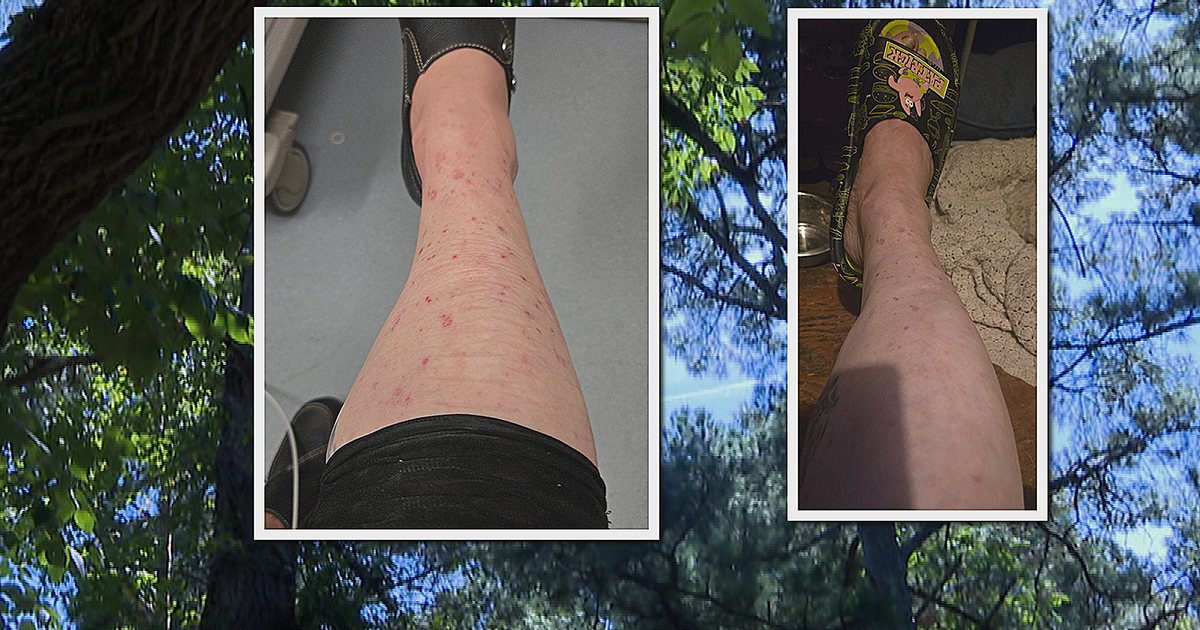
A Chatham County woman says she is grateful to be alive after a sudden illness left her hospitalized with sepsis, hearing loss and questions about whether a tick-borne infection played a role.
Ronnie Dunn said she has lived in the country for years and finding a tick was never unusual.
“I’m from the country. I’ve been bit by ticks so many times,” Dunn said.
That changed in August, when Dunn said she found a large, engorged tick attached to the top of her head.
“It was fat. It made me so mad that I had missed it,” Dunn said.
About a week and a half later, she became severely ill.
“I was just so sick. I didn’t even get out the bed all day, except to throw up and drink water and throw up,” Dunn recalled.
By the following day, Dunn said every joint in her body hurt and she was very fatigued. She went to work but felt so sick that she left and went to the emergency room, where she had a 103-degree fever.
“I can barely walk, like I’m stumbling,” Dunn said. “They had to give me a wheelchair.”
Dunn said she also pointed out a rash that had been spreading all over her body. She said she was initially discharged and told her symptoms may be due to an allergy.
When she didn’t start to improve, Dunn said she returned to the emergency room. This time, she said a doctor asked whether she had recently been bitten by a tick.
“I had these splotches all over me,” Dunn said. “It looked like somebody took a little pen and just poked little dots in my leg.”
Dunn said her platelet count had fallen to 17 and her sodium was so low doctors were concerned she could have a seizure. Other tests showed she was septic.
“When you almost die, it honestly changes you,” Dunn said. “If I wouldn’t have went back to the emergency room, then life would have probably been a lot different.”
As for what exactly caused her illness, Dunn said doctors explained that her symptoms lined up with a possible case of Rocky Mountain spotted fever.
Rocky Mountain spotted fever, or RMSF, is a potentially deadly bacterial disease transmitted through the bite of an infected tick. Fever, headache and rash are among its most common symptoms, according to the Centers for Disease Control and Prevention.
Dr. Ross Boyce, a UNC Health infectious diseases specialist who studies tick-borne illnesses, said Rocky Mountain spotted fever is caused by Rickettsia rickettsii, one of several related Rickettsia bacteria that can be transmitted by ticks in North Carolina.
“Rocky Mountain spotted fever is by far the most lethal tick-borne disease really in North America,” Boyce said.
Boyce said RMSF can be complicated to differentiate from other related Rickettsia, which can cause less severe disease.
Many tick-borne bacteria do not grow well using traditional laboratory culture methods, so doctors often rely on antibody tests that measure the body’s immune response to an infection.
“The antibody test can’t tell the difference between the different types of spotted fever bacteria,” Boyce said. “They all cross-react and will return positive.”
Boyce said another disadvantage is that antibodies can still show up on tests long after an infection.
“One of the disadvantages of this is that antibodies often remain positive for months to years after an infection,” Boyce said. “So it’s really hard to know, are you currently sick with this or is it that you were exposed a year ago, five years ago, 10 years ago?”
The CDC similarly warns that a single acute antibody test cannot confirm RMSF. Antibodies can be absent early in an illness and can remain elevated long after an infection has resolved. Paired blood samples taken weeks apart can provide stronger evidence of a recent infection.
The CDC also recommends that treatment for suspected RMSF not be delayed while waiting for test results because early treatment can prevent severe illness and death.
Boyce said the American dog tick, which can transmit the bacteria that causes RMSF, is less common in central North Carolina than some other ticks. Lone star and Gulf Coast ticks make up the overwhelming majority of ticks in the region and can transmit other pathogens, including ehrlichiosis.
Dunn provided WRAL with bloodwork showing antibodies reactive to Ehrlichia chaffeensis, a bacterium associated with ehrlichiosis.
Boyce said ehrlichiosis deserves more attention in North Carolina because it is transmitted by the Lone Star tick and can cause severe disease.
“Most of the cases of patients that I see in the hospital with a tick-borne disease have ehrlichiosis,” Boyce said. “I think it’s under-recognized.”
Dunn said additional testing was still underway to help determine what role, if any, a tick-borne infection played in her illness.
And a tick may not be the only thing that made her sick.
Dunn also provided WRAL with results showing Capnocytophaga canimorsus was detected in her blood.
The bacteria is commonly found in the mouths of dogs and can, in rare cases, cause serious bloodstream infections. Dunn believes exposure to dog saliva may have played a role.
As she searches for answers, Dunn described the combination of findings and symptoms as a “very traumatic experience.”
Weeks after her initial symptoms began, she is still battling hearing loss and is taking high-dose steroids to reduce swelling. Dunn said she lost 15 pounds and continues to struggle with her appetite and energy.
Dunn said the experience also changed how she approaches daily life and warns others to take precautions whenever spending time outdoors.
“I don’t want nobody to ever have to go through what I went through, ever,” Dunn said. “It changes your life. I mean, God gave me a second chance, and I’m not going to waste it.”
Boyce recommends checking carefully for ticks after spending time outside, including less-visible areas of the body. Long sleeves and pants and repellents such as DEET and permethrin can also reduce the risk of tick bites.
“I always tell patients to remember that ticks have learned to evolve to not be found,” Boyce said. “They’re going to go to places like behind your kneecaps, under your armpits.”
If a tick is attached, Boyce recommends using tweezers to grasp it as close to the skin as possible and pulling steadily and gently, rather than attempting to burn or smother the tick.
Once the tick is no longer living, keeping it in a sealed, plastic bag can also be helpful for subsequent disease identification if symptoms develop.
Dunn said she hopes sharing what happened to her will encourage others to pay attention when something feels wrong.
“Listen to your body,” Dunn said. “Immediately go get help.”