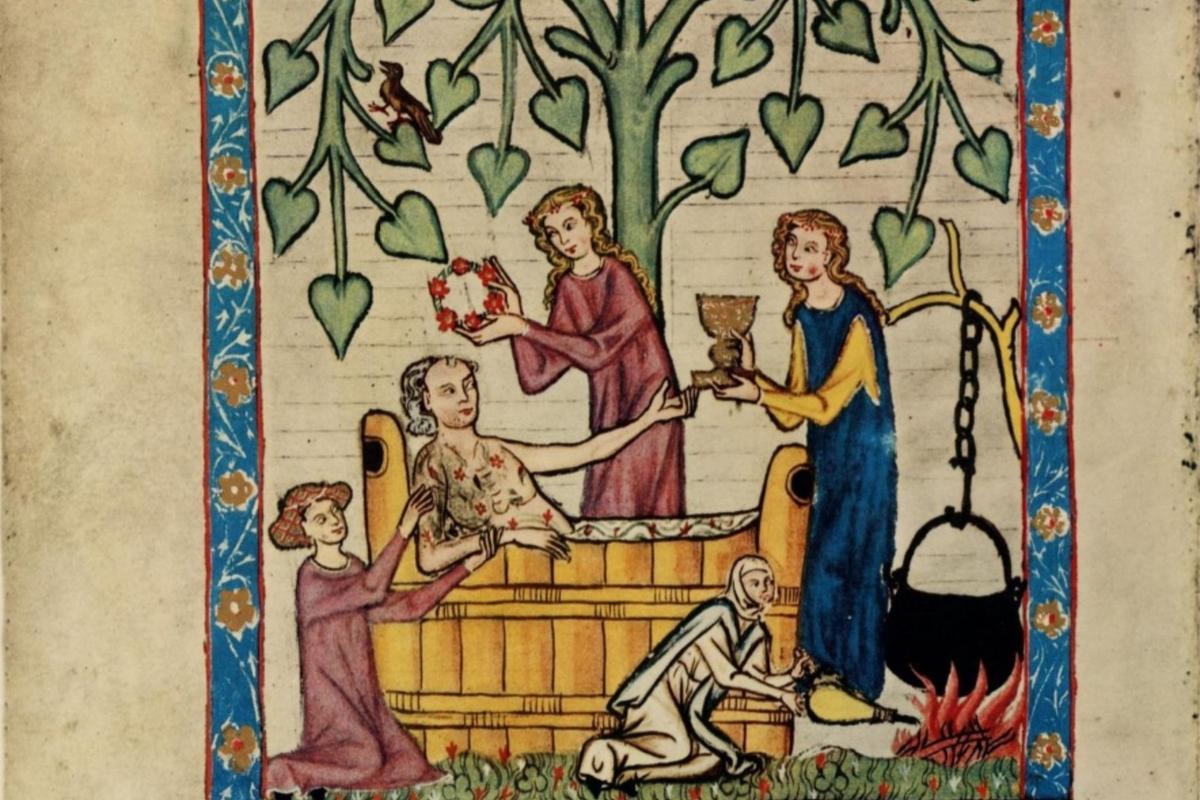
Early one morning in the late 12th century, Bishop Hugh of Lincoln arrived in the Hertfordshire village of Cheshunt. There, he was immediately surrounded by a crowd of people, who begged him to help one of their neighbours. And so, dismounting from his horse, he went to the man’s house, where he was confronted by the disturbing sight of a possessed man ‘lying prostrate with his head tied to a post and each of his hands to great stakes fixed in the ground.’ Despite these restraints, the man constantly writhed around, rolling his eyes, gnashing his teeth, and sticking his tongue out. To Hugh, as to the local onlookers, the diagnosis was clear: this unfortunate sailor had been possessed by a demon and could be cured only by an exorcism. Once the necessary rituals were performed, he was ‘delivered from the demon [and] … after living devoutly for some years, finally made a good and peaceful end.’
For Hugh’s biographer, Adam of Eynsham, the incident was worth recounting because it demonstrated not only that the future saint had healing powers, but that he was a brave and compassionate man (in sharp contrast to the local bishop, who had ‘galloped away as if pursued by the Furies’, rather than face a possessed man). But, to us, the story – full of fear, cruelty and superstition – sums up both everything that was wrong with medieval attitudes to mental illness, and the apparent uselessness of medieval medicine in the face of serious illness.
And yet, as is so often the case when studying the distant past, the reality was rather more complicated. Influenced by stories of demonic possession (and there are lots of them, especially in saints’ lives and miracle collections), I long assumed that our ancestors’ attitudes to, and experiences of, mental health were completely different to our own – and that they would have little sympathy with our fast-growing mental health crisis. But when I turned my attention away from religious texts, and began to research medieval ideas about healthy living, I soon came across medieval people who discussed mental health in ways that felt far more familiar to me.
The similarities were particularly apparent in medical writings, which outline a sophisticated argument that mental wellness was at the heart of a healthy lifestyle. According to the dominant humoral system of medicine, health was achieved by keeping four bodily fluids (blood, phlegm, black bile, and yellow bile) in balance. The best way to do this was through careful management of the six non-naturals, a set of external factors that had a direct impact on the human body, and that included many of our modern preoccupations, such as diet, exercise and sleep, as well as the emotions.
This last factor featured prominently in regimens (how-to books about healthy living, which were extremely popular in late-medieval Europe), in which people were warned that, for the sake of their health, they must control their emotions. According to the 14th-century Sevillian physician Juan de Aviñón, ‘it is necessary that a man that wishes to preserve his health will not become angry, nor irritated, nor worried as much as possible, because once he does so he greatly harms his body.’ Similarly, the Bavarian physician Arnold von Bamberg warned that emotional dysregulation could disrupt an individual’s eating habits, exercise routine and ability to sleep; a person who did not pay sufficient attention to his feelings would inevitably end up needing medical treatment. And it seems that people did blame their bodily ailments on mental travails. For example, in 1395, when the Italian politician and wool merchant Niccolaio Martini was ill with a high fever, he told his friend Margherita Datini that ‘he came down with this illness after getting very upset’ about the result of a recent election.
Too much responsibility could make a person ill, with high-status men thought to be at particular risk
Certain emotions were so detrimental to health that they could cause sudden illnesses, or even death. Fear was especially dangerous: among the miracles performed by the hand of St James (which was kept at Reading Abbey from the mid-12th century) was the cure of Alice, an Essex clerk’s daughter who saw a ghost when milking sheep on Good Friday. Her terror caused the blood to freeze around her heart, and so confused her senses that she suffered a temporary fit of mania and threw herself into a fire. Anger, which warmed and dried the body, was also unhealthy; as a chronic problem, it would (in the words of one mid-15th-century German regimen) ‘consume the body swiftly, so that the man meets a short end’, while a serious temper tantrum could prove fatal. One chronicler claimed that Henry I’s final illness was caused by a dispute with his daughter, the English king being ‘provoked by these irritations to anger and bitter ill-feeling, which were said by some to have been the origin of the chill in his bowels and later the cause of his death’.
Fear and anger were usually acute emotions, quick to come and go, but medical experts also warned about the dangers of chronic emotional distress. One of my favourite medieval images compares the mind to a bent bow which, although strong, cannot survive continual strain, so that ongoing ‘disputes in the household’ could ‘shorten a person’s years’. Just as we worry about stress, medieval people recognised that too much responsibility could make a person ill, with high-status men thought to be at particular risk. In an English conduct book written around the turn of the 13th century, Daniel of Beccles claimed that a master ‘lives like a toiling ant’; his ‘pressing worries gnaw at his gut and burden his shoulders’, and his mind is ‘always focused on calamities’. The anonymous biographer of the French knight Jean II Le Meingre (c1366-1421), better-known as Boucicaut, described his packed daily schedule, but suggested that ‘those who love him indeed, those who would wish him long life and the good health which makes public duties manageable … ought rather to advise him to be a little less conscientious and to take at least some time for repose and recreation.’ If he did not do so, he would surely become ill.
Similarly, though we tend to assume that life in the medieval cloister was rather cushy, a surprising number of monks felt themselves to be under intolerable pressure. Whenever I visit Rievaulx Abbey (now a picturesque ruin in the North York Moors National Park), I spare a thought for Matthew, a 13th-century monk there, who complained to his friend William, the prior of nearby Byland, that his duties as precentor were making him ill; he felt that ‘from the bottom of my feet to the very top of my head … there is no peace in my bones’, and was also suffering from stomach pains and exhaustion. His job was, he complained, too much for one elderly man, and he was sure that it would kill him. Matthew’s fate is unknown, but some monks did suffer breakdowns that were attributed to overwork. At St Albans, Alexander de Langley first became ill when his monastic duties caused him ‘to have fits of raving and to give himself wonderful great airs’. And when his workload was reduced, he then began to study too much, which ‘in the end robbed him of his wits’.
Others were plagued by anxiety. The Tuscan merchant Francesco Datini (c1335-1410), who once wrote that ‘Fate has so willed that, from the day of my birth, I should never know a whole happy day,’ worried about almost everything, especially his business and the Black Death (which struck Italy repeatedly throughout his life, its first wave having orphaned him as a young boy). In 1395, he told his wife Margherita that ‘I dreamed last night of a house which had fallen to pieces, and all my household were inside it’; this had set him thinking about a ship of which he’d had no news for more than two months, and he felt ‘so vexed by many matters, it is a wonder I am not out of my mind.’ Inevitably, she in turn worried about him, urging him to relax for the sake of his health: on one occasion when he was ‘very worried’, she asked him ‘why dwell on it so much that you harm both body and soul?’
Datini’s anxiety seems to have been exacerbated by depressive tendencies, since Margherita also fretted that ‘What worries me most is that you seem to have been extremely melancholy, though you refuse to tell me anything…’ Like its modern counterpart, melancholia’s main characteristics were persistent low mood and a lack of interest in daily life, although sufferers might also ‘see before their eyes terrible and frightening and black shapes such as monks, black men killing them, [and] demons’. Datini’s fellow sufferers included King Duarte of Portugal (1391-1438), who wrote in moving detail about his life-long struggle with a ‘melancholic humour’, which first affected him when he served as regent during a major plague outbreak. And, once again, monks were thought to be especially vulnerable, since their many burdens (which included long periods of silence, constant church services, too much entertaining, and receiving bad news about friends) made them prone to acedia, which left them ‘so much disturbed in spirit, that they move about among their fellows as though they were half-dead.’
Fortunately for these unfortunate individuals, though medieval people did not have access to modern psychiatric medicines or therapists, the medical profession was increasingly interested in both emotional health and the mind-body connection, which informed the treatments on offer. Melancholiacs, for example, were usually thought to be suffering from an excess of black bile, which caused the brain to fill with mist, obscuring rational thought. Consequently, their doctors should address the underlying physical problem by purging the superfluous humours and increasing bodily heat, perhaps using syrups made with warming ingredients such as cinnamon and liquorice, or massage with warm oils.
More broadly, medieval people shared our interest in the ability of mind-altering substances to prevent and treat mental health problems. Saffron was widely believed to provoke joy – although one Welsh recipe collection (c1400) warned against eating too much ‘in case you die of happiness’ – and both oregano and fennel were credited with similar powers. Alternatively, a melancholiac might be advised to eat ostrich liver – a suggestion I find particularly unappealing, though I could be persuaded to test the supposed benefits of precious stones. According to Abbess Hildegard of Bingen (1098-1179), ‘If you are oppressed with sadness, [you should] look at an onyx intently, then place it in your mouth. The oppression of your mind will cease.’ She also advised that holding and looking at beryl, or placing a sapphire in one’s mouth, could calm anger.
But these remedies worked best when combined with lifestyle changes, so that patients were also told to do things that would cheer them up – much as modern doctors use social prescriptions to encourage activities that improve wellbeing. When Taddeo Alderotti treated Obizzo II d’Este, lord of Ferrara (c1247-93), who had suffered from melancholy and insomnia for more than two years, his prescription included ‘taking walks … seeing things that are beautiful and delightful to him … hearing songs and instruments that he likes … being told about and promised great yields from profitable markets’. In fact, joy was widely considered to be not just a useful cure but also an important part of a healthy lifestyle for, as one mid-15th-century German verse regimen reminded readers: ‘A sorrowful heart often brings people to the end/but the joyful mind always makes the life’s age blossom.’ While virtually every other strong emotion dried up the body, joy was good because it moistened it; other benefits included purer blood, sharper wits, higher energy levels and a healthy complexion. It could even make a person more attractive.
One ailing friar was warned to stop reading ‘horrible stories depicting martyrdoms or death’
Consequently, medical experts encouraged everyone to do things that would cheer them up and distract them from their problems – and their suggestions include many things that I (and many others around the world) still find helpful. Spending time with loved ones was an important source of pleasure for many, including Francesco Datini, whose friendship with the lawyer Lapo Mazzei (to whom Margherita once wrote ‘Pray tell Francesco some of your jests, that they may bring solace to his melancholy’) was clearly important. And, like us, medieval people often sought companionship from their pets. Cats, dogs and birds were especially popular, though Robert de Insula, bishop of Durham in 1274-83, kept monkeys ‘to ease the burden of his worries’ and Alfonso X of Castile (1221-84) had a ferret he ‘loved dearly and carried with him and cared for tenderly’.
Recent studies have shown that regular engagement with the arts can improve both our physical and mental health, and medieval people shared our belief that culture was good for them. Reading, for example, was widely considered to be a healthy activity, although it was important to choose cheerful books; one ailing friar was warned to stop reading ‘horrible stories depicting martyrdoms or death’, for the sake of his health. (As a keen reader with a particular fondness for what my sister calls ‘your sad-people books’, I feel somewhat attacked by this piece of advice.)
Many regimens also extolled the benefits of music, which was often used to cheer those facing difficult personal circumstances. In the 1390s, when a prominent Bolognese lawyer’s son was dying of ‘a destructive and horrible illness’, the city government sent him a master musician and storyteller to sustain him in his troubles, explaining that ‘constant worrying deprives individuals of their vital breath, and the best remedy for this is to listen to stories and songs as often as possible.’ Around the same time, they granted a safe conduct for a medical practitioner named Sergio of Polo, who used song to ‘calm human minds and restore weak and infirm hearts to a state of deep joy and tranquillity’.
Getting out of the house was also thought to have significant benefits for both physical and mental health, so that depressed monks were encouraged to take long walks, and wealthier monasteries often owned country houses where exhausted monks could ‘benefit from a change of air and surroundings’. Medieval people were enthusiastic about the health benefits of gardens, which provided sensory stimulation (from green grass, sweet-smelling flowers and tinkling water features), as well as opportunities for exercise and relaxation. When Francesco Datini built himself a house in his native Prato, he included a large pleasure garden ‘full of oranges, roses and violets and other lovely flowers’ – and though he latter considered that this had been ‘a great piece of folly’, since he would have made more money from a farm, he clearly derived pleasure from this indulgence. Others liked working in the garden: the humanist scholar Bartolomeo Platina (1421-81) particularly enjoyed weeding and pruning.
Gardening was good, Platina believed, because it relaxed the mind while exercising the body, and exercise was an important part of a healthy lifestyle. Though indoor activities such as weight-lifting and stair-climbing were sometimes recommended in regimens, most experts believed that the best forms of exercise were those done outdoors, such as walking. As a keen walker, I certainly agree with the London-based 15th-century medical writer John Mirfield, who explained that outdoor exercise is good not just for the body, but also for the soul and mind, ‘for then a man is exposed to wholesome air, and he rejoices in gazing far and near, and upon the sky, the sea and the green landscape; and he is therefore constrained to commend, to praise, and to magnify the Lord his God. Exercise therefore is good, since … it unites a man to his Creator.’
Mirfield’s description of outdoor exercise as something that provided physical, mental and spiritual benefits reflects the widespread belief that the health of body, mind and soul were intertwined, and that religious devotions could, by improving a person’s mood, convey the same health benefits as secular pleasures. Consequently, medical texts identified piety as a quality that would improve an individual’s health. One late-13th-century Occitan regimen included prayer as one of the activities a person must do ‘with joy’, in order to lengthen their life, while the bestselling Dietary written by the monk-poet John Lydgate (c1370-c1451) discussed moral conduct and the importance of regular devotions (a person should, for example, ‘do reverens’ to God on rising) alongside warnings to regulate one’s emotions.
And it is clear that religious belief helped many medieval people cope with difficult times. King Duarte’s experience of melancholy was shaped by his conviction that his illness was ordained by God; consequently, though he consulted physicians and made some changes to his lifestyle (including improving his work-life balance and getting more sleep), he found that devotion to God and the Virgin Mary, expressed through pious deeds such as almsgiving, confession, and taking communion, offered the greatest relief. The Florentine wool merchant Giovanni di Paolo Morelli had a similar experience when tormented by grief and guilt after the death of his eldest son – a loss on which he reflects in his memoir, one of the saddest I have ever read. He found the first anniversary of the boy’s death especially hard, as terrible dreams left him ‘desperate almost to the point of putting an end to all those adversities’. But his faith saved him.
Though taking care of one’s mental health was always important, there were times when it became crucial to one’s survival. From the first outbreak of the Black Death, many believed that a negative attitude could make a person more vulnerable: according to the French physician Chalin de Vivario, many succumbed to the plague because of the fears and imaginings produced by hearing funeral bells and morbid gossip. However, healthy living could offer some protection against infection, so that people were encouraged to keep their spirits up – much as we were encouraged to do during COVID-19 lockdowns. According to the Bolognese professor Tommaso del Garbo (c1305-70), the best ways to create joy and pleasure ‘during this time of pestilence’ included spending time with happy and carefree people, relaxing in the garden, and enjoying music and stories.
Keeping positive in the face of mass mortality was beneficial to all, but in non-plague times emotional wellbeing was particularly important for certain groups. Pregnant women, for example, were warned that ‘anger, deep sadness, fear, and similar emotions’ could kill a foetus, as could a sudden shock, such as a clap of thunder. Consequently, women who’d had multiple miscarriages were sometimes treated for melancholy, with their doctors seemingly viewing their mental state as the cause of, as much as a consequence of, their fertility issues. One Paduan woman named Elizabeth was told that her repeated losses probably resulted from excessive anger or sorrow, which drew the spirits away from the womb and made it too cold; only if her mental state improved would she be able to carry a pregnancy to term. In order to avoid such trauma, mothers-to-be were urged to ‘live in friendship with God and be merry’.
‘The exercise of the mind increases its strength to such an extent that many people are cured of their ills through sheer delight’
Medieval people were also very aware of the mental challenges they might face in their final years, including memory loss. According to the 11th-century Andalusian poet Samuel ibn Naghrillah, a man who lived into his 90s would inevitably be ‘beset with confusion, not knowing his left from his right’, while the future Pope Innocent III (1160-1216) claimed that old men were ‘easily provoked and hard to calm down’, moody and argumentative – and prone to ‘[praise] the good old days and hate the present’. In the most severe cases, individuals might lose the ability to perform their usual functions: Edmund Lacey, bishop of Exeter in 1420-55, was obliged to delegate most of his episcopal responsibilities from the late 1440s, at which time the mayor of Exeter observed that the elderly prelate ‘had no more understanding of the substance of this matter than the image in the wall-hanging there’.
According to the medical writer Gabriele Zerbi, author of Gerontocomia (1489), there were good physiological reasons for such age-related difficulties. He explained that old people were often forgetful ‘because cold and dryness are dominant in them’, and as the spirits became thick and sluggish, they also became dull-witted, fanciful, and depressed. But fortunately, just like their younger peers, the elderly could benefit from a healthy dose of pleasure, which improved their mental health as well as reducing pain and sluggishness; music (the effect of which on the mind and spirits was comparable to that of medicines on the body) was particularly good for them. Moreover, Zerbi claimed: ‘The exercise of the mind increases its strength to such an extent that many people are cured of their ills through sheer delight,’ with conversation, storytelling and maths problems all helping to keep an ageing mind active. In addition, many elderly people continued to work – most out of necessity, but some because they felt it was good for them. The poet Francesco Petrarch (1304-74), for example, ignored his friends’ urging that he should work less: he insisted that his studies were such a pleasure to him that ‘When I begin to rest and grow slow, I shall soon cease even to live.’
More than six centuries after Petrarch’s death, the mental health issues that troubled him and his contemporaries are still very much with us, so that, every year, millions of lives are touched by (and hundreds of thousands lost to) mental illness. Besides the immense personal cost, this epidemic also poses major challenges for society, placing a growing burden on our overstretched health services and overburdened economies. Consequently, it is of the utmost importance that everyone affected is able to access the best possible care, but, for many people around the world, the costs of doing so are prohibitive. Others have doubts about the wisdom of our current approach, highlighting the downsides of widely prescribed psychiatric drugs (which often have unpleasant side-effects, and which may work chiefly due to the placebo effect) and arguing that the overuse of diagnostic labels can sometimes do more harm than good.
So what, if anything, can we learn from medieval approaches to mental health that might improve the situation? Admittedly, there are many treatments – including exorcising demons, overdosing on saffron, and eating ostrich liver – that we should probably not revive. But we would, I think, do well to emulate our ancestors’ emphasis on preventive medicine, by focusing, both as individuals and as societies, on the connections and activities that build our mental resilience. There would also be obvious benefits to be gained from approaching mental health in a holistic manner, viewing it as a vital part of a healthy lifestyle rather than a standalone problem. But perhaps the most important lesson we can take from the experiences of Francesco Datini, King Duarte and the many other medieval people who struggled with their mental health is to remember that issues such as anxiety and depression are not a modern fad, but a perennial human problem.