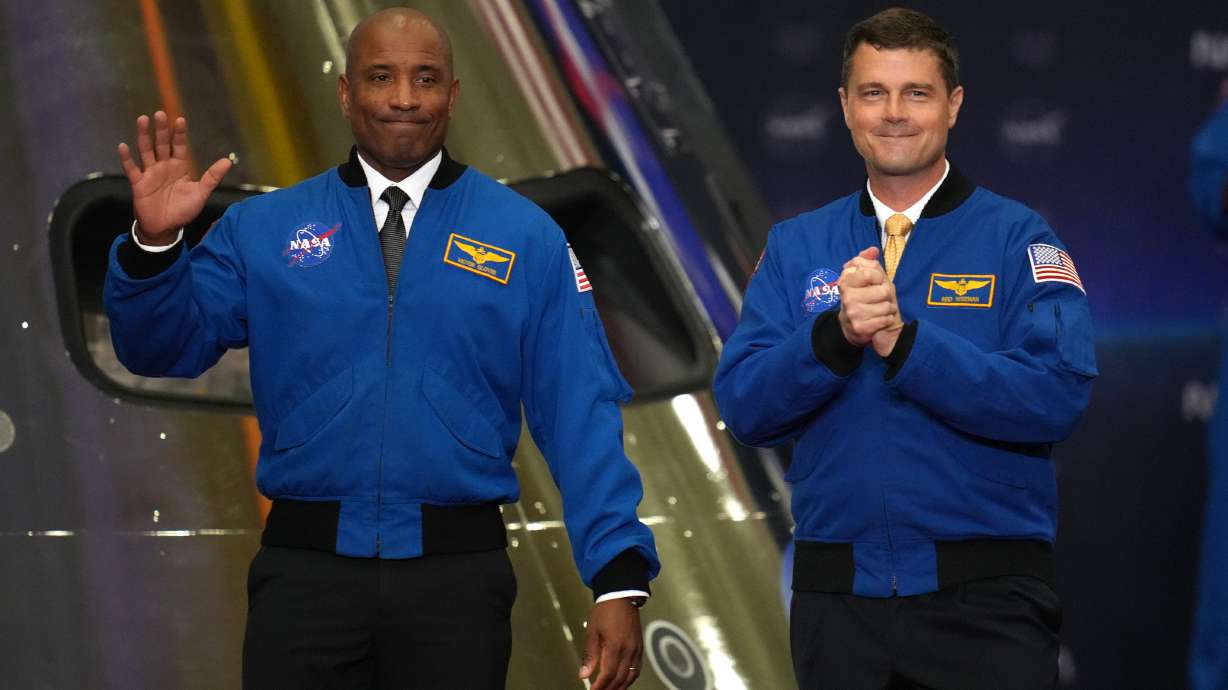
CAPE CANAVERAL, Fla. — The two NASA astronauts who led the launch of Artemis II to the moon earlier this year are stepping away from spaceflight. NASA announced Wednesday that Artemis II commander Reid Wiseman and pilot Victor Glover will no longer serve as active astronauts, but will continue to support the lunar exploration program as astronauts emeritus. Glover has accepted a leadership position at his alma mater, California Polytechnic State University, while Wiseman’s future plans were not revealed. They flew around the moon in April with two other astronauts, setting a new distance record for humanity. Artemis II’s Jeremy Hansen retired from the Canadian Space Agency in July. That leaves Christina Koch as the only crew member still on the list of active astronauts. As emeritus astronauts, Wiseman and Glover will donate their time to train and mentor NASA workers and share their knowledge for future lunar missions. It’s a new approach to harnessing experience, according to the space agency. “Together, they took on one of the most challenging missions in human spaceflight and helped return the United States to the lunar environment,” NASA Administrator Jared Isaacman said in a statement. “I’m grateful that they continue to share what they’ve learned.” NASA astronaut Victor Glover, a member of NASA’s Artemis II crew, speaks during a news conference April 16, 2026 in Houston. (Photo: Ashley Landis, Associated Press) Cal Poly said Glover will help shape long-term strategies and inspire students to study science and engineering. His new job in San Luis Obispo took effect on September 1. Wiseman’s change in status will take effect this month. Chosen by NASA as an astronaut in 2009, the retired Navy captain spent more than five months aboard the International Space Station in 2014, later becoming the space agency’s chief astronaut. After graduating from Cal Poly in 1999, Glover became a Navy test pilot before NASA chose him as an astronaut in 2013. He served as a pilot on SpaceX’s second crewed flight for NASA, a nearly six-month mission to the space station in 2020 and 2021. Glover’s eloquence stood out as he flew to and from the moon. NASA astronaut and Artemis II commander Reid Wiseman looks out one of the main cabin windows of the Orion spacecraft, looking toward Earth, as the crew travels toward the Moon on April 4, 2026. NASA’s Artemis II mission will take Wiseman, Glover, Koch and Hansen on a 10-day trip around the Moon and back aboard its Orion spacecraft. (Photo: NASA) Earth is an oasis in “a lot of nothingness, this thing we call the universe” where humanity exists as one, he observed from space. “This is an opportunity for us to remember where we are, who we are, and that we are the same and that we have to get through this together.” Wiseman also struck a chord when he and his crew asked permission to name one of the moon’s craters after his late wife, Carroll, who died of cancer in 2020. Last month, the Artemis II crew received the Congressional Space Medal of Honor from President Donald Trump during a ceremony at NASA’s Johnson Space Center. in Houston. Key findings in this article were generated with the help of large language models and reviewed by our editorial team. The article itself is written solely by humans.